



 Chat with AI
Exam 32: An Overview of Animal Diversity

Exam 1: Introduction: Evolution and Themes of Biology77 Questions
Exam 2: The Chemical Context of Life98 Questions
Exam 3: Water and Life92 Questions
Exam 4: Carbon and the Molecular Diversity of Life86 Questions
Exam 5: The Structure and Function of Large Biological Molecules131 Questions
Exam 6: A Tour of the Cell111 Questions
Exam 7: Membrane Structure and Function88 Questions
Exam 8: An Introduction to Metabolism92 Questions
Exam 9: Cellular Respiration and Fermentation128 Questions
Exam 10: Photosynthesis103 Questions
Exam 11: Cell Communication85 Questions
Exam 12: The Cell Cycle98 Questions
Exam 13: Meiosis and Sexual Life Cycles90 Questions
Exam 14: Mendel and the Gene Idea92 Questions
Exam 15: The Chromosomal Basis of Inheritance75 Questions
Exam 16: The Molecular Basis of Inheritance84 Questions
Exam 17: From Gene to Protein106 Questions
Exam 18: Regulation of Gene Expression116 Questions
Exam 19: Viruses71 Questions
Exam 20: DNA Tools and Biotechnology78 Questions
Exam 21: Genomes and Their Evolution64 Questions
Exam 22: Descent with Modification: A Darwinian View of Life68 Questions
Exam 23: The Evolution of Populations92 Questions
Exam 24: The Origin of Species76 Questions
Exam 25: The History of Life on Earth89 Questions
Exam 26: Phylogeny and the Tree of Life91 Questions
Exam 27: Bacteria and Archaea96 Questions
Exam 28: Protists82 Questions
Exam 29: Plant Diversity I: How Plants Colonized Land93 Questions
Exam 30: Plant Diversity II: The Evolution of Seed Plants119 Questions
Exam 31: Fungi105 Questions
Exam 32: An Overview of Animal Diversity93 Questions
Exam 33: An Introduction to Invertebrates111 Questions
Exam 34: The Origin and Evolution of Vertebrates126 Questions
Exam 35: Plant Structure,Growth,and Development82 Questions
Exam 36: Resource Acquisition and Transport in Vascular Plants100 Questions
Exam 37: Soil and Plant Nutrition99 Questions
Exam 38: Angiosperm Reproduction and Biotechnology107 Questions
Exam 39: Plant Responses to Internal and External Signals137 Questions
Exam 40: Basic Principles of Animal Form and Function98 Questions
Exam 41: Animal Nutrition87 Questions
Exam 42: Circulation and Gas Exchange112 Questions
Exam 43: The Immune System123 Questions
Exam 44: Osmoregulation and Excretion91 Questions
Exam 45: Hormones and the Endocrine System92 Questions
Exam 46: Animal Reproduction104 Questions
Exam 47: Animal Development106 Questions
Exam 48: Neurons,Synapses,and Signalling93 Questions
Exam 49: Nervous Systems85 Questions
Exam 50: Sensory and Motor Mechanisms106 Questions
Exam 51: Animal Behaviour91 Questions
Exam 52: An Introduction to Ecology and the Biosphere90 Questions
Exam 53: Population Ecology89 Questions
Exam 54: Community Ecology97 Questions
Exam 55: Ecosystems and Restoration Ecology98 Questions
Exam 56: Conservation Biology and Global Change90 Questions
Select questions type


Fossil evidence indicates that the following events occurred in what sequence,from earliest to most recent?
1)Protostomes invade terrestrial environments.
2)Cambrian explosion occurs.
3)Deuterostomes invade terrestrial environments.
4)Vertebrates become top predators in the seas.
(Multiple Choice)
4.8/5  (74)
(74) 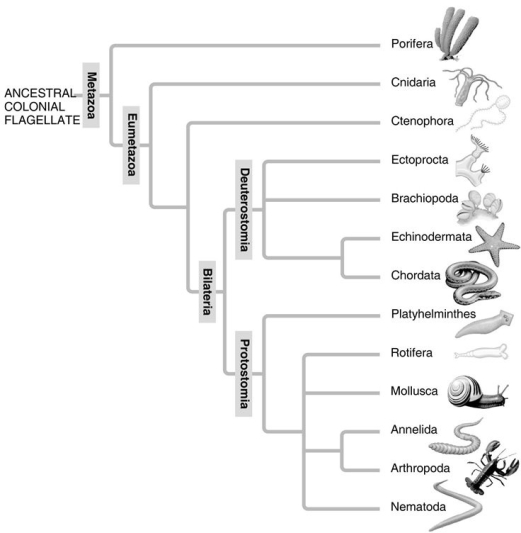
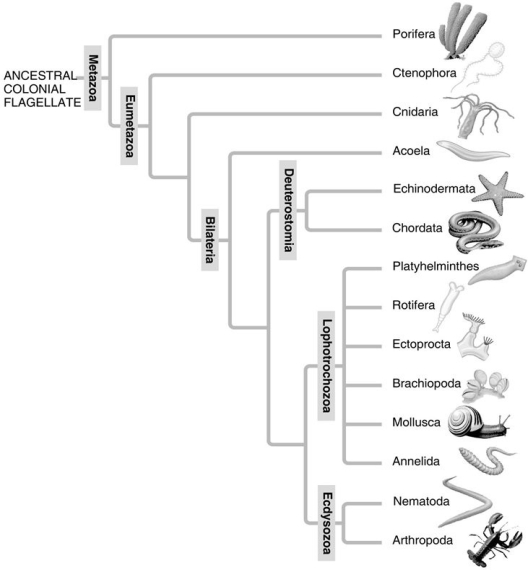 -Which of the following is a point of conflict between the phylogenetic analyses presented in these two figures?
 (Multiple Choice)
4.8/5 (84)
(84) Arthropods invaded land about 100 million years before vertebrates did so.This most clearly implies that
(Multiple Choice)
4.8/5 (81)
(81) Use the following information to answer the questions below.
The most recently discovered phylum in the animal kingdom (1995)is the phylum Cycliophora.It includes three species of tiny organisms that live in large numbers on the outsides of the mouthparts and appendages of lobsters.The feeding stage permanently attaches to the lobster via an adhesive disk,and collects scraps of food from its host's feeding by capturing the scraps in a current created by a ring of cilia.The body is sac-like and has a U-shaped intestine that brings the anus close to the mouth.Cycliophorans are eucoelomate,do not moult (though their host does),and their embryos undergo spiral cleavage.
-Basing your inferences on information in the previous paragraph,to which clade(s)should cycliophorans belong?
1)Eumetazoa
2)Deuterostomia
3)Bilateria
4)Ecdysozoa
5)Lophotrochozoa
(Multiple Choice)
5.0/5 (91)
(91) What was an early selective advantage of a coelom in animals? A coelom ________.
(Multiple Choice)
4.9/5 (82)
(82) Which developmental mode is correctly matched with the specific characteristics?
(Multiple Choice)
4.7/5 (81)
(81) What does recent evidence from molecular systematics reveal about the relationship between grades and clades?
(Multiple Choice)
4.8/5 (89)
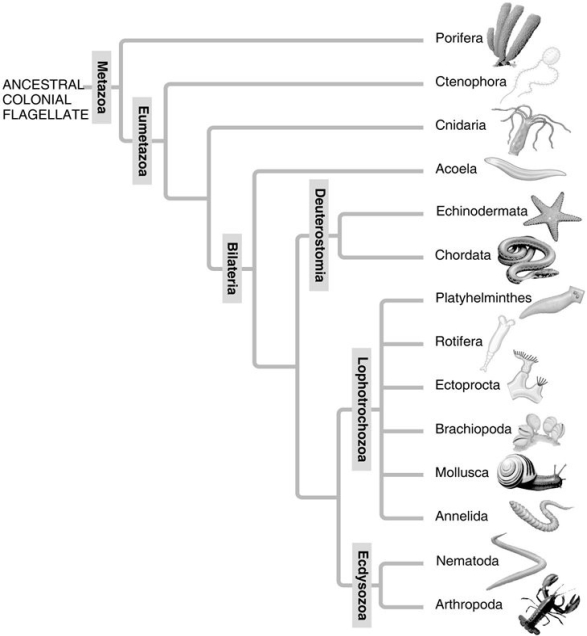
(89) 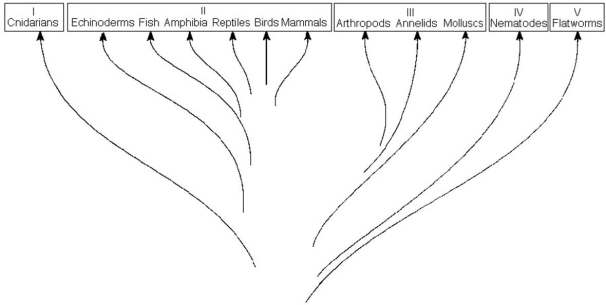 The figure above shows a chart of the animal kingdom set up as a modified phylogenetic tree.Use the diagram to answer the following questions.
-Which group contains diploblastic organisms?
The figure above shows a chart of the animal kingdom set up as a modified phylogenetic tree.Use the diagram to answer the following questions.
-Which group contains diploblastic organisms? (Multiple Choice)
4.7/5 (86)
(86) Use the following two diagrams (A and B)to answer the questions below.
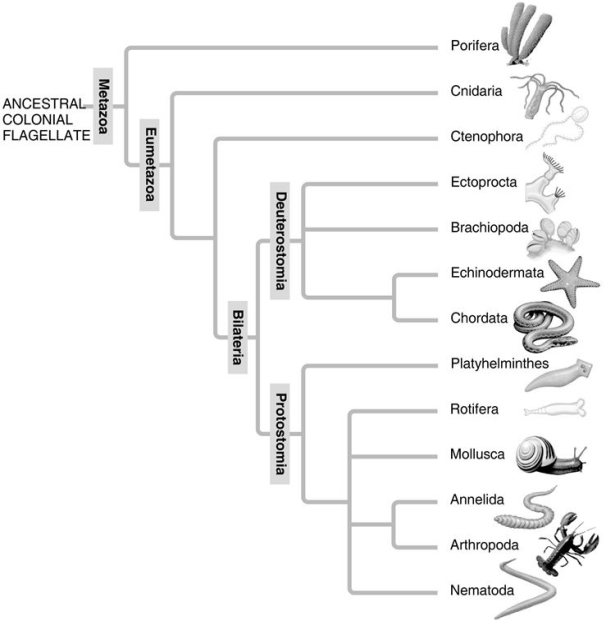 A: Morphological phylogeny.
 B: Molecular phylogeny.
-In the traditional phylogeny (A),the phylum Platyhelminthes is depicted as a sister taxon to the rest of the protostome phyla,and as having diverged earlier from the lineage that led to the rest of the protostomes.In the molecular phylogeny (B),Platyhelminthes is depicted as a lophotrochozoan phylum.What probably led to this change?
A: Morphological phylogeny.
B: Molecular phylogeny.
-In the traditional phylogeny (A),the phylum Platyhelminthes is depicted as a sister taxon to the rest of the protostome phyla,and as having diverged earlier from the lineage that led to the rest of the protostomes.In the molecular phylogeny (B),Platyhelminthes is depicted as a lophotrochozoan phylum.What probably led to this change? (Multiple Choice)
4.8/5 (74)
(74) In individual insects of some species,whole chromosomes that carry larval genes are eliminated from the genomes of somatic cells at the time of metamorphosis.A consequence of this occurrence is that
(Multiple Choice)
4.9/5 (81)
(81) The larvae of some insects are merely small versions of the adult,whereas the larvae of other insects look completely different from adults,eat different foods,and may live in different habitats.Which of the following most directly favours the evolution of the latter,more radical,kind of metamorphosis?
(Multiple Choice)
4.7/5 (84)
(84) While looking at some seawater through your microscope,you spot the egg of an unknown animal.Which of the following tests could you use to determine whether the developing organism is a protostome or a deuterostome? See whether the embryo ________.
(Multiple Choice)
4.7/5 (84)
(84) Use the following information to answer the questions below.
Trichoplax adhaerens (Tp)is the only living species in the phylum Placozoa.Individuals are about 1 mm wide and only 27 μm high,are irregularly shaped,and consist of a total of about 2000 cells,which are diploid (2n = 12).There are four types of cells,none of which are nerve or muscle cells,and none of which have cell walls.They move using cilia,and any "edge" can lead.Tp feeds on marine microbes,mostly unicellular green algae,by crawling atop the algae and trapping it between its ventral surface and the substrate.Enzymes are then secreted onto the algae,and the resulting nutrients are absorbed.Tp sperm cells have never been observed,nor have embryos past the 64-cell (blastula)stage.
-If Tp sperm are observed by future researchers,how many chromosomes should be found in a Tp sperm nucleus?
(Multiple Choice)
4.8/5 (77)
(77) The following questions refer to the description below.
You have taken an introductory course in animal biology and know that animals have evolved with different types of symmetry.Animals that show radial symmetry have a top and bottom,but do not have a left or right side,nor a front or back end.Animals that show bilateral symmetry have a top and bottom,left and right sides,and distinct anterior and posterior ends.
-You and a friend have flown to the coast of British Columbia to do some hiking and whale watching.As you are walking along the beach collecting shells,you notice a strange animal washed up on the beach and it is not a species that you recognize.Just by looking at the animal,what is a quick way that you can surmise the animal's mode of locomotion and method of food acquisition?
(Multiple Choice)
4.9/5 (59)
(59) Use the following information to answer the questions below.
Trichoplax adhaerens (Tp)is the only living species in the phylum Placozoa.Individuals are about 1 mm wide and only 27 μm high,are irregularly shaped,and consist of a total of about 2000 cells,which are diploid (2n = 12).There are four types of cells,none of which are nerve or muscle cells,and none of which have cell walls.They move using cilia,and any "edge" can lead.Tp feeds on marine microbes,mostly unicellular green algae,by crawling atop the algae and trapping it between its ventral surface and the substrate.Enzymes are then secreted onto the algae,and the resulting nutrients are absorbed.Tp sperm cells have never been observed,nor have embryos past the 64-cell (blastula)stage.
-In how many of the following ways is Tp unlike the typical animal?
1)Tp is multicellular.
2)Tp lacks muscle and nerve cells.
3)Tp has cilia.
4)Tp has a different place where digestion of food occurs.
5)Tp lacks cell walls.
(Multiple Choice)
4.8/5 (87)
(87) Which of the following traits differentiates animals from plants and fungi?
(Multiple Choice)
4.9/5 (75)
(75) With the current molecular-based phylogeny in mind,rank the following from most inclusive to least inclusive.
1)ecdysozoan
2)protostome
3)eumetazoan
4)triploblastic
(Multiple Choice)
4.8/5 (80)
(80) Which of the following characteristics generally applies to protostome development?
(Multiple Choice)
4.9/5 (77)
(77) 
Filters
- Essay(0)
- Multiple Choice(0)
- Short Answer(0)
- True False(0)
- Matching(0)