



 Chat with AI
Exam 32: An Overview of Animal Diversity

Exam 1: Introduction: Evolution and Themes of Biology77 Questions
Exam 2: The Chemical Context of Life98 Questions
Exam 3: Water and Life92 Questions
Exam 4: Carbon and the Molecular Diversity of Life86 Questions
Exam 5: The Structure and Function of Large Biological Molecules131 Questions
Exam 6: A Tour of the Cell111 Questions
Exam 7: Membrane Structure and Function88 Questions
Exam 8: An Introduction to Metabolism92 Questions
Exam 9: Cellular Respiration and Fermentation128 Questions
Exam 10: Photosynthesis103 Questions
Exam 11: Cell Communication85 Questions
Exam 12: The Cell Cycle98 Questions
Exam 13: Meiosis and Sexual Life Cycles90 Questions
Exam 14: Mendel and the Gene Idea92 Questions
Exam 15: The Chromosomal Basis of Inheritance75 Questions
Exam 16: The Molecular Basis of Inheritance84 Questions
Exam 17: From Gene to Protein106 Questions
Exam 18: Regulation of Gene Expression116 Questions
Exam 19: Viruses71 Questions
Exam 20: DNA Tools and Biotechnology78 Questions
Exam 21: Genomes and Their Evolution64 Questions
Exam 22: Descent with Modification: A Darwinian View of Life68 Questions
Exam 23: The Evolution of Populations92 Questions
Exam 24: The Origin of Species76 Questions
Exam 25: The History of Life on Earth89 Questions
Exam 26: Phylogeny and the Tree of Life91 Questions
Exam 27: Bacteria and Archaea96 Questions
Exam 28: Protists82 Questions
Exam 29: Plant Diversity I: How Plants Colonized Land93 Questions
Exam 30: Plant Diversity II: The Evolution of Seed Plants119 Questions
Exam 31: Fungi105 Questions
Exam 32: An Overview of Animal Diversity93 Questions
Exam 33: An Introduction to Invertebrates111 Questions
Exam 34: The Origin and Evolution of Vertebrates126 Questions
Exam 35: Plant Structure,Growth,and Development82 Questions
Exam 36: Resource Acquisition and Transport in Vascular Plants100 Questions
Exam 37: Soil and Plant Nutrition99 Questions
Exam 38: Angiosperm Reproduction and Biotechnology107 Questions
Exam 39: Plant Responses to Internal and External Signals137 Questions
Exam 40: Basic Principles of Animal Form and Function98 Questions
Exam 41: Animal Nutrition87 Questions
Exam 42: Circulation and Gas Exchange112 Questions
Exam 43: The Immune System123 Questions
Exam 44: Osmoregulation and Excretion91 Questions
Exam 45: Hormones and the Endocrine System92 Questions
Exam 46: Animal Reproduction104 Questions
Exam 47: Animal Development106 Questions
Exam 48: Neurons,Synapses,and Signalling93 Questions
Exam 49: Nervous Systems85 Questions
Exam 50: Sensory and Motor Mechanisms106 Questions
Exam 51: Animal Behaviour91 Questions
Exam 52: An Introduction to Ecology and the Biosphere90 Questions
Exam 53: Population Ecology89 Questions
Exam 54: Community Ecology97 Questions
Exam 55: Ecosystems and Restoration Ecology98 Questions
Exam 56: Conservation Biology and Global Change90 Questions
Select questions type


If harbouring large populations of cycliophorans neither helps nor harms their lobster hosts,then cycliophorans can be properly considered to be
1)parasites.
2)mutualists.
3)commensals.
4)symbionts.
5)endosymbionts.
(Multiple Choice)
4.8/5  (80)
(80) An organism that exhibits cephalization probably also ________.
(Multiple Choice)
4.9/5 (83)
(83) Use the following table to answer the questions below.
Proposed Number of Hox Genes in Various Extant and Extinct Animals
 -All things being equal,which of these is the most parsimonious explanation for the change in the number of Hox genes from the last common ancestor of insects and vertebrates to ancestral vertebrates,as shown in the table?
 (Multiple Choice)
4.9/5 (68)
(68) When you consider the evolutionary history of animals,what are some plausible explanations for the diversification and extinction of some animal species?
(Multiple Choice)
4.7/5 (71)
(71) Which of the following was probably the least important factor in bringing about the Cambrian explosion?
(Multiple Choice)
4.8/5 (93)
(93) Which of the following would you classify as something other than an animal?
(Multiple Choice)
4.9/5 (92)
(92) Using similarities in embryonic development,body symmetry,and other anatomical features to assign an organism to a clade involves
1)cladistics based on body plan.
2)molecular-based phylogeny.
3)morphology-based phylogeny.
(Multiple Choice)
4.8/5 (82)
(82) 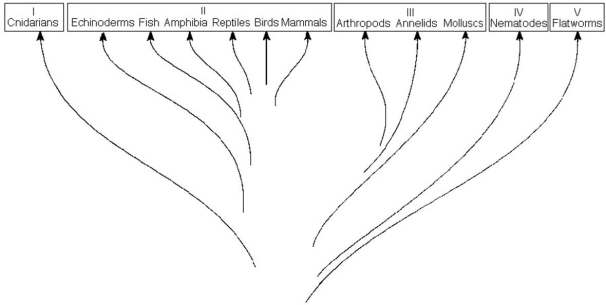 The figure above shows a chart of the animal kingdom set up as a modified phylogenetic tree.Use the diagram to answer the following questions.
-Which two groups have members that undergo ecdysis?
The figure above shows a chart of the animal kingdom set up as a modified phylogenetic tree.Use the diagram to answer the following questions.
-Which two groups have members that undergo ecdysis? (Multiple Choice)
4.9/5 (75)
(75) If the current molecular evidence regarding animal origins is well-substantiated in the future,then what will be true of any contrary evidence regarding the origin of animals derived from the fossil record?
(Multiple Choice)
4.9/5 (78)
(78) In an experiment,several Tp individuals were stained different colours.The stained individuals were then passed through a strainer,disaggregated to the level of single cells,and collected into a common container of sea water.Which subsequent finding would be most surprising if the Tp individuals used in this experiment had been produced by sexual,rather than asexual,means?
(Multiple Choice)
4.9/5 (66)
(66) Cycliophorans have two types of larvae.One type of larva is produced when the digestive system of a female is impregnated by a male.The digestive system then collapses and develops into a larva,which swims away in search of a new host after the surrounding female dies.Which is the embryonic tissue that is apparently most important in forming this type of larva?
(Multiple Choice)
4.8/5 (80)
(80) The most ancient branch point in animal phylogeny is that between having
(Multiple Choice)
4.8/5 (67)
(67) Placozoan evolutionary relationships to other animals are currently unclear,and different phylogenies can be created,depending on the character used to infer relatedness.Sponges have no tissues,but about 20 cell types.Tp (Trichoplax adhaerens)produces a neuropeptide almost identical to one found in cnidarians.The genome of Tp,though the smallest of any known animal,shares many features of complex eumetazoan (even human!)genomes.Use the phylogenetic trees that follow to answer the questions below.
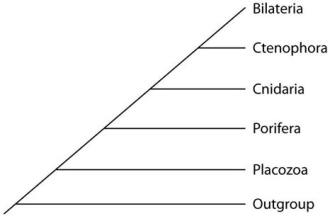 I
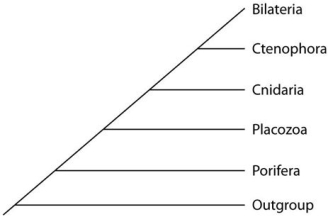 II
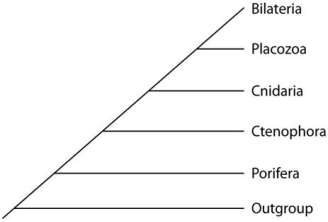 III
-Which phylogeny has been created by emphasizing genomic features of placozoans?
I
II
III
-Which phylogeny has been created by emphasizing genomic features of placozoans? (Multiple Choice)
5.0/5 (63)
(63) Placozoan evolutionary relationships to other animals are currently unclear,and different phylogenies can be created,depending on the character used to infer relatedness.Sponges have no tissues,but about 20 cell types.Tp (Trichoplax adhaerens)produces a neuropeptide almost identical to one found in cnidarians.The genome of Tp,though the smallest of any known animal,shares many features of complex eumetazoan (even human!)genomes.Use the phylogenetic trees that follow to answer the questions below.
I
II
III
-Which phylogeny has been created by emphasizing a protein found in placozoans?
I
II
III
-Which phylogeny has been created by emphasizing a protein found in placozoans? (Multiple Choice)
4.8/5 (72)
(72) Use the following information to answer the questions below.
A student encounters an animal embryo at the eight-cell stage.The four smaller cells that comprise one hemisphere of the embryo seem to be rotated 45 degrees and to lie in the grooves between larger,underlying cells (i.e.,spiral cleavage).
-If we were to separate these eight cells and attempt to culture them individually,then what is most likely to happen?
(Multiple Choice)
4.9/5 (72)
(72) What is true of the feeding stage of cycliophorans?
1)It is chemoheterotrophic.
2)It is sessile.
3)It captures food in a manner similar to that of animals with lophophores.
4)It has radial symmetry.
(Multiple Choice)
4.8/5 (85)
(85) Use the following information to answer the questions below.
The most recently discovered phylum in the animal kingdom (1995)is the phylum Cycliophora.It includes three species of tiny organisms that live in large numbers on the outsides of the mouthparts and appendages of lobsters.The feeding stage permanently attaches to the lobster via an adhesive disk,and collects scraps of food from its host's feeding by capturing the scraps in a current created by a ring of cilia.The body is sac-like and has a U-shaped intestine that brings the anus close to the mouth.Cycliophorans are eucoelomate,do not moult (though their host does),and their embryos undergo spiral cleavage.
-Which of these features is least useful in assigning the phylum Cycliophora to a clade of animals?
(Multiple Choice)
4.8/5 (82)
(82) Protostome characteristics generally include which of the following?
(Multiple Choice)
4.9/5 (62)
(62) 
Filters
- Essay(0)
- Multiple Choice(0)
- Short Answer(0)
- True False(0)
- Matching(0)