



 Chat with AI
Exam 32: An Overview of Animal Diversity

Exam 1: Introduction: Evolution and Themes of Biology77 Questions
Exam 2: The Chemical Context of Life98 Questions
Exam 3: Water and Life92 Questions
Exam 4: Carbon and the Molecular Diversity of Life86 Questions
Exam 5: The Structure and Function of Large Biological Molecules131 Questions
Exam 6: A Tour of the Cell111 Questions
Exam 7: Membrane Structure and Function88 Questions
Exam 8: An Introduction to Metabolism92 Questions
Exam 9: Cellular Respiration and Fermentation128 Questions
Exam 10: Photosynthesis103 Questions
Exam 11: Cell Communication85 Questions
Exam 12: The Cell Cycle98 Questions
Exam 13: Meiosis and Sexual Life Cycles90 Questions
Exam 14: Mendel and the Gene Idea92 Questions
Exam 15: The Chromosomal Basis of Inheritance75 Questions
Exam 16: The Molecular Basis of Inheritance84 Questions
Exam 17: From Gene to Protein106 Questions
Exam 18: Regulation of Gene Expression116 Questions
Exam 19: Viruses71 Questions
Exam 20: DNA Tools and Biotechnology78 Questions
Exam 21: Genomes and Their Evolution64 Questions
Exam 22: Descent with Modification: A Darwinian View of Life68 Questions
Exam 23: The Evolution of Populations92 Questions
Exam 24: The Origin of Species76 Questions
Exam 25: The History of Life on Earth89 Questions
Exam 26: Phylogeny and the Tree of Life91 Questions
Exam 27: Bacteria and Archaea96 Questions
Exam 28: Protists82 Questions
Exam 29: Plant Diversity I: How Plants Colonized Land93 Questions
Exam 30: Plant Diversity II: The Evolution of Seed Plants119 Questions
Exam 31: Fungi105 Questions
Exam 32: An Overview of Animal Diversity93 Questions
Exam 33: An Introduction to Invertebrates111 Questions
Exam 34: The Origin and Evolution of Vertebrates126 Questions
Exam 35: Plant Structure,Growth,and Development82 Questions
Exam 36: Resource Acquisition and Transport in Vascular Plants100 Questions
Exam 37: Soil and Plant Nutrition99 Questions
Exam 38: Angiosperm Reproduction and Biotechnology107 Questions
Exam 39: Plant Responses to Internal and External Signals137 Questions
Exam 40: Basic Principles of Animal Form and Function98 Questions
Exam 41: Animal Nutrition87 Questions
Exam 42: Circulation and Gas Exchange112 Questions
Exam 43: The Immune System123 Questions
Exam 44: Osmoregulation and Excretion91 Questions
Exam 45: Hormones and the Endocrine System92 Questions
Exam 46: Animal Reproduction104 Questions
Exam 47: Animal Development106 Questions
Exam 48: Neurons,Synapses,and Signalling93 Questions
Exam 49: Nervous Systems85 Questions
Exam 50: Sensory and Motor Mechanisms106 Questions
Exam 51: Animal Behaviour91 Questions
Exam 52: An Introduction to Ecology and the Biosphere90 Questions
Exam 53: Population Ecology89 Questions
Exam 54: Community Ecology97 Questions
Exam 55: Ecosystems and Restoration Ecology98 Questions
Exam 56: Conservation Biology and Global Change90 Questions
Select questions type


Use the following two diagrams (A and B)to answer the questions below.
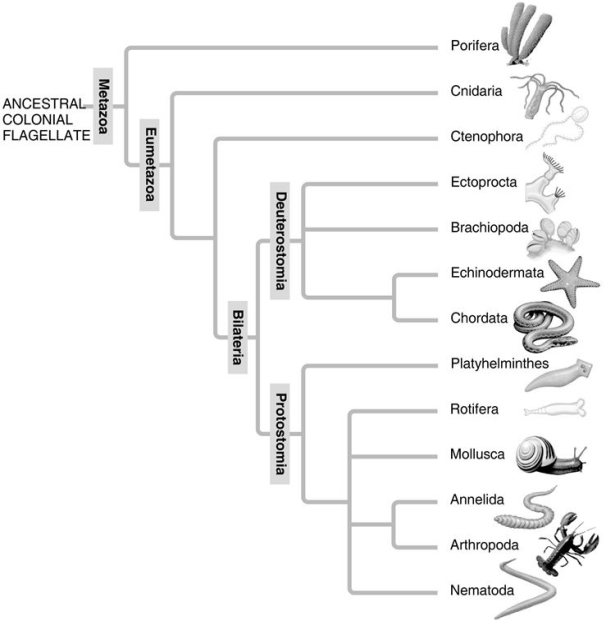 A: Morphological phylogeny.
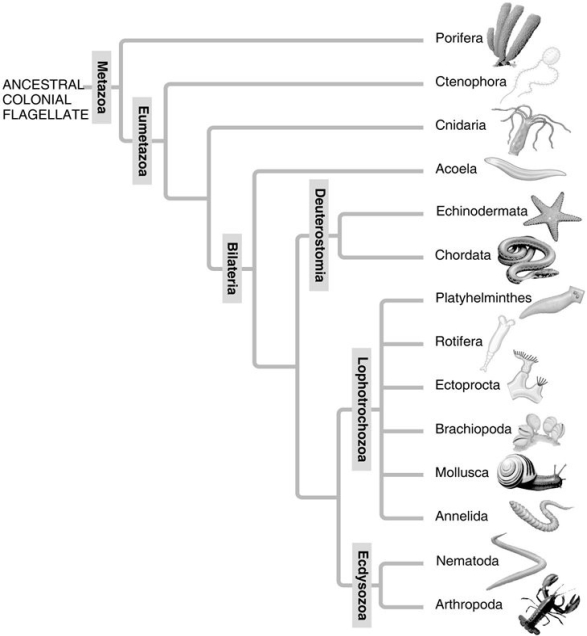 B: Molecular phylogeny.
-What is true of the deuterostomes in the molecular phylogeny (B)that is not true in the traditional phylogeny (A)?
A: Morphological phylogeny.
B: Molecular phylogeny.
-What is true of the deuterostomes in the molecular phylogeny (B)that is not true in the traditional phylogeny (A)? (Multiple Choice)
5.0/5  (89)
(89) Which of the following statements is incorrect with respect to animal phylogeny?
(Multiple Choice)
4.9/5 (79)
(79) Soon after the coelom begins to form,a researcher injects a dye into the coelom of a deuterostome embryo.Initially,the dye should be able to flow directly into the
(Multiple Choice)
4.8/5 (58)
(58) What distinguishes a coelomate animal from a pseudocoelomate animal is that coelomates
(Multiple Choice)
4.8/5 (76)
(76) The distinction between sponges and other animal phyla is based mainly on the absence versus the presence of
(Multiple Choice)
4.9/5 (63)
(63) According to the evidence collected so far,the animal kingdom is
(Multiple Choice)
4.9/5 (76)
(76) Placozoan evolutionary relationships to other animals are currently unclear,and different phylogenies can be created,depending on the character used to infer relatedness.Sponges have no tissues,but about 20 cell types.Tp (Trichoplax adhaerens)produces a neuropeptide almost identical to one found in cnidarians.The genome of Tp,though the smallest of any known animal,shares many features of complex eumetazoan (even human!)genomes.Use the phylogenetic trees that follow to answer the questions below.
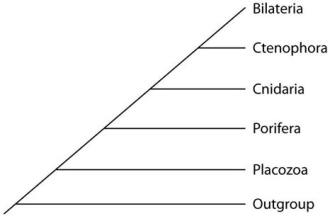 I
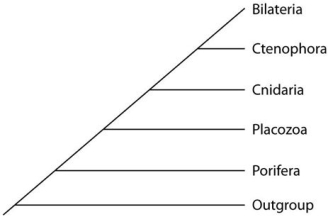 II
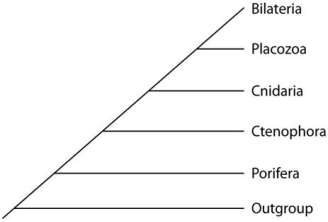 III
-Which phylogeny has been created by emphasizing the structural simplicity of placozoans?
I
II
III
-Which phylogeny has been created by emphasizing the structural simplicity of placozoans? (Multiple Choice)
4.9/5 (86)
(86) At which developmental stage should one be able to first distinguish a protostome embryo from a deuterostome embryo?
(Multiple Choice)
4.9/5 (77)
(77) Which of the following is a feature of the tube-within-a-tube body plan in most animal phyla?
(Multiple Choice)
4.9/5 (74)
(74) Use the following information to answer the questions below.
A student encounters an animal embryo at the eight-cell stage.The four smaller cells that comprise one hemisphere of the embryo seem to be rotated 45 degrees and to lie in the grooves between larger,underlying cells (i.e.,spiral cleavage).
-This embryo may potentially develop into a(n)
(Multiple Choice)
4.8/5 (79)
(79) What is the probable sequence in which the following clades of animals originated,from earliest to most recent?
1)tetrapods
2)vertebrates
3)deuterostomes
4)amniotes
5)bilaterians
(Multiple Choice)
4.7/5 (85)
(85) What do animals as diverse as corals and monkeys have in common?
(Multiple Choice)
5.0/5 (76)
(76) If a multicellular animal lacks true tissues,then it can properly be included among the
(Multiple Choice)
4.9/5 (80)
(80) On the basis of the cleavage pattern of cycliophoran embryos,which of these should be true?
(Multiple Choice)
4.9/5 (73)
(73) At which developmental stage should one be able to first distinguish a diploblastic embryo from a triploblastic embryo?
(Multiple Choice)
4.9/5 (78)
(78) Whatever its ultimate cause(s),the Cambrian explosion is a prime example of
(Multiple Choice)
4.9/5 (78)
(78) Which of the following statements concerning animal taxonomy is (are)true?
1)Animals are more closely related to plants than to fungi.
2)All animal clades based on body plan have been found to be incorrect.
3)Kingdom Animalia is monophyletic.
4)Only animals reproduce by sexual means.
5)Animals are thought to have evolved from flagellated protists similar to modern choanoflagellates.
(Multiple Choice)
4.9/5 (73)
(73) Use the following table to answer the questions below.
Proposed Number of Hox Genes in Various Extant and Extinct Animals
 -What conclusion is apparent from the data in the table?
 (Multiple Choice)
4.8/5 (70)
(70) You have before you a living organism,which you examine carefully.Which of the following should convince you that the organism is acoelomate?
(Multiple Choice)
4.8/5 (90)
(90) 
Filters
- Essay(0)
- Multiple Choice(0)
- Short Answer(0)
- True False(0)
- Matching(0)