



 Chat with AI
Exam 30: Plant Diversity II: The Evolution of Seed Plants

Exam 1: Introduction: Evolution and Themes of Biology77 Questions
Exam 2: The Chemical Context of Life98 Questions
Exam 3: Water and Life92 Questions
Exam 4: Carbon and the Molecular Diversity of Life86 Questions
Exam 5: The Structure and Function of Large Biological Molecules131 Questions
Exam 6: A Tour of the Cell111 Questions
Exam 7: Membrane Structure and Function88 Questions
Exam 8: An Introduction to Metabolism92 Questions
Exam 9: Cellular Respiration and Fermentation128 Questions
Exam 10: Photosynthesis103 Questions
Exam 11: Cell Communication85 Questions
Exam 12: The Cell Cycle98 Questions
Exam 13: Meiosis and Sexual Life Cycles90 Questions
Exam 14: Mendel and the Gene Idea92 Questions
Exam 15: The Chromosomal Basis of Inheritance75 Questions
Exam 16: The Molecular Basis of Inheritance84 Questions
Exam 17: From Gene to Protein106 Questions
Exam 18: Regulation of Gene Expression116 Questions
Exam 19: Viruses71 Questions
Exam 20: DNA Tools and Biotechnology78 Questions
Exam 21: Genomes and Their Evolution64 Questions
Exam 22: Descent with Modification: A Darwinian View of Life68 Questions
Exam 23: The Evolution of Populations92 Questions
Exam 24: The Origin of Species76 Questions
Exam 25: The History of Life on Earth89 Questions
Exam 26: Phylogeny and the Tree of Life91 Questions
Exam 27: Bacteria and Archaea96 Questions
Exam 28: Protists82 Questions
Exam 29: Plant Diversity I: How Plants Colonized Land93 Questions
Exam 30: Plant Diversity II: The Evolution of Seed Plants119 Questions
Exam 31: Fungi105 Questions
Exam 32: An Overview of Animal Diversity93 Questions
Exam 33: An Introduction to Invertebrates111 Questions
Exam 34: The Origin and Evolution of Vertebrates126 Questions
Exam 35: Plant Structure,Growth,and Development82 Questions
Exam 36: Resource Acquisition and Transport in Vascular Plants100 Questions
Exam 37: Soil and Plant Nutrition99 Questions
Exam 38: Angiosperm Reproduction and Biotechnology107 Questions
Exam 39: Plant Responses to Internal and External Signals137 Questions
Exam 40: Basic Principles of Animal Form and Function98 Questions
Exam 41: Animal Nutrition87 Questions
Exam 42: Circulation and Gas Exchange112 Questions
Exam 43: The Immune System123 Questions
Exam 44: Osmoregulation and Excretion91 Questions
Exam 45: Hormones and the Endocrine System92 Questions
Exam 46: Animal Reproduction104 Questions
Exam 47: Animal Development106 Questions
Exam 48: Neurons,Synapses,and Signalling93 Questions
Exam 49: Nervous Systems85 Questions
Exam 50: Sensory and Motor Mechanisms106 Questions
Exam 51: Animal Behaviour91 Questions
Exam 52: An Introduction to Ecology and the Biosphere90 Questions
Exam 53: Population Ecology89 Questions
Exam 54: Community Ecology97 Questions
Exam 55: Ecosystems and Restoration Ecology98 Questions
Exam 56: Conservation Biology and Global Change90 Questions
Select questions type


The embryo sac of an angiosperm flower is best represented by which number in the above figure?
(Multiple Choice)
4.9/5  (91)
(91) Which group is noted for the independence of gametophyte and sporophyte generations from each other?
(Multiple Choice)
4.9/5 (97)
(97) Use the following information to answer the questions below.
The following questions refer to the generalized life cycle for land plants shown in the figure below.Each number within a circle or square represents a specific plant or plant part,and each number over an arrow represents either meiosis,mitosis,or fertilization.
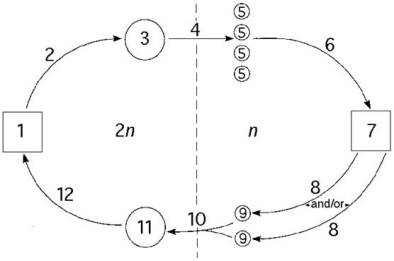 -In the figure above,which number represents the mature gametophyte?
 (Multiple Choice)
4.7/5 (92)
(92) Which of the following structures is incorrectly matched with function in the life cycle of an angiosperm?
(Multiple Choice)
4.9/5 (78)
(78) Ecologists often build models to depict the relationships between organisms.In such models,an arrow is used to link two organisms in a relationship.The arrowhead is next to the organism that is affected.If the effect is positive,the arrow is labeled with (+),and if negative,then the label is (-).Which of the following models best illustrates the relationship of the Brazil nut tree and the other organisms associated with it?
(Multiple Choice)
4.8/5 (73)
(73) Use the following information to answer the question(s)below.
Scarlet gilia (Ipomopsis aggregata)usually has red flowers in an inflorescence of up to 250 flowers.In certain populations in the Arizona mountains,however,the flowers range from red to pink to white.In early summer,most of the flowers were red.Six to eight weeks later,the same individual plants were still present; the flowers ranged from pink to white,and few red flowers were present.The major pollinators early in the season were two species of hummingbirds active during the day; they emigrated to lower elevations,and the major pollinator later in the season was a hawk moth (a type of moth).The hawk moth was most active at sunset and later,and it preferred light pink to white flowers after dark.When hummingbirds were present,more red flowers than white flowers produced fruit.When only hawk moths were present,more white flowers produced fruit (K.N.Paige and T.G.Whitham.1985.Individual and population shifts in flower colour by scarlet gilia: A mechanism for pollinator tracking.Science 227:315-17).
-Refer to the paragraph on scarlet gilia.Some plants changed their flowers to lighter colours,and some retained the same darker colour all season.Which plants do you expect produced more fruit?
(Multiple Choice)
4.8/5 (83)
(83) Use the following information to answer the questions below.
In onions (Allium),cells of the sporophyte have 16 chromosomes within each nucleus.Match the number of chromosomes present in each of the following onion tissues.
-How many chromosomes should be in an endosperm nucleus?
(Multiple Choice)
4.9/5 (82)
(82) Arrange the following in the correct sequence,from earliest to most recent,in which these plant traits originated.
1)sporophyte dominance,gametophyte independence
2)sporophyte dominance,gametophyte dependence
3)gametophyte dominance,sporophyte dependence
(Multiple Choice)
4.9/5 (75)
(75) Use the following information to answer the questions below.
In onions (Allium),cells of the sporophyte have 16 chromosomes within each nucleus.Match the number of chromosomes present in each of the following onion tissues.
-How many chromosomes should be in a generative cell nucleus?
(Multiple Choice)
4.7/5 (72)
(72) The next few questions refer to the following description.Match the animal features with the appropriate angiosperm analogue.
Oviparous (egg-laying)animals have internal fertilization (sperm cells encounter eggs within the female's body).Yolk and/or albumen is (are)provided to the embryo,and a shell is then deposited around the embryo and its food source.Eggs are subsequently deposited in an environment that promotes their further development,or are incubated by one or both parents.
-The shell of an animal egg is what type of angiosperm analogue?
(Multiple Choice)
4.8/5 (80)
(80) Reptilian embryos are protected from desiccation by a leathery shell.Similarly,which pair of structures protects seed plants' embryos and male gametophytes,respectively,from desiccation?
(Multiple Choice)
4.7/5 (78)
(78) Which of the following sex and generation combinations most directly produces the pollen tube?
(Multiple Choice)
4.8/5 (84)
(84) Use the following information to answer the questions below.
The Brazil nut tree,Bertholletia excels (n = 17),is native to tropical rain forests of South America.It is a hardwood tree that can grow to over 50 metres,is a source of high-quality lumber,and is a favourite nesting site for harpy eagles.As the rainy season ends,tough-walled fruits,each containing 8-25 seeds (Brazil nuts),fall to the forest floor.About $50 million worth of nuts are harvested each year.Scientists have discovered that the pale yellow,self-incompatible flowers of Brazil nut trees admit only female orchid bees as pollinators.
-Animals that consume Brazil nuts are deriving nutrition mostly from tissue whose nuclei have how many chromosomes?
(Multiple Choice)
4.9/5 (82)
(82) The closest relatives of the familiar pine and spruce trees are
(Multiple Choice)
4.8/5 (72)
(72) Which structure(s)must pass through the micropyle for successful fertilization to occur in angiosperms?
(Multiple Choice)
4.8/5 (73)
(73) Which number represents a megaspore mother cell in the figure above?
(Multiple Choice)
5.0/5 (95)
(95) Use the following information to answer the questions below.
In onions (Allium),cells of the sporophyte have 16 chromosomes within each nucleus.Match the number of chromosomes present in each of the following onion tissues.
-How many chromosomes should be in an embryo nucleus?
(Multiple Choice)
4.8/5 (87)
(87) In addition to seeds,which of the following characteristics are unique to the seed-producing plants?
(Multiple Choice)
4.7/5 (80)
(80) 
Filters
- Essay(0)
- Multiple Choice(0)
- Short Answer(0)
- True False(0)
- Matching(0)