



 Chat with AI
Exam 17: From Gene to Protein

Exam 1: Introduction: Evolution and Themes of Biology77 Questions
Exam 2: The Chemical Context of Life98 Questions
Exam 3: Water and Life92 Questions
Exam 4: Carbon and the Molecular Diversity of Life86 Questions
Exam 5: The Structure and Function of Large Biological Molecules131 Questions
Exam 6: A Tour of the Cell111 Questions
Exam 7: Membrane Structure and Function88 Questions
Exam 8: An Introduction to Metabolism92 Questions
Exam 9: Cellular Respiration and Fermentation128 Questions
Exam 10: Photosynthesis103 Questions
Exam 11: Cell Communication85 Questions
Exam 12: The Cell Cycle98 Questions
Exam 13: Meiosis and Sexual Life Cycles90 Questions
Exam 14: Mendel and the Gene Idea92 Questions
Exam 15: The Chromosomal Basis of Inheritance75 Questions
Exam 16: The Molecular Basis of Inheritance84 Questions
Exam 17: From Gene to Protein106 Questions
Exam 18: Regulation of Gene Expression116 Questions
Exam 19: Viruses71 Questions
Exam 20: DNA Tools and Biotechnology78 Questions
Exam 21: Genomes and Their Evolution64 Questions
Exam 22: Descent with Modification: A Darwinian View of Life68 Questions
Exam 23: The Evolution of Populations92 Questions
Exam 24: The Origin of Species76 Questions
Exam 25: The History of Life on Earth89 Questions
Exam 26: Phylogeny and the Tree of Life91 Questions
Exam 27: Bacteria and Archaea96 Questions
Exam 28: Protists82 Questions
Exam 29: Plant Diversity I: How Plants Colonized Land93 Questions
Exam 30: Plant Diversity II: The Evolution of Seed Plants119 Questions
Exam 31: Fungi105 Questions
Exam 32: An Overview of Animal Diversity93 Questions
Exam 33: An Introduction to Invertebrates111 Questions
Exam 34: The Origin and Evolution of Vertebrates126 Questions
Exam 35: Plant Structure,Growth,and Development82 Questions
Exam 36: Resource Acquisition and Transport in Vascular Plants100 Questions
Exam 37: Soil and Plant Nutrition99 Questions
Exam 38: Angiosperm Reproduction and Biotechnology107 Questions
Exam 39: Plant Responses to Internal and External Signals137 Questions
Exam 40: Basic Principles of Animal Form and Function98 Questions
Exam 41: Animal Nutrition87 Questions
Exam 42: Circulation and Gas Exchange112 Questions
Exam 43: The Immune System123 Questions
Exam 44: Osmoregulation and Excretion91 Questions
Exam 45: Hormones and the Endocrine System92 Questions
Exam 46: Animal Reproduction104 Questions
Exam 47: Animal Development106 Questions
Exam 48: Neurons,Synapses,and Signalling93 Questions
Exam 49: Nervous Systems85 Questions
Exam 50: Sensory and Motor Mechanisms106 Questions
Exam 51: Animal Behaviour91 Questions
Exam 52: An Introduction to Ecology and the Biosphere90 Questions
Exam 53: Population Ecology89 Questions
Exam 54: Community Ecology97 Questions
Exam 55: Ecosystems and Restoration Ecology98 Questions
Exam 56: Conservation Biology and Global Change90 Questions
Select questions type


Use the following information to answer the questions below.
Yeast is capable of synthesizing the amino acids necessary for survival and can grow on minimal media or enriched media easily.In both conditions,the colonies have a cream colour.The production of adenine is regulated by two genes,ADE1 and ADE2.If either of these genes is defective,adenine cannot be synthesized and the colony will look red (as a result of accumulation of precursors).A common undergraduate lab study is to irradiate yeast cells with ultra violet light from 2-5 sec up to 1-5 minutes,and see what will happen.
-What is the role of UV light in this circumstance?
(Multiple Choice)
4.8/5  (81)
(81) Which of the following provides some evidence that RNA probably evolved before DNA?
(Multiple Choice)
4.9/5 (94)
(94) Use the following information to answer the next few questions.
The enzyme polynucleotide phosphorylase randomly assembles nucleotides into a polynucleotide polymer.
-You add polynucleotide phosphorylase to a solution of ATP,GTP,and UTP.How many artificial mRNA 3 nucleotide codons would be possible?
(Multiple Choice)
4.8/5 (77)
(77) Why might a point mutation in DNA make a difference in the level of protein's activity?
(Multiple Choice)
5.0/5 (70)
(70) The "universal" genetic code is now known to have exceptions.Evidence for this can be found if which of the following is true?
(Multiple Choice)
4.9/5 (81)
(81) The following information should be used for the next few questions.
A part of an mRNA molecule with the following sequence is being read by a ribosome: 5' CCG-ACG 3' (mRNA).The following charged transfer RNA molecules (with their anticodons shown in the 3' to 5' direction)are available.Two of them can correctly match the mRNA so that a dipeptide can form.
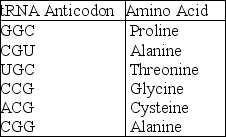 -The anticodon loop of the first tRNA that will complement this mRNA is
 (Multiple Choice)
4.8/5 (77)
(77) Which one of the following,if missing,would usually prevent translation from starting?
(Multiple Choice)
4.9/5 (81)
(81) The white fur colouration of the "spirit bear" of British Columbia,is a result of
(Multiple Choice)
4.8/5 (70)
(70) During elongation,which site in the ribosome represents the location where a codon is being read?
(Multiple Choice)
5.0/5 (75)
(75) Transcription in eukaryotes requires which of the following in addition to RNA polymerase?
(Multiple Choice)
4.8/5 (77)
(77) Which of the following contradicts the one-gene,one-enzyme hypothesis?
(Multiple Choice)
5.0/5 (73)
(73) The TATA sequence is found approximately 25 nucleotides upstream from the start site of transcription.This most probably relates to which of the following?
(Multiple Choice)
4.9/5 (84)
(84) The following questions refer to this figure of a simple metabolic pathway:
 -If A,B,and C are all required for growth,a strain that is mutant for the gene-encoding enzyme A would be able to grow on which of the following media?
 (Multiple Choice)
5.0/5 (70)
(70) Which of the following mutations is most likely to cause a phenotypic change?
(Multiple Choice)
4.8/5 (81)
(81) When the function of the newly made polypeptide is to be secreted from the cell where it has been made,what must occur?
(Multiple Choice)
4.7/5 (75)
(75) The following questions refer to this figure of a simple metabolic pathway:
-If A,B,and C are all required for growth,a strain mutant for the gene-encoding enzyme B would be capable of growing on which of the following media?
-If A,B,and C are all required for growth,a strain mutant for the gene-encoding enzyme B would be capable of growing on which of the following media? (Multiple Choice)
4.9/5 (94)
(94) 
Filters
- Essay(0)
- Multiple Choice(0)
- Short Answer(0)
- True False(0)
- Matching(0)