



 Chat with AI
Exam 47: Animal Development

Exam 1: Introduction: Themes in the Study of Life66 Questions
Exam 2: The Chemical Context of Life83 Questions
Exam 3: Water and the Fitness of the Environment66 Questions
Exam 4: Carbon and the Molecular Diversity of Life68 Questions
Exam 5: The Structure and Function of Large Biological Molecules109 Questions
Exam 6: A Tour of the Cell75 Questions
Exam 7: Membrane Structure and Function75 Questions
Exam 8: An Introduction to Metabolism79 Questions
Exam 9: Cellular Respiration: Harvesting Chemical Energy103 Questions
Exam 10: Photosynthesis74 Questions
Exam 11: Cell Communication62 Questions
Exam 12: The Cell Cycle80 Questions
Exam 13: Meiosis and Sexual Life Cycles68 Questions
Exam 14: Mendel and the Gene Idea90 Questions
Exam 15: The Chromosomal Basis of Inheritance75 Questions
Exam 16: The Molecular Basis of Inheritance72 Questions
Exam 17: From Gene to Protein84 Questions
Exam 18: Control of Gene Expression101 Questions
Exam 19: Viruses38 Questions
Exam 20: Biotechnology70 Questions
Exam 21: Genomes and Their Evolution37 Questions
Exam 22: Descent With Modification: a Darwinian View of Life57 Questions
Exam 23: The Evolution of Populations84 Questions
Exam 24: The Origin of Species60 Questions
Exam 25: The History of Life on Earth85 Questions
Exam 26: Phylogeny and the Tree of Life90 Questions
Exam 27: Bacteria and Archaea78 Questions
Exam 28: Protists79 Questions
Exam 29: Plant Diversity I: How Plants Colonized Land74 Questions
Exam 30: Plant Diversity Ii: the Evolution of Seed Plants101 Questions
Exam 31: Fungi87 Questions
Exam 32: An Introduction to Animal Diversity82 Questions
Exam 33: Invertebrates98 Questions
Exam 34: Vertebrates112 Questions
Exam 35: Plant Structure, Growth, and Development77 Questions
Exam 36: Transport in Vascular Plants84 Questions
Exam 37: Soil and Plant Nutrition85 Questions
Exam 38: Angiosperm Reproduction and Biotechnology86 Questions
Exam 39: Plant Responses to Internal and External Signals111 Questions
Exam 40: Basic Principles of Animal Form and Function74 Questions
Exam 41: Animal Nutrition68 Questions
Exam 42: Circulation and Gas Exchange78 Questions
Exam 43: The Immune System85 Questions
Exam 44: Osmoregulation and Excretion49 Questions
Exam 45: Hormones and the Endocrine System71 Questions
Exam 46: Animal Reproduction85 Questions
Exam 47: Animal Development75 Questions
Exam 48: Neurons, Synapses, and Signaling52 Questions
Exam 49: Nervous Systems48 Questions
Exam 50: Sensory and Motor Mechanisms59 Questions
Exam 51: Animal Behavior74 Questions
Exam 52: An Introduction to Ecology and the Biosphere71 Questions
Exam 53: Population Ecology80 Questions
Exam 54: Community Ecology74 Questions
Exam 55: Ecosystems79 Questions
Exam 56: Conservation Biology and Restoration Ecology65 Questions
Select questions type


A primitive streak forms during the early embryonic development of
(Multiple Choice)
5.0/5  (74)
(74) Molecular genetic evidence that certain genes shared by both humans and fruit flies initiate eye development in both species suggest a common
(Multiple Choice)
4.8/5 (73)
(73) In an egg cell treated with EDTA, a chemical that binds calcium and magnesium ions, the
(Multiple Choice)
4.8/5 (84)
(84) In mammalian eggs, the receptors for sperm are found in the
(Multiple Choice)
4.8/5 (82)
(82) The proposal that a human sperm contained a miniature human being is consistent with the now-discredited theory of development known as
(Multiple Choice)
5.0/5 (86)
(86) In an amphibian embryo, a band of cells called the neural crest
(Multiple Choice)
4.9/5 (82)
(82) Use the following information to answer the following questions.
In a study of the development of frog embryos, several early gastrulas were stained with vital dyes. The locations of the dyes after gastrulation were noted. The results are shown in the following table.
Tissue Stain Brain red Notochord yellow Liver green Lens of the eye blue Lining of the digestive tract purple
Figure 47.1
-The endoderm was probably stained with
(Multiple Choice)
5.0/5 (82)
(82) Hans Spemann and colleagues developed the concept of the primary organizer in amphibian embryos while studying the
(Multiple Choice)
4.9/5 (90)
(90) Thalidomide, now banned for use as a sedative in pregnancy, was used in the early 1960s by many women in their first trimester of pregnancy. Some of these women gave birth to children with arm and leg deformities, suggesting that the drug most likely influenced
(Multiple Choice)
4.8/5 (79)
(79) If an amphibian zygote is manipulated so that the first cleavage plane fails to divide the gray crescent, then
(Multiple Choice)
4.9/5 (88)
(88) Although it contributes no cells to the embryo, this structure guides the formation of the primitive streak:
(Multiple Choice)
4.8/5 (88)
(88) Changes in the shape of a cell usually involve a reorganization of the
(Multiple Choice)
4.8/5 (82)
(82) Cadherins and other cell-adhesion molecules that guide cell migration are
(Multiple Choice)
4.8/5 (79)
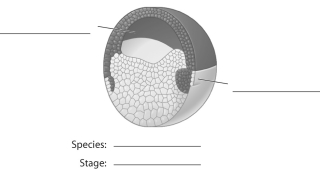
(79) Fill in the blanks in the figure below, and draw arrows showing the movement of ectoderm, mesoderm, and endoderm.
(Essay)
4.9/5 (70)
(70) 
Filters
- Essay(0)
- Multiple Choice(0)
- Short Answer(0)
- True False(0)
- Matching(0)