



 Chat with AI
Exam 43: The Immune System

Exam 1: Introduction: Themes in the Study of Life66 Questions
Exam 2: The Chemical Context of Life83 Questions
Exam 3: Water and the Fitness of the Environment66 Questions
Exam 4: Carbon and the Molecular Diversity of Life68 Questions
Exam 5: The Structure and Function of Large Biological Molecules109 Questions
Exam 6: A Tour of the Cell75 Questions
Exam 7: Membrane Structure and Function75 Questions
Exam 8: An Introduction to Metabolism79 Questions
Exam 9: Cellular Respiration: Harvesting Chemical Energy103 Questions
Exam 10: Photosynthesis74 Questions
Exam 11: Cell Communication62 Questions
Exam 12: The Cell Cycle80 Questions
Exam 13: Meiosis and Sexual Life Cycles68 Questions
Exam 14: Mendel and the Gene Idea90 Questions
Exam 15: The Chromosomal Basis of Inheritance75 Questions
Exam 16: The Molecular Basis of Inheritance72 Questions
Exam 17: From Gene to Protein84 Questions
Exam 18: Control of Gene Expression101 Questions
Exam 19: Viruses38 Questions
Exam 20: Biotechnology70 Questions
Exam 21: Genomes and Their Evolution37 Questions
Exam 22: Descent With Modification: a Darwinian View of Life57 Questions
Exam 23: The Evolution of Populations84 Questions
Exam 24: The Origin of Species60 Questions
Exam 25: The History of Life on Earth85 Questions
Exam 26: Phylogeny and the Tree of Life90 Questions
Exam 27: Bacteria and Archaea78 Questions
Exam 28: Protists79 Questions
Exam 29: Plant Diversity I: How Plants Colonized Land74 Questions
Exam 30: Plant Diversity Ii: the Evolution of Seed Plants101 Questions
Exam 31: Fungi87 Questions
Exam 32: An Introduction to Animal Diversity82 Questions
Exam 33: Invertebrates98 Questions
Exam 34: Vertebrates112 Questions
Exam 35: Plant Structure, Growth, and Development77 Questions
Exam 36: Transport in Vascular Plants84 Questions
Exam 37: Soil and Plant Nutrition85 Questions
Exam 38: Angiosperm Reproduction and Biotechnology86 Questions
Exam 39: Plant Responses to Internal and External Signals111 Questions
Exam 40: Basic Principles of Animal Form and Function74 Questions
Exam 41: Animal Nutrition68 Questions
Exam 42: Circulation and Gas Exchange78 Questions
Exam 43: The Immune System85 Questions
Exam 44: Osmoregulation and Excretion49 Questions
Exam 45: Hormones and the Endocrine System71 Questions
Exam 46: Animal Reproduction85 Questions
Exam 47: Animal Development75 Questions
Exam 48: Neurons, Synapses, and Signaling52 Questions
Exam 49: Nervous Systems48 Questions
Exam 50: Sensory and Motor Mechanisms59 Questions
Exam 51: Animal Behavior74 Questions
Exam 52: An Introduction to Ecology and the Biosphere71 Questions
Exam 53: Population Ecology80 Questions
Exam 54: Community Ecology74 Questions
Exam 55: Ecosystems79 Questions
Exam 56: Conservation Biology and Restoration Ecology65 Questions
Select questions type


A researcher is analyzing the immune response of a patient following the patient's exposure to an unknown agent while out of the country. The patient's blood is found to have a high proportion of lymphocytes with CD8 surface proteins. What is the likely cause?
(Multiple Choice)
4.8/5  (84)
(84) Which of the following is True of active but not passive immunity?
(Multiple Choice)
4.9/5 (81)
(81) The next questions refer to the following data on blood types.
Case 1 Case 2 Case 3 Mother , , , Fetus , , , Figure 43.2
-In which of the cases could the mother exhibit an anti-Rh-factor reaction to the developing fetus?
(Multiple Choice)
4.8/5 (94)
(94) Use the following information to answer the following questions.
An otherwise healthy student in your class is infected with EBV, the virus that causes infectious mononucleosis. The same student had already been infected when she was a child, and she had merely experienced a mild sore throat and swollen lymph nodes in her neck. This time, though infected, she does not get sick.
-B cells interacting with helper T cells are stimulated to differentiate when
(Multiple Choice)
4.9/5 (73)
(73) Use the information below as background for the following questions.
Immunodeficiencies may be genetic in origin. Two examples of these are Bruton's agammaglobulinemia, an X-linked disorder, and DiGeorge syndrome, caused by a deletion from chromosome 22. Bruton's results in underdeveloped B cells, while DiGeorge syndrome results in a missing or seriously underdeveloped thymus.
-In the human disease known as lupus, there is an immune reaction against a patient's own DNA from broken or dying cells. This kind of response typifies which kind of irregularity?
(Multiple Choice)
4.8/5 (72)
(72) Consider a pencil-shaped protein with two epitopes, Y (the "eraser" end)and Z (the "point" end). They are recognized by antibodies A1 and A2, respectively. Draw and label a picture showing the antibodies linking proteins into a complex that could trigger endocytosis by a macrophage.
(Essay)
4.9/5 (75)
(75) Use the following information to answer the following questions.
Cave art by early humans recognized the existence of the major signs of inflammation.
-Clonal selection is an explanation for how
(Multiple Choice)
4.9/5 (70)
(70) Use the following information to answer the following questions.
Cave art by early humans recognized the existence of the major signs of inflammation.
-Histamines trigger dilation of nearby blood vessels, and increase in their permeability. Which of the signs of inflammation are therefore associated with histamine release?
(Multiple Choice)
4.8/5 (70)
(70) Which statement best describes the difference in responses of effector B cells (plasma cells)and cytotoxic T cells?
(Multiple Choice)
4.9/5 (79)
(79) A transfusion of type A blood given to a person who has type O blood would result in which of the following?
(Multiple Choice)
4.9/5 (74)
(74) Why can normal immune responses be described as polyclonal?
(Multiple Choice)
4.9/5 (94)
(94) Use the following information to answer the following questions.
An otherwise healthy student in your class is infected with EBV, the virus that causes infectious mononucleosis. The same student had already been infected when she was a child, and she had merely experienced a mild sore throat and swollen lymph nodes in her neck. This time, though infected, she does not get sick.
-These cells are involved in cell-mediated immunity, and they respond to class I MHC molecule-antigen complexes:
(Multiple Choice)
4.7/5 (82)
(82) Use the following information to answer the following questions.
Cave art by early humans recognized the existence of the major signs of inflammation.
-Which of the following are symptoms of inflammation that might appear in such art?
(Multiple Choice)
4.8/5 (78)
(78) The next questions refer to the following data on blood types.
Case 1 Case 2 Case 3 Mother , , , Fetus , , , Figure 43.2
-In Cases 1 and 2 in the table, the mothers would be able, if needed, to supply blood to the newborn even 7-9 months after birth; the same would not be True for Case 3. Why?
(Multiple Choice)
4.9/5 (73)
(73) An immunoglobulin (Ig)molecule, of whatever class, has regions symbolized as C or V, H or L. A light chain has which of these regions?
(Multiple Choice)
4.9/5 (88)
(88) An invertebrate, such as an insect, has innate immunity that can be nonspecific about which pathogens are prevented from harming its metabolism. Which of the following is most likely to function this way in the insect's intestine?
(Multiple Choice)
4.8/5 (77)
(77) Use the graph in Figure 43.1 to answer the following questions.
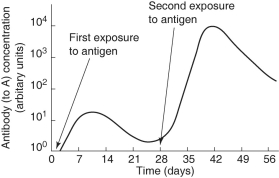 Figure 43.1
-When would you find antibodies being produced?
Figure 43.1
-When would you find antibodies being produced? (Multiple Choice)
4.9/5 (69)
(69) 
Filters
- Essay(0)
- Multiple Choice(0)
- Short Answer(0)
- True False(0)
- Matching(0)