



 Chat with AI
Exam 37: Soil and Plant Nutrition

Exam 1: Introduction: Themes in the Study of Life66 Questions
Exam 2: The Chemical Context of Life83 Questions
Exam 3: Water and the Fitness of the Environment66 Questions
Exam 4: Carbon and the Molecular Diversity of Life68 Questions
Exam 5: The Structure and Function of Large Biological Molecules109 Questions
Exam 6: A Tour of the Cell75 Questions
Exam 7: Membrane Structure and Function75 Questions
Exam 8: An Introduction to Metabolism79 Questions
Exam 9: Cellular Respiration: Harvesting Chemical Energy103 Questions
Exam 10: Photosynthesis74 Questions
Exam 11: Cell Communication62 Questions
Exam 12: The Cell Cycle80 Questions
Exam 13: Meiosis and Sexual Life Cycles68 Questions
Exam 14: Mendel and the Gene Idea90 Questions
Exam 15: The Chromosomal Basis of Inheritance75 Questions
Exam 16: The Molecular Basis of Inheritance72 Questions
Exam 17: From Gene to Protein84 Questions
Exam 18: Control of Gene Expression101 Questions
Exam 19: Viruses38 Questions
Exam 20: Biotechnology70 Questions
Exam 21: Genomes and Their Evolution37 Questions
Exam 22: Descent With Modification: a Darwinian View of Life57 Questions
Exam 23: The Evolution of Populations84 Questions
Exam 24: The Origin of Species60 Questions
Exam 25: The History of Life on Earth85 Questions
Exam 26: Phylogeny and the Tree of Life90 Questions
Exam 27: Bacteria and Archaea78 Questions
Exam 28: Protists79 Questions
Exam 29: Plant Diversity I: How Plants Colonized Land74 Questions
Exam 30: Plant Diversity Ii: the Evolution of Seed Plants101 Questions
Exam 31: Fungi87 Questions
Exam 32: An Introduction to Animal Diversity82 Questions
Exam 33: Invertebrates98 Questions
Exam 34: Vertebrates112 Questions
Exam 35: Plant Structure, Growth, and Development77 Questions
Exam 36: Transport in Vascular Plants84 Questions
Exam 37: Soil and Plant Nutrition85 Questions
Exam 38: Angiosperm Reproduction and Biotechnology86 Questions
Exam 39: Plant Responses to Internal and External Signals111 Questions
Exam 40: Basic Principles of Animal Form and Function74 Questions
Exam 41: Animal Nutrition68 Questions
Exam 42: Circulation and Gas Exchange78 Questions
Exam 43: The Immune System85 Questions
Exam 44: Osmoregulation and Excretion49 Questions
Exam 45: Hormones and the Endocrine System71 Questions
Exam 46: Animal Reproduction85 Questions
Exam 47: Animal Development75 Questions
Exam 48: Neurons, Synapses, and Signaling52 Questions
Exam 49: Nervous Systems48 Questions
Exam 50: Sensory and Motor Mechanisms59 Questions
Exam 51: Animal Behavior74 Questions
Exam 52: An Introduction to Ecology and the Biosphere71 Questions
Exam 53: Population Ecology80 Questions
Exam 54: Community Ecology74 Questions
Exam 55: Ecosystems79 Questions
Exam 56: Conservation Biology and Restoration Ecology65 Questions
Select questions type


For this pair of items, choose the option that best describes their relationship. (A)The number of essential macronutrients required by plants
(B)The number of essential micronutrients required by plants
(Multiple Choice)
4.8/5  (90)
(90) Most crop plants acquire their nitrogen mainly in the form of
(Multiple Choice)
5.0/5 (89)
(89) Carnivorous plants have evolved mechanisms that trap and digest small animals. The products of this digestion are used to supplement the plant's supply of
(Multiple Choice)
4.8/5 (71)
(71) For this pair of items, choose the option that best describes their relationship. (A)The amount of nitrogen in a fertilizer marked "15-10-5"
(B)The amount of nitrogen in a fertilizer marked "15-5-5"
(Multiple Choice)
4.9/5 (72)
(72) Organic molecules make up what percentage of the dry weight of a plant?
(Multiple Choice)
4.8/5 (74)
(74) For this pair of items, choose the option that best describes their relationship. (A)The amount of molybdenum in a gram of dried plant material
(B)The amount of sulfur in a gram of dried plant material
(Multiple Choice)
5.0/5 (74)
(74) Hyphae form a covering over roots. Altogether, these hyphae create a large surface area that helps to do which of the following?
(Multiple Choice)
5.0/5 (66)
(66) What should be added to soil to prevent minerals from leaching away?
(Multiple Choice)
4.9/5 (72)
(72) Reddish-purple coloring of leaves, especially along the margins of young leaves, is a typical symptom of deficiency of which element?
(Multiple Choice)
4.7/5 (71)
(71) Which soil mineral is most likely leached away during a hard rain?
(Multiple Choice)
4.9/5 (79)
(79) Which two elements make up more than 90% of the dry weight of plants?
(Multiple Choice)
4.7/5 (66)
(66) Which of the following essential nutrients plays an essential role in the opening and closing of the stomatal aperture?
(Multiple Choice)
4.9/5 (75)
(75) The fungal hyphae of both ectomycorrhizae and arbuscular mycorrhizae absorb water and minerals, which they supply to their plant hosts.
(True/False)
4.8/5 (79)
(79) Draw a simple sketch of cation exchange, showing a root hair, a soil particle with anions, and a hydrogen ion displacing a mineral cation.
(Essay)
4.8/5 (73)
(73) In what way do nitrogen compounds differ from other minerals needed by plants?
(Multiple Choice)
4.9/5 (76)
(76) A growing plant exhibits chlorosis of the leaves of the entire plant. The chlorosis is probably due to a deficiency of which of the following macronutrients?
(Multiple Choice)
5.0/5 (83)
(83) Among important crop plants, nitrogen-fixing root nodules are most commonly an attribute of
(Multiple Choice)
4.8/5 (86)
(86) Figure 37.1 shows the results of a study to determine the effect of soil air spaces on plant growth.
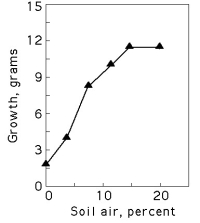 Figure 37.1
-The best conclusion from the data in Figure 37.1 is that the plant
Figure 37.1
-The best conclusion from the data in Figure 37.1 is that the plant (Multiple Choice)
4.8/5 (71)
(71) 
Filters
- Essay(0)
- Multiple Choice(0)
- Short Answer(0)
- True False(0)
- Matching(0)