



 Chat with AI
Exam 37: Soil and Plant Nutrition

Exam 1: Introduction: Themes in the Study of Life66 Questions
Exam 2: The Chemical Context of Life83 Questions
Exam 3: Water and the Fitness of the Environment66 Questions
Exam 4: Carbon and the Molecular Diversity of Life68 Questions
Exam 5: The Structure and Function of Large Biological Molecules109 Questions
Exam 6: A Tour of the Cell75 Questions
Exam 7: Membrane Structure and Function75 Questions
Exam 8: An Introduction to Metabolism79 Questions
Exam 9: Cellular Respiration: Harvesting Chemical Energy103 Questions
Exam 10: Photosynthesis74 Questions
Exam 11: Cell Communication62 Questions
Exam 12: The Cell Cycle80 Questions
Exam 13: Meiosis and Sexual Life Cycles68 Questions
Exam 14: Mendel and the Gene Idea90 Questions
Exam 15: The Chromosomal Basis of Inheritance75 Questions
Exam 16: The Molecular Basis of Inheritance72 Questions
Exam 17: From Gene to Protein84 Questions
Exam 18: Control of Gene Expression101 Questions
Exam 19: Viruses38 Questions
Exam 20: Biotechnology70 Questions
Exam 21: Genomes and Their Evolution37 Questions
Exam 22: Descent With Modification: a Darwinian View of Life57 Questions
Exam 23: The Evolution of Populations84 Questions
Exam 24: The Origin of Species60 Questions
Exam 25: The History of Life on Earth85 Questions
Exam 26: Phylogeny and the Tree of Life90 Questions
Exam 27: Bacteria and Archaea78 Questions
Exam 28: Protists79 Questions
Exam 29: Plant Diversity I: How Plants Colonized Land74 Questions
Exam 30: Plant Diversity Ii: the Evolution of Seed Plants101 Questions
Exam 31: Fungi87 Questions
Exam 32: An Introduction to Animal Diversity82 Questions
Exam 33: Invertebrates98 Questions
Exam 34: Vertebrates112 Questions
Exam 35: Plant Structure, Growth, and Development77 Questions
Exam 36: Transport in Vascular Plants84 Questions
Exam 37: Soil and Plant Nutrition85 Questions
Exam 38: Angiosperm Reproduction and Biotechnology86 Questions
Exam 39: Plant Responses to Internal and External Signals111 Questions
Exam 40: Basic Principles of Animal Form and Function74 Questions
Exam 41: Animal Nutrition68 Questions
Exam 42: Circulation and Gas Exchange78 Questions
Exam 43: The Immune System85 Questions
Exam 44: Osmoregulation and Excretion49 Questions
Exam 45: Hormones and the Endocrine System71 Questions
Exam 46: Animal Reproduction85 Questions
Exam 47: Animal Development75 Questions
Exam 48: Neurons, Synapses, and Signaling52 Questions
Exam 49: Nervous Systems48 Questions
Exam 50: Sensory and Motor Mechanisms59 Questions
Exam 51: Animal Behavior74 Questions
Exam 52: An Introduction to Ecology and the Biosphere71 Questions
Exam 53: Population Ecology80 Questions
Exam 54: Community Ecology74 Questions
Exam 55: Ecosystems79 Questions
Exam 56: Conservation Biology and Restoration Ecology65 Questions
Select questions type


Some of the problems associated with intensive irrigation include all but
(Multiple Choice)
4.8/5  (92)
(92) A mineral deficiency is likely to affect older leaves more than younger leaves if
(Multiple Choice)
4.8/5 (65)
(65) Macronutrients, elements required in relatively large amounts, typically have catalytic functions as cofactors of enzymes.
(True/False)
4.8/5 (70)
(70) In west Texas, cotton has become an important crop in the last several decades. However, in this hot, dry part of the country there is little rainfall, so farmers irrigate their cotton fields. They must also regularly fertilize the cotton fields because the soil is very sandy. Figure 37.2 shows the record of annual productivity (measured in kilograms of cotton per hectare of land) since 1960 in a west Texas cotton field. Use these data to answer the following questions.
 Figure 37.2
-A young farmer purchases some land in a relatively arid area and is interested in earning a reasonable profit for many years. Which of the following strategies would best allow such a goal to be achieved?
Figure 37.2
-A young farmer purchases some land in a relatively arid area and is interested in earning a reasonable profit for many years. Which of the following strategies would best allow such a goal to be achieved? (Multiple Choice)
5.0/5 (88)
(88) A soil well suited for the growth of most plants would have all of the following properties except
(Multiple Choice)
4.9/5 (79)
(79) Figure 37.1 shows the results of a study to determine the effect of soil air spaces on plant growth.
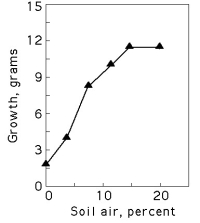 Figure 37.1
-The best explanation for the shape of the growth response curve in figure 37.1 is that
Figure 37.1
-The best explanation for the shape of the growth response curve in figure 37.1 is that (Multiple Choice)
4.7/5 (70)
(70) Which of the following is of least concern to a researcher in a mineral nutrition experiment?
(Multiple Choice)
4.9/5 (86)
(86) Which of the following is a primary difference between ectomycorrhizae and endomycorrhizae?
(Multiple Choice)
4.9/5 (65)
(65) Which of the following describes the fate of most of the water taken up by a plant?
(Multiple Choice)
4.8/5 (77)
(77) The earliest vascular plants on land had underground stems (rhizomes)but no roots. Water and mineral nutrients were most likely obtained by
(Multiple Choice)
4.8/5 (69)
(69) In hydroponic culture, what is the purpose of bubbling air into the solute?
(Multiple Choice)
4.7/5 (87)
(87) Which of the following is a True statement about nitrogen fixation in root nodules?
(Multiple Choice)
4.9/5 (81)
(81) If you wanted to increase the cation exchange and water retention capacity of loamy soil, what should you do?
(Multiple Choice)
4.9/5 (82)
(82) We would expect the greatest difference in plant health between two groups of plants of the same species, one group with mycorrhizae and one group without mycorrhizae, in an environment
(Multiple Choice)
4.8/5 (85)
(85) 
Filters
- Essay(0)
- Multiple Choice(0)
- Short Answer(0)
- True False(0)
- Matching(0)