



 Chat with AI
Exam 30: Plant Diversity Ii: the Evolution of Seed Plants

Exam 1: Introduction: Themes in the Study of Life66 Questions
Exam 2: The Chemical Context of Life83 Questions
Exam 3: Water and the Fitness of the Environment66 Questions
Exam 4: Carbon and the Molecular Diversity of Life68 Questions
Exam 5: The Structure and Function of Large Biological Molecules109 Questions
Exam 6: A Tour of the Cell75 Questions
Exam 7: Membrane Structure and Function75 Questions
Exam 8: An Introduction to Metabolism79 Questions
Exam 9: Cellular Respiration: Harvesting Chemical Energy103 Questions
Exam 10: Photosynthesis74 Questions
Exam 11: Cell Communication62 Questions
Exam 12: The Cell Cycle80 Questions
Exam 13: Meiosis and Sexual Life Cycles68 Questions
Exam 14: Mendel and the Gene Idea90 Questions
Exam 15: The Chromosomal Basis of Inheritance75 Questions
Exam 16: The Molecular Basis of Inheritance72 Questions
Exam 17: From Gene to Protein84 Questions
Exam 18: Control of Gene Expression101 Questions
Exam 19: Viruses38 Questions
Exam 20: Biotechnology70 Questions
Exam 21: Genomes and Their Evolution37 Questions
Exam 22: Descent With Modification: a Darwinian View of Life57 Questions
Exam 23: The Evolution of Populations84 Questions
Exam 24: The Origin of Species60 Questions
Exam 25: The History of Life on Earth85 Questions
Exam 26: Phylogeny and the Tree of Life90 Questions
Exam 27: Bacteria and Archaea78 Questions
Exam 28: Protists79 Questions
Exam 29: Plant Diversity I: How Plants Colonized Land74 Questions
Exam 30: Plant Diversity Ii: the Evolution of Seed Plants101 Questions
Exam 31: Fungi87 Questions
Exam 32: An Introduction to Animal Diversity82 Questions
Exam 33: Invertebrates98 Questions
Exam 34: Vertebrates112 Questions
Exam 35: Plant Structure, Growth, and Development77 Questions
Exam 36: Transport in Vascular Plants84 Questions
Exam 37: Soil and Plant Nutrition85 Questions
Exam 38: Angiosperm Reproduction and Biotechnology86 Questions
Exam 39: Plant Responses to Internal and External Signals111 Questions
Exam 40: Basic Principles of Animal Form and Function74 Questions
Exam 41: Animal Nutrition68 Questions
Exam 42: Circulation and Gas Exchange78 Questions
Exam 43: The Immune System85 Questions
Exam 44: Osmoregulation and Excretion49 Questions
Exam 45: Hormones and the Endocrine System71 Questions
Exam 46: Animal Reproduction85 Questions
Exam 47: Animal Development75 Questions
Exam 48: Neurons, Synapses, and Signaling52 Questions
Exam 49: Nervous Systems48 Questions
Exam 50: Sensory and Motor Mechanisms59 Questions
Exam 51: Animal Behavior74 Questions
Exam 52: An Introduction to Ecology and the Biosphere71 Questions
Exam 53: Population Ecology80 Questions
Exam 54: Community Ecology74 Questions
Exam 55: Ecosystems79 Questions
Exam 56: Conservation Biology and Restoration Ecology65 Questions
Select questions type


The following questions refer to the description below.
The cycads, a mostly tropical phylum of gymnosperms, evolved about 300 million years ago and were dominant forms during the Age of the Dinosaurs. Though their sperm are flagellated, their ovules are pollinated by beetles. These beetles get nutrition (they eat pollen) and shelter from the microsporophylls. Upon visiting megasporophylls, the beetles transfer pollen to the exposed ovules. In cycads, pollen cones and seed cones are borne on different plants. Cycads synthesize neurotoxins, especially in the seeds, that are effective against most animals, including humans.
-Which structure is common to both gymnosperms and angiosperms?
(Multiple Choice)
4.9/5  (72)
(72) In terms of alternation of generations, the internal parts of the pollen grains of seed-producing plants are most similar to a
(Multiple Choice)
4.8/5 (86)
(86) In a typical angiosperm, what is the sequence of structures encountered by the tip of a growing pollen tube on its way to the egg?
1) micropyle
2) style
3) ovary
4) stigma
(Multiple Choice)
4.8/5 (71)
(71) All of the following cellular structures are functionally important in cells of the gametophytes of both angiosperms and gymnosperms, except
(Multiple Choice)
4.9/5 (72)
(72) Use the letters A-D to label where on the phylogenetic tree each of the following derived characters appeared.
A)flowers
B)embryos
C)seeds
D)vascular tissue 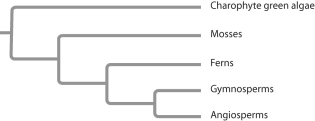
(Essay)
4.8/5 (89)
(89) In onions (Allium), cells of the sporophyte have 16 chromosomes within each nucleus. Match the number of chromosomes present in each of the onion tissues listed below.
-How many chromosomes should be in a generative cell nucleus?
(Multiple Choice)
4.7/5 (73)
(73) A botanist was visiting a tropical region for the purpose of discovering plants with medicinal properties. All of the following might be ways of identifying potentially useful plants except
(Multiple Choice)
4.8/5 (78)
(78) The main way that pine trees disperse their offspring is by using
(Multiple Choice)
4.8/5 (77)
(77) The following questions refer to the description below.
The cycads, a mostly tropical phylum of gymnosperms, evolved about 300 million years ago and were dominant forms during the Age of the Dinosaurs. Though their sperm are flagellated, their ovules are pollinated by beetles. These beetles get nutrition (they eat pollen) and shelter from the microsporophylls. Upon visiting megasporophylls, the beetles transfer pollen to the exposed ovules. In cycads, pollen cones and seed cones are borne on different plants. Cycads synthesize neurotoxins, especially in the seeds, that are effective against most animals, including humans.
-Which feature of cycads makes them similar to many angiosperms?
1) They have exposed ovules.
2) They have flagellated sperm.
3) They are pollinated by animals.
(Multiple Choice)
4.7/5 (94)
(94) The following questions refer to the generalized life cycle for land plants shown in Figure 30.1. Each number within a circle or square represents a specific plant or plant part, and each number over an arrow represents either meiosis, mitosis, or fertilization.
 Figure 30.1
-In angiosperms, which number most nearly represents the event that initiates the formation of endosperm?
Figure 30.1
-In angiosperms, which number most nearly represents the event that initiates the formation of endosperm? (Multiple Choice)
4.8/5 (73)
(73) Arrange the following structures, which can be found on male pine trees, from the largest structure to the smallest structure (or from most inclusive to least inclusive). 1. sporophyte
2) microspores
3) microsporangia
4) pollen cone
5) pollen nuclei
(Multiple Choice)
4.9/5 (86)
(86) Which of the following is an ongoing trend in the evolution of land plants?
(Multiple Choice)
4.9/5 (82)
(82) The following questions refer to the description below. Match the animal features with the appropriate angiosperm analog.
Oviparous (egg-laying) animals have internal fertilization (sperm cells encounter eggs within the female's body). Yolk and/or albumen is (are) provided to the embryo, and a shell is then deposited around the embryo and its food source. Eggs are subsequently deposited in an environment that promotes their further development, or are incubated by one or both parents.
-The seeds of orchids are among the smallest known, with virtually no endosperm and with miniscule seed leaves. Consequently, what should one expect to be True of such seeds?
(Multiple Choice)
4.8/5 (78)
(78) The following questions refer to the description below.
The cycads, a mostly tropical phylum of gymnosperms, evolved about 300 million years ago and were dominant forms during the Age of the Dinosaurs. Though their sperm are flagellated, their ovules are pollinated by beetles. These beetles get nutrition (they eat pollen) and shelter from the microsporophylls. Upon visiting megasporophylls, the beetles transfer pollen to the exposed ovules. In cycads, pollen cones and seed cones are borne on different plants. Cycads synthesize neurotoxins, especially in the seeds, that are effective against most animals, including humans.
-What is True of stamens, sepals, petals, carpels, and pinecone scales?
(Multiple Choice)
4.8/5 (88)
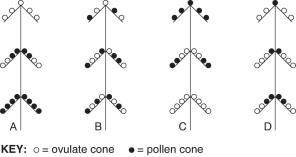
(88) In most pine species, pollen cones and seed (ovulate)cones are borne on the same tree. In a habitat where few air currents exist at, or near, the forest floor but nearly continuous in the tree canopy, which of these is the most adaptive arrangement of the two kinds of cones on pines in this habitat?
(Short Answer)
5.0/5 (71)
(71) The following questions refer to the description below. Match the animal features with the appropriate angiosperm analog.
Oviparous (egg-laying) animals have internal fertilization (sperm cells encounter eggs within the female's body). Yolk and/or albumen is (are) provided to the embryo, and a shell is then deposited around the embryo and its food source. Eggs are subsequently deposited in an environment that promotes their further development, or are incubated by one or both parents.
-Which of the following is a structure of angiosperm gametophytes?
(Multiple Choice)
4.8/5 (72)
(72) In onions (Allium), cells of the sporophyte have 16 chromosomes within each nucleus. Match the number of chromosomes present in each of the onion tissues listed below.
-How many chromosomes should be in an embryo nucleus?
(Multiple Choice)
4.8/5 (70)
(70) Gymnosperms differ from both extinct and extant ferns because they
(Multiple Choice)
4.7/5 (73)
(73) The following questions refer to the generalized life cycle for land plants shown in Figure 30.1. Each number within a circle or square represents a specific plant or plant part, and each number over an arrow represents either meiosis, mitosis, or fertilization.
Figure 30.1
-Which numbers represent haploid cells or tissues?
Figure 30.1
-Which numbers represent haploid cells or tissues? (Multiple Choice)
4.9/5 (78)
(78) Which of the following flower parts develops into the pulp of a fleshy fruit?
(Multiple Choice)
4.9/5 (82)
(82) 
Filters
- Essay(0)
- Multiple Choice(0)
- Short Answer(0)
- True False(0)
- Matching(0)