



 Chat with AI
Exam 29: Plant Diversity I: How Plants Colonized Land

Exam 1: Introduction: Themes in the Study of Life66 Questions
Exam 2: The Chemical Context of Life83 Questions
Exam 3: Water and the Fitness of the Environment66 Questions
Exam 4: Carbon and the Molecular Diversity of Life68 Questions
Exam 5: The Structure and Function of Large Biological Molecules109 Questions
Exam 6: A Tour of the Cell75 Questions
Exam 7: Membrane Structure and Function75 Questions
Exam 8: An Introduction to Metabolism79 Questions
Exam 9: Cellular Respiration: Harvesting Chemical Energy103 Questions
Exam 10: Photosynthesis74 Questions
Exam 11: Cell Communication62 Questions
Exam 12: The Cell Cycle80 Questions
Exam 13: Meiosis and Sexual Life Cycles68 Questions
Exam 14: Mendel and the Gene Idea90 Questions
Exam 15: The Chromosomal Basis of Inheritance75 Questions
Exam 16: The Molecular Basis of Inheritance72 Questions
Exam 17: From Gene to Protein84 Questions
Exam 18: Control of Gene Expression101 Questions
Exam 19: Viruses38 Questions
Exam 20: Biotechnology70 Questions
Exam 21: Genomes and Their Evolution37 Questions
Exam 22: Descent With Modification: a Darwinian View of Life57 Questions
Exam 23: The Evolution of Populations84 Questions
Exam 24: The Origin of Species60 Questions
Exam 25: The History of Life on Earth85 Questions
Exam 26: Phylogeny and the Tree of Life90 Questions
Exam 27: Bacteria and Archaea78 Questions
Exam 28: Protists79 Questions
Exam 29: Plant Diversity I: How Plants Colonized Land74 Questions
Exam 30: Plant Diversity Ii: the Evolution of Seed Plants101 Questions
Exam 31: Fungi87 Questions
Exam 32: An Introduction to Animal Diversity82 Questions
Exam 33: Invertebrates98 Questions
Exam 34: Vertebrates112 Questions
Exam 35: Plant Structure, Growth, and Development77 Questions
Exam 36: Transport in Vascular Plants84 Questions
Exam 37: Soil and Plant Nutrition85 Questions
Exam 38: Angiosperm Reproduction and Biotechnology86 Questions
Exam 39: Plant Responses to Internal and External Signals111 Questions
Exam 40: Basic Principles of Animal Form and Function74 Questions
Exam 41: Animal Nutrition68 Questions
Exam 42: Circulation and Gas Exchange78 Questions
Exam 43: The Immune System85 Questions
Exam 44: Osmoregulation and Excretion49 Questions
Exam 45: Hormones and the Endocrine System71 Questions
Exam 46: Animal Reproduction85 Questions
Exam 47: Animal Development75 Questions
Exam 48: Neurons, Synapses, and Signaling52 Questions
Exam 49: Nervous Systems48 Questions
Exam 50: Sensory and Motor Mechanisms59 Questions
Exam 51: Animal Behavior74 Questions
Exam 52: An Introduction to Ecology and the Biosphere71 Questions
Exam 53: Population Ecology80 Questions
Exam 54: Community Ecology74 Questions
Exam 55: Ecosystems79 Questions
Exam 56: Conservation Biology and Restoration Ecology65 Questions
Select questions type


Assuming that they all belong to the same plant, arrange the following structures from largest to smallest (or from most inclusive to least inclusive). 1. spores
2) sporophylls
3) sporophytes
4) sporangia
(Multiple Choice)
4.9/5  (86)
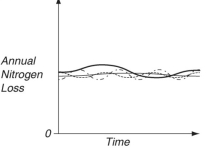
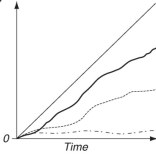
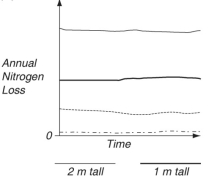
(86) Refer to the information below to answer the following questions. Researchers decided to test the hypothesis that if the 2-m tall Polytrichum gametophyte-sporophyte plants had acted as a physical buffer, then they would have reduced water's ability to erode the soil, and carry away its nitrogen. They began with four equal-sized areas where Polytrichum mosses grew to a height of 2 m above the soil surface. One of the four areas was not modified. In the second area, the mosses were trimmed to a height of 1 m above the soil surface. In the third area, the mosses were trimmed to a height of 0.5 m above the soil surface. In the fourth area, the mosses were trimmed all the way to the ground, leaving only the rhizoids. Water, simulating rainfall, was then added in a controlled fashion to all plots over the course of one year. Figure 29.2 below presents four graphs, which depict potential results of this experiment.
(A)
 (C)
 (B)
 (D)
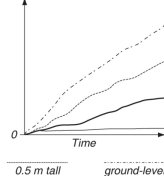 Figure 29.2
-Which graph of soil nitrogen loss over time in Figure 29.2 most strongly supports the hypothesis that if the 2-m tall Polytrichum gametophyte-sporophyte plants had acted as a physical buffer, then they would have reduced water's ability to erode the soil, and carry away its nitrogen?
(C)
(B)
(D)
Figure 29.2
-Which graph of soil nitrogen loss over time in Figure 29.2 most strongly supports the hypothesis that if the 2-m tall Polytrichum gametophyte-sporophyte plants had acted as a physical buffer, then they would have reduced water's ability to erode the soil, and carry away its nitrogen? (Short Answer)
4.8/5 (69)
(69) A major change that occurred during the evolution of plants from their algal ancestors was the origin of a branched sporophyte. What advantage would branched sporophytes provide in this stage of the life cycle?
(Multiple Choice)
4.8/5 (76)
(76) Mitotic activity by the apical meristem of a root makes which of the following more possible?
(Multiple Choice)
4.9/5 (83)
(83) If a fern gametophyte is a hermaphrodite (that is, has both male and female gametangia on the same plant), then it
(Multiple Choice)
4.8/5 (77)
(77) Each of the following is a general characteristic of bryophytes except
(Multiple Choice)
4.8/5 (68)
(68) The structural integrity of bacteria is to peptidoglycan as the structural integrity of plant spores is to
(Multiple Choice)
4.7/5 (83)
(83) Which of these should have had gene sequences most similar to the charophyte that was the common ancestor of the land plants?
(Multiple Choice)
4.8/5 (70)
(70) Two, small, poorly drained lakes lie close to each other in a northern forest. The basins of both lakes are composed of the same geologic substratum. One lake is surrounded by a dense Sphagnum mat; the other is not. Compared to the pond with Sphagnum, the pond lacking the moss mat should have
(Multiple Choice)
4.8/5 (88)
(88) Choose the adaptation below that best meets each particular challenge for life on land.
-transport of water, minerals, and nutrients
(Multiple Choice)
4.8/5 (65)
(65) The following questions are based on the description and Figure 29.1 below, which is the same as Fig. 29.10 in the textbook.
Researchers tested nitrogen loss from soil where the moss Polytrichum was growing, to soil from which Polytrichum had been removed. The data are presented below.
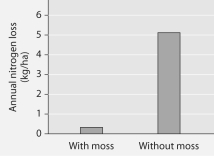 Figure 29.1
-Loss of soil nitrogen via "gaseous emission" was found to be negligible. Rather, most loss of soil nitrogen was due to water erosion of the soil. Which of these hypotheses is least likely to account for the observed results?
Figure 29.1
-Loss of soil nitrogen via "gaseous emission" was found to be negligible. Rather, most loss of soil nitrogen was due to water erosion of the soil. Which of these hypotheses is least likely to account for the observed results? (Multiple Choice)
4.8/5 (69)
(69) Among bryophytes, only the sporophytes of mosses and hornworts have stomata, whereas stomata are missing from liverwort sporophytes. If the common ancestor of all bryophytes had sporophytes that bore stomata, then which of these might account for their absence from liverwort sporophytes? If, in contrast to early mosses and hornworts, early liverwort sporophytes had
(Multiple Choice)
4.8/5 (93)
(93) 
Filters
- Essay(0)
- Multiple Choice(0)
- Short Answer(0)
- True False(0)
- Matching(0)