



 Chat with AI
Exam 29: Plant Diversity I: How Plants Colonized Land

Exam 1: Introduction: Themes in the Study of Life66 Questions
Exam 2: The Chemical Context of Life83 Questions
Exam 3: Water and the Fitness of the Environment66 Questions
Exam 4: Carbon and the Molecular Diversity of Life68 Questions
Exam 5: The Structure and Function of Large Biological Molecules109 Questions
Exam 6: A Tour of the Cell75 Questions
Exam 7: Membrane Structure and Function75 Questions
Exam 8: An Introduction to Metabolism79 Questions
Exam 9: Cellular Respiration: Harvesting Chemical Energy103 Questions
Exam 10: Photosynthesis74 Questions
Exam 11: Cell Communication62 Questions
Exam 12: The Cell Cycle80 Questions
Exam 13: Meiosis and Sexual Life Cycles68 Questions
Exam 14: Mendel and the Gene Idea90 Questions
Exam 15: The Chromosomal Basis of Inheritance75 Questions
Exam 16: The Molecular Basis of Inheritance72 Questions
Exam 17: From Gene to Protein84 Questions
Exam 18: Control of Gene Expression101 Questions
Exam 19: Viruses38 Questions
Exam 20: Biotechnology70 Questions
Exam 21: Genomes and Their Evolution37 Questions
Exam 22: Descent With Modification: a Darwinian View of Life57 Questions
Exam 23: The Evolution of Populations84 Questions
Exam 24: The Origin of Species60 Questions
Exam 25: The History of Life on Earth85 Questions
Exam 26: Phylogeny and the Tree of Life90 Questions
Exam 27: Bacteria and Archaea78 Questions
Exam 28: Protists79 Questions
Exam 29: Plant Diversity I: How Plants Colonized Land74 Questions
Exam 30: Plant Diversity Ii: the Evolution of Seed Plants101 Questions
Exam 31: Fungi87 Questions
Exam 32: An Introduction to Animal Diversity82 Questions
Exam 33: Invertebrates98 Questions
Exam 34: Vertebrates112 Questions
Exam 35: Plant Structure, Growth, and Development77 Questions
Exam 36: Transport in Vascular Plants84 Questions
Exam 37: Soil and Plant Nutrition85 Questions
Exam 38: Angiosperm Reproduction and Biotechnology86 Questions
Exam 39: Plant Responses to Internal and External Signals111 Questions
Exam 40: Basic Principles of Animal Form and Function74 Questions
Exam 41: Animal Nutrition68 Questions
Exam 42: Circulation and Gas Exchange78 Questions
Exam 43: The Immune System85 Questions
Exam 44: Osmoregulation and Excretion49 Questions
Exam 45: Hormones and the Endocrine System71 Questions
Exam 46: Animal Reproduction85 Questions
Exam 47: Animal Development75 Questions
Exam 48: Neurons, Synapses, and Signaling52 Questions
Exam 49: Nervous Systems48 Questions
Exam 50: Sensory and Motor Mechanisms59 Questions
Exam 51: Animal Behavior74 Questions
Exam 52: An Introduction to Ecology and the Biosphere71 Questions
Exam 53: Population Ecology80 Questions
Exam 54: Community Ecology74 Questions
Exam 55: Ecosystems79 Questions
Exam 56: Conservation Biology and Restoration Ecology65 Questions
Select questions type


The following questions are based on the description and Figure 29.1 below, which is the same as Fig. 29.10 in the textbook.
Researchers tested nitrogen loss from soil where the moss Polytrichum was growing, to soil from which Polytrichum had been removed. The data are presented below.
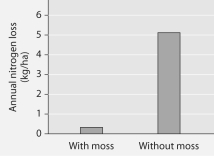 Figure 29.1
-A potential source of nitrogen in a sandy soil environment might be the bacterium, Rhizobium, which inhabits the root nodules of leguminous plants. Which of these statements is True, and should prevent Rhizobium or other root-inhabiting nitrogen-fixers from contributing nitrogen to the soil in this experiment?
Figure 29.1
-A potential source of nitrogen in a sandy soil environment might be the bacterium, Rhizobium, which inhabits the root nodules of leguminous plants. Which of these statements is True, and should prevent Rhizobium or other root-inhabiting nitrogen-fixers from contributing nitrogen to the soil in this experiment? (Multiple Choice)
4.9/5  (78)
(78) Which event during the evolution of land plants probably made the synthesis of secondary compounds most beneficial?
(Multiple Choice)
4.9/5 (86)
(86) If intelligent extraterrestrials visited Earth 475 million years ago, and then again 300 million years ago (at the close of the Carboniferous period), what trends would they have noticed in Earth's terrestrial vegetation over this period?
1) a trend from dominant gametophytes to dominant sprophytes
2) a trend from sporangia borne on modified leaves (sporophylls)to sporangia borne on stalks (seta)
3) a trend from no True leaves, to microphylls, to megaphylls
4) a trend from soil-surface-hugging plants to "overtopping" plants
5) a trend toward increased lignification of conducting systems
(Multiple Choice)
4.8/5 (86)
(86) Closer observation reveals that these small spheres are produced on tiny extensions of the stem, each of which helps compose the strobilus. These small, spore-producing extensions of the stem are called
(Multiple Choice)
4.7/5 (69)
(69) Refer to the information below to answer the following questions. Researchers decided to test the hypothesis that if the 2-m tall Polytrichum gametophyte-sporophyte plants had acted as a physical buffer, then they would have reduced water's ability to erode the soil, and carry away its nitrogen. They began with four equal-sized areas where Polytrichum mosses grew to a height of 2 m above the soil surface. One of the four areas was not modified. In the second area, the mosses were trimmed to a height of 1 m above the soil surface. In the third area, the mosses were trimmed to a height of 0.5 m above the soil surface. In the fourth area, the mosses were trimmed all the way to the ground, leaving only the rhizoids. Water, simulating rainfall, was then added in a controlled fashion to all plots over the course of one year. Figure 29.2 below presents four graphs, which depict potential results of this experiment.
(A)
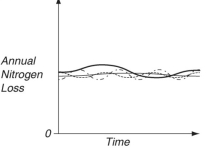 (C)
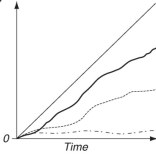 (B)
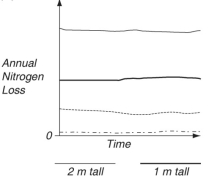 (D)
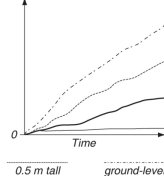 Figure 29.2
-Which of these potential results of applying a metabolic poison to the rhizoids of Polytrichum should interfere the least with the ability to draw valid conclusions from this experiment?
(C)
(B)
(D)
Figure 29.2
-Which of these potential results of applying a metabolic poison to the rhizoids of Polytrichum should interfere the least with the ability to draw valid conclusions from this experiment? (Multiple Choice)
4.9/5 (58)
(58) Choose the adaptation below that best meets each particular challenge for life on land.
-protection from desiccation
(Multiple Choice)
4.8/5 (67)
(67) Which of the following characteristics, if observed in an unidentified green organism, would make it unlikely to be a charophyte?
(Multiple Choice)
4.8/5 (75)
(75) Identify each of the following structures as haploid or diploid:
A)sporophyte
B)spore
C)gametophyte
D)zygote
E)sperm
(Essay)
4.8/5 (70)
(70) A researcher wants to develop a test that will distinguish charophytes and land plants from green algae. Which of the following chemicals would be the best subject for such an assay?
(Multiple Choice)
4.8/5 (79)
(79) Besides oil, what other chemical should be detected in substantial amounts upon chemical analysis of these small spheres?
(Multiple Choice)
4.7/5 (72)
(72) In which of the following taxa does the mature sporophyte depend completely on the gametophyte for nutrition?
(Multiple Choice)
4.7/5 (79)
(79) A dissection of the interior of this organism's stem should reveal
(Multiple Choice)
4.9/5 (75)
(75) If you are looking for structures that transfer water and nutrients from a bryophyte gametophyte to a bryophyte sporophyte, then on which part of the sporophyte should you focus your attention?
(Multiple Choice)
4.7/5 (79)
(79) The most recent common ancestor of all land plants was probably similar to modern-day members of which group?
(Multiple Choice)
4.8/5 (65)
(65) A botanist discovers a new species of plant in a tropical rain forest. After observing its anatomy and life cycle, the following characteristics are noted: flagellated sperm, xylem with tracheids, separate gametophyte and sporophyte generations with the sporophyte dominant, and no seeds. This plant is probably most closely related to
(Multiple Choice)
4.9/5 (74)
(74) Some green algae exhibit alternation of generations. All land plants exhibit alternation of generations. No charophytes exhibit alternation of generations. Keeping in mind the recent evidence from molecular systematics, the correct interpretation of these observations is that
(Multiple Choice)
4.8/5 (97)
(97) Bryophytes never formed forests (mats, yes, but not forests)because
(Multiple Choice)
4.7/5 (89)
(89) You are hiking in a forest and happen upon a plant featuring a central stemlike structure from which sprout many, tiny, leaflike structures. Which of these would be the most certain means of distinguishing whether it was a True moss, or a club moss?
(Multiple Choice)
4.9/5 (82)
(82) Of the following list, flagellated (swimming)sperm are generally present in which groups?
1) Lycophyta
2) Bryophyta
3) Angiosperms
4) Chlorophyta
5) Pterophyta
(Multiple Choice)
4.9/5 (77)
(77) 
Filters
- Essay(0)
- Multiple Choice(0)
- Short Answer(0)
- True False(0)
- Matching(0)