



 Chat with AI
Exam 29: Plant Diversity I: How Plants Colonized Land

Exam 1: Introduction: Themes in the Study of Life66 Questions
Exam 2: The Chemical Context of Life83 Questions
Exam 3: Water and the Fitness of the Environment66 Questions
Exam 4: Carbon and the Molecular Diversity of Life68 Questions
Exam 5: The Structure and Function of Large Biological Molecules109 Questions
Exam 6: A Tour of the Cell75 Questions
Exam 7: Membrane Structure and Function75 Questions
Exam 8: An Introduction to Metabolism79 Questions
Exam 9: Cellular Respiration: Harvesting Chemical Energy103 Questions
Exam 10: Photosynthesis74 Questions
Exam 11: Cell Communication62 Questions
Exam 12: The Cell Cycle80 Questions
Exam 13: Meiosis and Sexual Life Cycles68 Questions
Exam 14: Mendel and the Gene Idea90 Questions
Exam 15: The Chromosomal Basis of Inheritance75 Questions
Exam 16: The Molecular Basis of Inheritance72 Questions
Exam 17: From Gene to Protein84 Questions
Exam 18: Control of Gene Expression101 Questions
Exam 19: Viruses38 Questions
Exam 20: Biotechnology70 Questions
Exam 21: Genomes and Their Evolution37 Questions
Exam 22: Descent With Modification: a Darwinian View of Life57 Questions
Exam 23: The Evolution of Populations84 Questions
Exam 24: The Origin of Species60 Questions
Exam 25: The History of Life on Earth85 Questions
Exam 26: Phylogeny and the Tree of Life90 Questions
Exam 27: Bacteria and Archaea78 Questions
Exam 28: Protists79 Questions
Exam 29: Plant Diversity I: How Plants Colonized Land74 Questions
Exam 30: Plant Diversity Ii: the Evolution of Seed Plants101 Questions
Exam 31: Fungi87 Questions
Exam 32: An Introduction to Animal Diversity82 Questions
Exam 33: Invertebrates98 Questions
Exam 34: Vertebrates112 Questions
Exam 35: Plant Structure, Growth, and Development77 Questions
Exam 36: Transport in Vascular Plants84 Questions
Exam 37: Soil and Plant Nutrition85 Questions
Exam 38: Angiosperm Reproduction and Biotechnology86 Questions
Exam 39: Plant Responses to Internal and External Signals111 Questions
Exam 40: Basic Principles of Animal Form and Function74 Questions
Exam 41: Animal Nutrition68 Questions
Exam 42: Circulation and Gas Exchange78 Questions
Exam 43: The Immune System85 Questions
Exam 44: Osmoregulation and Excretion49 Questions
Exam 45: Hormones and the Endocrine System71 Questions
Exam 46: Animal Reproduction85 Questions
Exam 47: Animal Development75 Questions
Exam 48: Neurons, Synapses, and Signaling52 Questions
Exam 49: Nervous Systems48 Questions
Exam 50: Sensory and Motor Mechanisms59 Questions
Exam 51: Animal Behavior74 Questions
Exam 52: An Introduction to Ecology and the Biosphere71 Questions
Exam 53: Population Ecology80 Questions
Exam 54: Community Ecology74 Questions
Exam 55: Ecosystems79 Questions
Exam 56: Conservation Biology and Restoration Ecology65 Questions
Select questions type


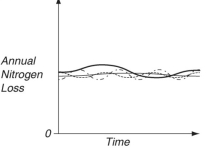
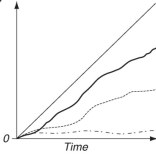
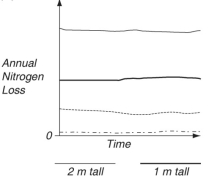
Refer to the information below to answer the following questions. Researchers decided to test the hypothesis that if the 2-m tall Polytrichum gametophyte-sporophyte plants had acted as a physical buffer, then they would have reduced water's ability to erode the soil, and carry away its nitrogen. They began with four equal-sized areas where Polytrichum mosses grew to a height of 2 m above the soil surface. One of the four areas was not modified. In the second area, the mosses were trimmed to a height of 1 m above the soil surface. In the third area, the mosses were trimmed to a height of 0.5 m above the soil surface. In the fourth area, the mosses were trimmed all the way to the ground, leaving only the rhizoids. Water, simulating rainfall, was then added in a controlled fashion to all plots over the course of one year. Figure 29.2 below presents four graphs, which depict potential results of this experiment.
(A)
 (C)
 (B)
 (D)
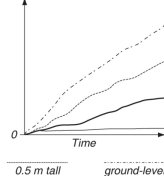 Figure 29.2
-If the actual results most closely resembled those in Figure 29.2(A), then a further question arising from these data is: "Do the Polytrichum rhizoids have to be alive in order to reduce soil nitrogen loss, or do dead rhizoids have the same effect? " Arrange the following steps in the correct sequence to test this hypothesis:
1) Add metabolic poison to the soil of the experimental plot of mosses.
2) Apply water equally to the experimental and control plots.
3) Measure initial soil nitrogen contents of control and experimental plots.
4) Determine nitrogen loss from soil of control and experimental plots.
5) Establish two identical plots of Polytrichum mosses; one as a control, the other as the experimental treatment.
(C)
(B)
(D)
Figure 29.2
-If the actual results most closely resembled those in Figure 29.2(A), then a further question arising from these data is: "Do the Polytrichum rhizoids have to be alive in order to reduce soil nitrogen loss, or do dead rhizoids have the same effect? " Arrange the following steps in the correct sequence to test this hypothesis:
1) Add metabolic poison to the soil of the experimental plot of mosses.
2) Apply water equally to the experimental and control plots.
3) Measure initial soil nitrogen contents of control and experimental plots.
4) Determine nitrogen loss from soil of control and experimental plots.
5) Establish two identical plots of Polytrichum mosses; one as a control, the other as the experimental treatment. (Multiple Choice)
4.8/5  (83)
(83) If humans had been present to build log structures during the Carboniferous period (they weren't), which plant type(s)would have been suitable sources of logs?
(Multiple Choice)
4.9/5 (70)
(70) The following characteristics all helped seedless plants become better adapted to land except
(Multiple Choice)
4.9/5 (63)
(63) Bryophytes may feature all of the following at some time during their existence except
(Multiple Choice)
4.9/5 (78)
(78) Working from deep geologic strata toward shallow geologic strata, what is the sequence in which fossils of these groups should make their first appearance?
1) charophytes
2) single-celled green algae
3) hornworts
4) plants with a dominant sporophyte
(Multiple Choice)
4.9/5 (62)
(62) Refer to the information below to answer the following questions. Researchers decided to test the hypothesis that if the 2-m tall Polytrichum gametophyte-sporophyte plants had acted as a physical buffer, then they would have reduced water's ability to erode the soil, and carry away its nitrogen. They began with four equal-sized areas where Polytrichum mosses grew to a height of 2 m above the soil surface. One of the four areas was not modified. In the second area, the mosses were trimmed to a height of 1 m above the soil surface. In the third area, the mosses were trimmed to a height of 0.5 m above the soil surface. In the fourth area, the mosses were trimmed all the way to the ground, leaving only the rhizoids. Water, simulating rainfall, was then added in a controlled fashion to all plots over the course of one year. Figure 29.2 below presents four graphs, which depict potential results of this experiment.
(A)
(C)
(B)
(D)
Figure 29.2
-Which graph of soil nitrogen loss over time in Figure 29.2 most strongly supports the hypothesis that if rhizoids had helped stabilize the soil, then less erosion and less loss of nitrogen would occur?
(C)
(B)
(D)
Figure 29.2
-Which graph of soil nitrogen loss over time in Figure 29.2 most strongly supports the hypothesis that if rhizoids had helped stabilize the soil, then less erosion and less loss of nitrogen would occur? (Short Answer)
4.8/5 (84)
(84) A number of characteristics are very similar between charophytes and members of the kingdom Plantae. Of the following, which characteristic does not provide evidence for a close evolutionary relationship between these two groups?
(Multiple Choice)
4.9/5 (75)
(75) Which of the following characteristics of plants is absent in their closest relatives, the charophyte algae?
(Multiple Choice)
4.8/5 (77)
(77) Why should one expect the soil's nitrogen not to be contained solely within the rhizoids of the Polytrichum mosses?
(Multiple Choice)
4.7/5 (90)
(90) A fungal infection damages all peristomes, preventing them from performing their function. Which process will be directly hindered as a result?
(Multiple Choice)
4.9/5 (77)
(77) Beginning with the germination of a moss spore, what is the sequence of structures that develop after germination?
1) embryo
2) gametes
3) sporophyte
4) protonema
5) gametophore
(Multiple Choice)
5.0/5 (86)
(86) Bryophytes have all of the following characteristics except
(Multiple Choice)
4.8/5 (82)
(82) The following are common to both charophytes and land plants except
(Multiple Choice)
4.9/5 (62)
(62) Which of the following taxa includes the largest amount of genetic diversity among plantlike organisms?
(Multiple Choice)
4.9/5 (83)
(83) During glacial periods in the early evolution of land plants, which of these is a beneficial adaptation regarding the number of stomata per unit surface area, and what accounts for it?
(Multiple Choice)
4.9/5 (81)
(81) 
Filters
- Essay(0)
- Multiple Choice(0)
- Short Answer(0)
- True False(0)
- Matching(0)