



 Chat with AI
Exam 10: Photosynthesis

Exam 1: Introduction: Themes in the Study of Life66 Questions
Exam 2: The Chemical Context of Life83 Questions
Exam 3: Water and the Fitness of the Environment66 Questions
Exam 4: Carbon and the Molecular Diversity of Life68 Questions
Exam 5: The Structure and Function of Large Biological Molecules109 Questions
Exam 6: A Tour of the Cell75 Questions
Exam 7: Membrane Structure and Function75 Questions
Exam 8: An Introduction to Metabolism79 Questions
Exam 9: Cellular Respiration: Harvesting Chemical Energy103 Questions
Exam 10: Photosynthesis74 Questions
Exam 11: Cell Communication62 Questions
Exam 12: The Cell Cycle80 Questions
Exam 13: Meiosis and Sexual Life Cycles68 Questions
Exam 14: Mendel and the Gene Idea90 Questions
Exam 15: The Chromosomal Basis of Inheritance75 Questions
Exam 16: The Molecular Basis of Inheritance72 Questions
Exam 17: From Gene to Protein84 Questions
Exam 18: Control of Gene Expression101 Questions
Exam 19: Viruses38 Questions
Exam 20: Biotechnology70 Questions
Exam 21: Genomes and Their Evolution37 Questions
Exam 22: Descent With Modification: a Darwinian View of Life57 Questions
Exam 23: The Evolution of Populations84 Questions
Exam 24: The Origin of Species60 Questions
Exam 25: The History of Life on Earth85 Questions
Exam 26: Phylogeny and the Tree of Life90 Questions
Exam 27: Bacteria and Archaea78 Questions
Exam 28: Protists79 Questions
Exam 29: Plant Diversity I: How Plants Colonized Land74 Questions
Exam 30: Plant Diversity Ii: the Evolution of Seed Plants101 Questions
Exam 31: Fungi87 Questions
Exam 32: An Introduction to Animal Diversity82 Questions
Exam 33: Invertebrates98 Questions
Exam 34: Vertebrates112 Questions
Exam 35: Plant Structure, Growth, and Development77 Questions
Exam 36: Transport in Vascular Plants84 Questions
Exam 37: Soil and Plant Nutrition85 Questions
Exam 38: Angiosperm Reproduction and Biotechnology86 Questions
Exam 39: Plant Responses to Internal and External Signals111 Questions
Exam 40: Basic Principles of Animal Form and Function74 Questions
Exam 41: Animal Nutrition68 Questions
Exam 42: Circulation and Gas Exchange78 Questions
Exam 43: The Immune System85 Questions
Exam 44: Osmoregulation and Excretion49 Questions
Exam 45: Hormones and the Endocrine System71 Questions
Exam 46: Animal Reproduction85 Questions
Exam 47: Animal Development75 Questions
Exam 48: Neurons, Synapses, and Signaling52 Questions
Exam 49: Nervous Systems48 Questions
Exam 50: Sensory and Motor Mechanisms59 Questions
Exam 51: Animal Behavior74 Questions
Exam 52: An Introduction to Ecology and the Biosphere71 Questions
Exam 53: Population Ecology80 Questions
Exam 54: Community Ecology74 Questions
Exam 55: Ecosystems79 Questions
Exam 56: Conservation Biology and Restoration Ecology65 Questions
Select questions type


Figure 10.1 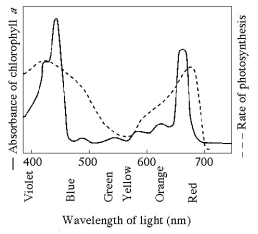 -P680⁺ is said to be the strongest biological oxidizing agent. Why?
 (Multiple Choice)
4.8/5  (72)
(72) Figure 10.1
-Generation of proton gradients across membranes occurs during
-Generation of proton gradients across membranes occurs during (Multiple Choice)
4.9/5 (82)
(82) Figure 10.3 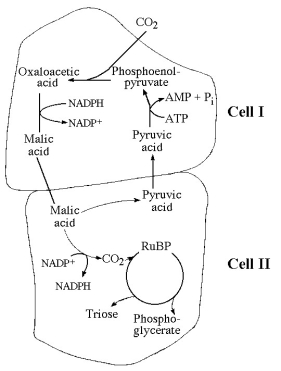 -Photorespiration lowers the efficiency of photosynthesis by preventing the formation of
 (Multiple Choice)
4.8/5 (76)
(76) Figure 10.3
-Referring to Figure 10.3, oxygen would inhibit the CO₂ fixation reactions in
-Referring to Figure 10.3, oxygen would inhibit the CO₂ fixation reactions in (Multiple Choice)
5.0/5 (87)
(87) Figure 10.1
-Where do the enzymatic reactions of the Calvin cycle take place?
-Where do the enzymatic reactions of the Calvin cycle take place? (Multiple Choice)
4.8/5 (81)
(81) Figure 10.3
-Which of the following does not occur during the Calvin cycle?
-Which of the following does not occur during the Calvin cycle? (Multiple Choice)
4.9/5 (74)
(74) Figure 10.1
-Cyclic electron flow may be photoprotective (protective to light-induced damage). Which of the following experiments could provide information on this phenomenon?
-Cyclic electron flow may be photoprotective (protective to light-induced damage). Which of the following experiments could provide information on this phenomenon? (Multiple Choice)
4.8/5 (74)
(74) For the following questions, compare the light reactions with the Calvin cycle of photosynthesis in plants.
-Produces NADH
(Multiple Choice)
4.9/5 (79)
(79) Figure 10.1
-What are the products of linear photophosphorylation?
-What are the products of linear photophosphorylation? (Multiple Choice)
5.0/5 (80)
(80) Figure 10.1
-Assume a thylakoid is somehow punctured so that the interior of the thylakoid is no longer separated from the stroma. This damage will have the most direct effect on which of the following processes?
-Assume a thylakoid is somehow punctured so that the interior of the thylakoid is no longer separated from the stroma. This damage will have the most direct effect on which of the following processes? (Multiple Choice)
4.9/5 (73)
(73) Figure 10.2 Use the following figure and the stages labeled A, B, C, D, and E to answer the following questions.
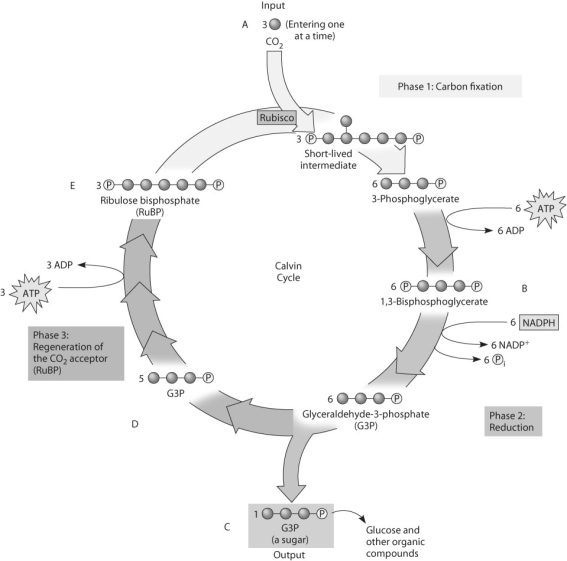 -Which molecule(s)of the Calvin cycle is/are most like molecules found in glycolysis?
 (Multiple Choice)
4.8/5 (76)
(76) Use the following information to answer the questions below.
Theodor W. Engelmann illuminated a filament of algae with light that passed through a prism, thus exposing different segments of algae to different wavelengths of light. He added aerobic bacteria and then noted in which areas the bacteria congregated. He noted that the largest groups were found in the areas illuminated by the red and blue light.
-What did Engelmann conclude about the congregation of bacteria in the red and blue areas?
(Multiple Choice)
4.9/5 (68)
(68) Figure 10.3
-Why are C₄ plants able to photosynthesize with no apparent photorespiration?
-Why are C₄ plants able to photosynthesize with no apparent photorespiration? (Multiple Choice)
4.9/5 (65)
(65) Figure 10.1
-Reduction of oxygen which forms water occurs during
-Reduction of oxygen which forms water occurs during (Multiple Choice)
4.8/5 (86)
(86) Figure 10.1
-Compared with the lines for chlorophyll a in the figure, where would you expect to find the lines to differ for chlorophyll b?
-Compared with the lines for chlorophyll a in the figure, where would you expect to find the lines to differ for chlorophyll b? (Multiple Choice)
4.9/5 (91)
(91) Figure 10.1
-Suppose the interior of the thylakoids of isolated chloroplasts were made acidic and then transferred in the dark to a pH-8 solution. What would be likely to happen?
-Suppose the interior of the thylakoids of isolated chloroplasts were made acidic and then transferred in the dark to a pH-8 solution. What would be likely to happen? (Multiple Choice)
4.8/5 (92)
(92) For the following questions, compare the light reactions with the Calvin cycle of photosynthesis in plants.
-In the process of carbon fixation, RuBP attaches a CO₂ to produce a 6 carbon molecule, which is then split in two. After phosphorylation and reduction, what more needs to happen in the Calvin cycle?
(Multiple Choice)
5.0/5 (66)
(66) Figure 10.1
-Some photosynthetic organisms contain chloroplasts that lack photosystem II, yet are able to survive. The best way to detect the lack of photosystem II in these organisms would be
-Some photosynthetic organisms contain chloroplasts that lack photosystem II, yet are able to survive. The best way to detect the lack of photosystem II in these organisms would be (Multiple Choice)
4.8/5 (83)
(83) Figure 10.1
-Some photosynthetic bacteria (e.g., purple sulfur bacteria)have photosystem I but not II, while others (e.g. cyanobacteria)have both PSI and PSII. Which of the following might this observation imply?
-Some photosynthetic bacteria (e.g., purple sulfur bacteria)have photosystem I but not II, while others (e.g. cyanobacteria)have both PSI and PSII. Which of the following might this observation imply? (Multiple Choice)
4.9/5 (64)
(64) 
Filters
- Essay(0)
- Multiple Choice(0)
- Short Answer(0)
- True False(0)
- Matching(0)