



 Chat with AI
Exam 9: Cellular Respiration: Harvesting Chemical Energy

Exam 1: Introduction: Themes in the Study of Life66 Questions
Exam 2: The Chemical Context of Life83 Questions
Exam 3: Water and the Fitness of the Environment66 Questions
Exam 4: Carbon and the Molecular Diversity of Life68 Questions
Exam 5: The Structure and Function of Large Biological Molecules109 Questions
Exam 6: A Tour of the Cell75 Questions
Exam 7: Membrane Structure and Function75 Questions
Exam 8: An Introduction to Metabolism79 Questions
Exam 9: Cellular Respiration: Harvesting Chemical Energy103 Questions
Exam 10: Photosynthesis74 Questions
Exam 11: Cell Communication62 Questions
Exam 12: The Cell Cycle80 Questions
Exam 13: Meiosis and Sexual Life Cycles68 Questions
Exam 14: Mendel and the Gene Idea90 Questions
Exam 15: The Chromosomal Basis of Inheritance75 Questions
Exam 16: The Molecular Basis of Inheritance72 Questions
Exam 17: From Gene to Protein84 Questions
Exam 18: Control of Gene Expression101 Questions
Exam 19: Viruses38 Questions
Exam 20: Biotechnology70 Questions
Exam 21: Genomes and Their Evolution37 Questions
Exam 22: Descent With Modification: a Darwinian View of Life57 Questions
Exam 23: The Evolution of Populations84 Questions
Exam 24: The Origin of Species60 Questions
Exam 25: The History of Life on Earth85 Questions
Exam 26: Phylogeny and the Tree of Life90 Questions
Exam 27: Bacteria and Archaea78 Questions
Exam 28: Protists79 Questions
Exam 29: Plant Diversity I: How Plants Colonized Land74 Questions
Exam 30: Plant Diversity Ii: the Evolution of Seed Plants101 Questions
Exam 31: Fungi87 Questions
Exam 32: An Introduction to Animal Diversity82 Questions
Exam 33: Invertebrates98 Questions
Exam 34: Vertebrates112 Questions
Exam 35: Plant Structure, Growth, and Development77 Questions
Exam 36: Transport in Vascular Plants84 Questions
Exam 37: Soil and Plant Nutrition85 Questions
Exam 38: Angiosperm Reproduction and Biotechnology86 Questions
Exam 39: Plant Responses to Internal and External Signals111 Questions
Exam 40: Basic Principles of Animal Form and Function74 Questions
Exam 41: Animal Nutrition68 Questions
Exam 42: Circulation and Gas Exchange78 Questions
Exam 43: The Immune System85 Questions
Exam 44: Osmoregulation and Excretion49 Questions
Exam 45: Hormones and the Endocrine System71 Questions
Exam 46: Animal Reproduction85 Questions
Exam 47: Animal Development75 Questions
Exam 48: Neurons, Synapses, and Signaling52 Questions
Exam 49: Nervous Systems48 Questions
Exam 50: Sensory and Motor Mechanisms59 Questions
Exam 51: Animal Behavior74 Questions
Exam 52: An Introduction to Ecology and the Biosphere71 Questions
Exam 53: Population Ecology80 Questions
Exam 54: Community Ecology74 Questions
Exam 55: Ecosystems79 Questions
Exam 56: Conservation Biology and Restoration Ecology65 Questions
Select questions type


Refer to Figure 9.1 to answer the following questions.
Figure 9.1 illustrates some of the steps (reactions) of glycolysis in their proper sequence. Each step is lettered. Use these letters to answer the questions.
 -Which step involves an endergonic reaction?
 (Short Answer)
4.9/5  (75)
(75) Figure 9.3  -Which of the following occurs in the cytosol of a eukaryotic cell?
 (Multiple Choice)
4.9/5 (78)
(78) Figure 9.3
-When muscle cells are oxygen deprived, the heart still pumps. What must the heart cells be able to do?
-When muscle cells are oxygen deprived, the heart still pumps. What must the heart cells be able to do? (Multiple Choice)
4.9/5 (93)
(93) Figure 9.3
-Which of the following couples chemiosmosis to energy storage?
-Which of the following couples chemiosmosis to energy storage? (Multiple Choice)
5.0/5 (81)
(81) Refer to Figure 9.1 to answer the following questions.
Figure 9.1 illustrates some of the steps (reactions) of glycolysis in their proper sequence. Each step is lettered. Use these letters to answer the questions.
-Starting with one molecule of glucose, the "net" products of glycolysis are
-Starting with one molecule of glucose, the "net" products of glycolysis are (Multiple Choice)
4.8/5 (88)
(88) Refer to Figure 9.2, showing the citric acid cycle, as a guide to answer the following questions.
 -What is proton-motive force?
 (Multiple Choice)
4.9/5 (82)
(82) When a molecule of NAD+ (nicotinamide adenine dinucleotide)gains a hydrogen atom (not a hydrogen ion)the molecule becomes
(Multiple Choice)
5.0/5 (76)
(76) Figure 9.3
-Which metabolic pathway is common to both cellular respiration and fermentation?
-Which metabolic pathway is common to both cellular respiration and fermentation? (Multiple Choice)
4.9/5 (90)
(90) The molecule that functions as the reducing agent (electron donor)in a redox or oxidation-reduction reaction
(Multiple Choice)
4.9/5 (77)
(77) Refer to Figure 9.2, showing the citric acid cycle, as a guide to answer the following questions.
-When hydrogen ions are pumped from the mitochondrial matrix across the inner membrane and into the intermembrane space, the result is the
-When hydrogen ions are pumped from the mitochondrial matrix across the inner membrane and into the intermembrane space, the result is the (Multiple Choice)
4.8/5 (75)
(75) Use the following to answer the following questions.
Exposing inner mitochondrial membranes to ultrasonic vibrations will disrupt the membranes. However, the fragments will reseal "inside out." These little vesicles that result can still transfer electrons from NADH to oxygen and synthesize ATP. If the membranes are agitated still further however, the ability to synthesize ATP is lost.
-After the first disruption, when electron transfer and ATP synthesize still occur, what must be present?
(Multiple Choice)
5.0/5 (69)
(69) Figure 9.3
-The graph here shows the pH difference across the inner mitochondrial membrane over time in an actively respiring cell. At the time indicated by the vertical arrow, a metabolic poison is added that specifically and completely inhibits all function of mitochondrial ATP synthase. Draw what you would expect to see for the rest of the graphed line.
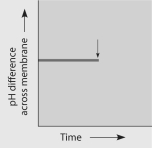
-The graph here shows the pH difference across the inner mitochondrial membrane over time in an actively respiring cell. At the time indicated by the vertical arrow, a metabolic poison is added that specifically and completely inhibits all function of mitochondrial ATP synthase. Draw what you would expect to see for the rest of the graphed line.
(Essay)
5.0/5 (66)
(66) Refer to Figure 9.1 to answer the following questions.
Figure 9.1 illustrates some of the steps (reactions) of glycolysis in their proper sequence. Each step is lettered. Use these letters to answer the questions.
-Substrate-level phosphorylation accounts for approximately what percentage of the ATP formed during glycolysis?
-Substrate-level phosphorylation accounts for approximately what percentage of the ATP formed during glycolysis? (Multiple Choice)
5.0/5 (72)
(72) Figure 9.3
-Phosphofructokinase is an allosteric enzyme that catalyzes the conversion of fructose-6-phosphate to fructose-1,6-bisphosphate, an early step of glycolysis. In the presence of oxygen, an increase in the amount ATP in a cell would be expected to
-Phosphofructokinase is an allosteric enzyme that catalyzes the conversion of fructose-6-phosphate to fructose-1,6-bisphosphate, an early step of glycolysis. In the presence of oxygen, an increase in the amount ATP in a cell would be expected to (Multiple Choice)
4.9/5 (77)
(77) Refer to Figure 9.2, showing the citric acid cycle, as a guide to answer the following questions.
-During aerobic respiration, electrons travel downhill in which sequence?
-During aerobic respiration, electrons travel downhill in which sequence? (Multiple Choice)
4.8/5 (79)
(79) Refer to Figure 9.1 to answer the following questions.
Figure 9.1 illustrates some of the steps (reactions) of glycolysis in their proper sequence. Each step is lettered. Use these letters to answer the questions.
-Which step consists of a phosphorylation reaction in which ATP is the phosphate source?
-Which step consists of a phosphorylation reaction in which ATP is the phosphate source? (Short Answer)
5.0/5 (81)
(81) Refer to Figure 9.1 to answer the following questions.
Figure 9.1 illustrates some of the steps (reactions) of glycolysis in their proper sequence. Each step is lettered. Use these letters to answer the questions.
-In which step is an inorganic phosphate added to the reactant?
-In which step is an inorganic phosphate added to the reactant? (Short Answer)
4.9/5 (85)
(85) Refer to Figure 9.1 to answer the following questions.
Figure 9.1 illustrates some of the steps (reactions) of glycolysis in their proper sequence. Each step is lettered. Use these letters to answer the questions.
-During glycolysis, when glucose is catabolized to pyruvate, most of the energy of glucose is
-During glycolysis, when glucose is catabolized to pyruvate, most of the energy of glucose is (Multiple Choice)
4.8/5 (90)
(90) Refer to Figure 9.2, showing the citric acid cycle, as a guide to answer the following questions.
-Where are the proteins of the electron transport chain located?
-Where are the proteins of the electron transport chain located? (Multiple Choice)
4.8/5 (73)
(73) 
Filters
- Essay(0)
- Multiple Choice(0)
- Short Answer(0)
- True False(0)
- Matching(0)