



 Chat with AI
Exam 55: Ecosystems and Restoration Ecology

Exam 1: Introduction: Evolution and Themes of Biology77 Questions
Exam 2: The Chemical Context of Life98 Questions
Exam 3: Water and Life92 Questions
Exam 4: Carbon and the Molecular Diversity of Life86 Questions
Exam 5: The Structure and Function of Large Biological Molecules131 Questions
Exam 6: A Tour of the Cell111 Questions
Exam 7: Membrane Structure and Function88 Questions
Exam 8: An Introduction to Metabolism92 Questions
Exam 9: Cellular Respiration and Fermentation128 Questions
Exam 10: Photosynthesis103 Questions
Exam 11: Cell Communication85 Questions
Exam 12: The Cell Cycle98 Questions
Exam 13: Meiosis and Sexual Life Cycles90 Questions
Exam 14: Mendel and the Gene Idea92 Questions
Exam 15: The Chromosomal Basis of Inheritance75 Questions
Exam 16: The Molecular Basis of Inheritance84 Questions
Exam 17: From Gene to Protein106 Questions
Exam 18: Regulation of Gene Expression116 Questions
Exam 19: Viruses71 Questions
Exam 20: DNA Tools and Biotechnology78 Questions
Exam 21: Genomes and Their Evolution64 Questions
Exam 22: Descent with Modification: A Darwinian View of Life68 Questions
Exam 23: The Evolution of Populations92 Questions
Exam 24: The Origin of Species76 Questions
Exam 25: The History of Life on Earth89 Questions
Exam 26: Phylogeny and the Tree of Life91 Questions
Exam 27: Bacteria and Archaea96 Questions
Exam 28: Protists82 Questions
Exam 29: Plant Diversity I: How Plants Colonized Land93 Questions
Exam 30: Plant Diversity II: The Evolution of Seed Plants119 Questions
Exam 31: Fungi105 Questions
Exam 32: An Overview of Animal Diversity93 Questions
Exam 33: An Introduction to Invertebrates111 Questions
Exam 34: The Origin and Evolution of Vertebrates126 Questions
Exam 35: Plant Structure,Growth,and Development82 Questions
Exam 36: Resource Acquisition and Transport in Vascular Plants100 Questions
Exam 37: Soil and Plant Nutrition99 Questions
Exam 38: Angiosperm Reproduction and Biotechnology107 Questions
Exam 39: Plant Responses to Internal and External Signals137 Questions
Exam 40: Basic Principles of Animal Form and Function98 Questions
Exam 41: Animal Nutrition87 Questions
Exam 42: Circulation and Gas Exchange112 Questions
Exam 43: The Immune System123 Questions
Exam 44: Osmoregulation and Excretion91 Questions
Exam 45: Hormones and the Endocrine System92 Questions
Exam 46: Animal Reproduction104 Questions
Exam 47: Animal Development106 Questions
Exam 48: Neurons,Synapses,and Signalling93 Questions
Exam 49: Nervous Systems85 Questions
Exam 50: Sensory and Motor Mechanisms106 Questions
Exam 51: Animal Behaviour91 Questions
Exam 52: An Introduction to Ecology and the Biosphere90 Questions
Exam 53: Population Ecology89 Questions
Exam 54: Community Ecology97 Questions
Exam 55: Ecosystems and Restoration Ecology98 Questions
Exam 56: Conservation Biology and Global Change90 Questions
Select questions type


What do researchers typically focus on when they study a particular biogeochemical cycle?
I.the nature and size of the reservoirs
II.the rate of element movement between reservoirs
III.interaction of the current cycle with other cycles
(Multiple Choice)
4.9/5  (79)
(79) Use the following food web to answer the questions below.
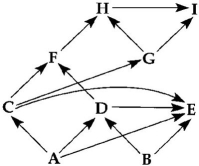 Diagram of a food web (arrows represent energy flow and letters represent species)
-If the figure above represents a marine food web,the smallest organism might be
Diagram of a food web (arrows represent energy flow and letters represent species)
-If the figure above represents a marine food web,the smallest organism might be (Multiple Choice)
4.9/5 (69)
(69) The following questions refer to the description below.
Fynbos are endemic shrubs found in the Cape province of South Africa.A small botanical region known as the Cape Floral Kingdom,is one of the richest areas in the world in terms of plant diversity.Fynbos shrubs,readily recognized by their small,hard,tough,leathery leaves,are well adapted to summer droughts,nutrient-poor soils,and periodic fires.The fynbos shrub community plays a key role in maintaining a regional supply of water.In recent decades,exotic plant species,such as acacia trees from Australia and pine trees from Europe,have been introduced to South Africa and have invaded the fynbos.Researchers are now observing that stream flow from fynbos watersheds is inversely proportional to plant biomass and natural fire cycles have changed.
-Speculate on the most likely reasons why exotic/invasive trees are disrupting the natural ecological functions of the fynbos shrub community.
1)Invasive tree species likely grow larger and faster than the shrubs and can increase the intensity and severity of fires,harming the native vegetation.
2)Invasive tree species require/utilize more water than native vegetation,decreasing stream flow.
3)Invasive trees are bigger than the native shrubs and prevent natural fires.
4)Invasive trees transpire less than the native fynbos,disrupting the hydrological cycle of the region.
5)The invasive species have a different root system and expose the area to soil erosion.
(Multiple Choice)
4.8/5 (87)
(87) Which of the following organisms is incorrectly paired with its trophic level?
(Multiple Choice)
4.8/5 (78)
(78) How is net ecosystem production (NEP)typically estimated in ecosystems?
(Multiple Choice)
4.9/5 (72)
(72) Which of these ecosystems accounts for the largest amount of Earth's net primary productivity?
(Multiple Choice)
4.9/5 (74)
(74) When levels of CO₂ are experimentally increased in a typical grassland community,C₃ plants generally respond with a greater increase in productivity than C₄ plants.This is because
(Multiple Choice)
4.8/5 (74)
(74) Which of the following lists of organisms is ranked in correct order from lowest to highest percent in production efficiency?
(Multiple Choice)
4.7/5 (81)
(81) Which of the following is primarily responsible for limiting the number of trophic levels in most ecosystems?
(Multiple Choice)
4.9/5 (80)
(80) What is the primary limiting factor for aquatic productivity?
(Multiple Choice)
4.9/5 (77)
(77) Subtraction of which of the following will convert gross primary productivity into net primary productivity?
(Multiple Choice)
4.9/5 (81)
(81) The total biomass of photosynthetic autotrophs present in an ecosystem is known as
(Multiple Choice)
5.0/5 (78)
(78) Use the following food web to answer the questions below.
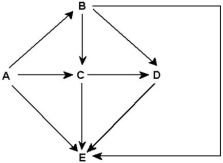 Food web for a particular terrestrial ecosystem (arrows represent energy flow and letters represent species)
-Examine this food web for a particular terrestrial ecosystem.Which pair of species could be omnivores?
Food web for a particular terrestrial ecosystem (arrows represent energy flow and letters represent species)
-Examine this food web for a particular terrestrial ecosystem.Which pair of species could be omnivores? (Multiple Choice)
4.8/5 (83)
(83) If the sun were to suddenly stop providing energy to Earth,most ecosystems would vanish.Which of the following ecosystems would likely survive the longest after this hypothetical disaster?
(Multiple Choice)
4.7/5 (85)
(85) If the flow of energy in an arctic ecosystem goes through a simple food chain,perhaps involving humans,starting from phytoplankton to zooplankton to fish to seals to polar bears,then which of the following could be true?
(Multiple Choice)
4.8/5 (74)
(74) 
Filters
- Essay(0)
- Multiple Choice(0)
- Short Answer(0)
- True False(0)
- Matching(0)