



 Chat with AI
Exam 55: Ecosystems and Restoration Ecology

Exam 1: Introduction: Evolution and Themes of Biology77 Questions
Exam 2: The Chemical Context of Life98 Questions
Exam 3: Water and Life92 Questions
Exam 4: Carbon and the Molecular Diversity of Life86 Questions
Exam 5: The Structure and Function of Large Biological Molecules131 Questions
Exam 6: A Tour of the Cell111 Questions
Exam 7: Membrane Structure and Function88 Questions
Exam 8: An Introduction to Metabolism92 Questions
Exam 9: Cellular Respiration and Fermentation128 Questions
Exam 10: Photosynthesis103 Questions
Exam 11: Cell Communication85 Questions
Exam 12: The Cell Cycle98 Questions
Exam 13: Meiosis and Sexual Life Cycles90 Questions
Exam 14: Mendel and the Gene Idea92 Questions
Exam 15: The Chromosomal Basis of Inheritance75 Questions
Exam 16: The Molecular Basis of Inheritance84 Questions
Exam 17: From Gene to Protein106 Questions
Exam 18: Regulation of Gene Expression116 Questions
Exam 19: Viruses71 Questions
Exam 20: DNA Tools and Biotechnology78 Questions
Exam 21: Genomes and Their Evolution64 Questions
Exam 22: Descent with Modification: A Darwinian View of Life68 Questions
Exam 23: The Evolution of Populations92 Questions
Exam 24: The Origin of Species76 Questions
Exam 25: The History of Life on Earth89 Questions
Exam 26: Phylogeny and the Tree of Life91 Questions
Exam 27: Bacteria and Archaea96 Questions
Exam 28: Protists82 Questions
Exam 29: Plant Diversity I: How Plants Colonized Land93 Questions
Exam 30: Plant Diversity II: The Evolution of Seed Plants119 Questions
Exam 31: Fungi105 Questions
Exam 32: An Overview of Animal Diversity93 Questions
Exam 33: An Introduction to Invertebrates111 Questions
Exam 34: The Origin and Evolution of Vertebrates126 Questions
Exam 35: Plant Structure,Growth,and Development82 Questions
Exam 36: Resource Acquisition and Transport in Vascular Plants100 Questions
Exam 37: Soil and Plant Nutrition99 Questions
Exam 38: Angiosperm Reproduction and Biotechnology107 Questions
Exam 39: Plant Responses to Internal and External Signals137 Questions
Exam 40: Basic Principles of Animal Form and Function98 Questions
Exam 41: Animal Nutrition87 Questions
Exam 42: Circulation and Gas Exchange112 Questions
Exam 43: The Immune System123 Questions
Exam 44: Osmoregulation and Excretion91 Questions
Exam 45: Hormones and the Endocrine System92 Questions
Exam 46: Animal Reproduction104 Questions
Exam 47: Animal Development106 Questions
Exam 48: Neurons,Synapses,and Signalling93 Questions
Exam 49: Nervous Systems85 Questions
Exam 50: Sensory and Motor Mechanisms106 Questions
Exam 51: Animal Behaviour91 Questions
Exam 52: An Introduction to Ecology and the Biosphere90 Questions
Exam 53: Population Ecology89 Questions
Exam 54: Community Ecology97 Questions
Exam 55: Ecosystems and Restoration Ecology98 Questions
Exam 56: Conservation Biology and Global Change90 Questions
Select questions type


Why is net primary production (NPP)a more useful measurement to an ecosystem ecologist than gross primary production (GPP)?
(Multiple Choice)
4.9/5  (88)
(88) Consider the food chain grass → grasshopper → mouse → snake → hawk.How much of the chemical energy fixed by photosynthesis of the grass (100%)is available to the hawk?
(Multiple Choice)
4.8/5 (72)
(72) Aquatic primary productivity is most limited by which of the following?
(Multiple Choice)
4.9/5 (79)
(79) Secondary consumers that can eat only primary consumers receive what percentage of the energy fixed by primary producers in a typical field ecosystem?
(Multiple Choice)
4.9/5 (66)
(66) The following questions refer to the description below.
Fynbos are endemic shrubs found in the Cape province of South Africa.A small botanical region known as the Cape Floral Kingdom,is one of the richest areas in the world in terms of plant diversity.Fynbos shrubs,readily recognized by their small,hard,tough,leathery leaves,are well adapted to summer droughts,nutrient-poor soils,and periodic fires.The fynbos shrub community plays a key role in maintaining a regional supply of water.In recent decades,exotic plant species,such as acacia trees from Australia and pine trees from Europe,have been introduced to South Africa and have invaded the fynbos.Researchers are now observing that stream flow from fynbos watersheds is inversely proportional to plant biomass and natural fire cycles have changed.
-Restoration ecology projects,including the removal of exotic species from the fynbos shrub community described above,are important because
(Multiple Choice)
4.8/5 (80)
(80) The discipline that applies ecological principles to returning degraded ecosystems to a more natural state is known as
(Multiple Choice)
5.0/5 (82)
(82) How is it that satellites can detect differences in primary productivity on Earth?
(Multiple Choice)
4.9/5 (82)
(82) Use the following figure to answer the questions below.
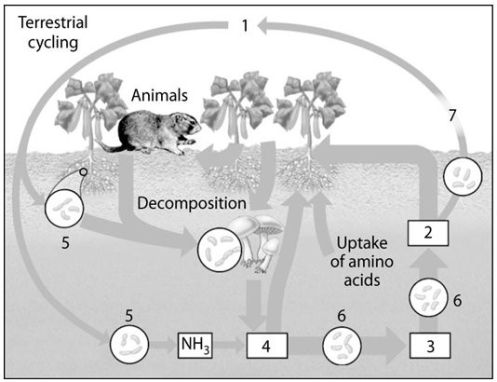 -On the diagram of the nitrogen cycle,which number represents nitrite (NO₂)?
 (Multiple Choice)
4.9/5 (79)
(79) Which of these ecosystems has the lowest net primary production per square metre?
(Multiple Choice)
4.9/5 (70)
(70) Aquatic ecosystems are least likely to be limited by which of the following nutrients?
(Multiple Choice)
4.7/5 (68)
(68) How is it that the open ocean produces the highest net primary productivity of Earth's ecosystems,yet net primary productivity per square metre is relatively low?
(Multiple Choice)
4.9/5 (91)
(91) During a year,plants never use 100% of the incoming solar radiation for photosynthesis.What is a reasonable explanation for this?
I.Plants cannot photosynthesize as well during winter (in cold winter climates).
II.Plants cannot photosynthesize as well on cloudy days.
III.The pigments that drive photosynthesis respond to only a fraction of the wavelengths that are available.
(Multiple Choice)
4.9/5 (64)
(64) How can biodiversity affect the way we decontaminate industrial sites?
I.Bacteria have been found to be able to detoxify certain chemicals; perhaps there are more.
II.Trees produce sawdust,which can be used to soak up chemicals.
III.Species evolving in contaminated areas could adapt and detoxify the area.
(Multiple Choice)
4.7/5 (81)
(81) Which statement most accurately describes how matter and energy are used in ecosystems?
(Multiple Choice)
4.9/5 (82)
(82) Which of these ecosystems has the highest net primary productivity per square metre?
(Multiple Choice)
4.8/5 (70)
(70) The law of conservation of matter states that matter cannot be created,yet matter is sometimes gained or lost to an ecosystem.What is the reason for this seeming contradiction?
(Multiple Choice)
4.9/5 (73)
(73) Suppose you are studying the nitrogen cycling in a pond ecosystem over the course of a month.While you are collecting data,a flock of 100 Canada geese lands and spends the night during a fall migration.What could you do to eliminate error in your study as a result of this event?
(Multiple Choice)
4.9/5 (81)
(81) 
Filters
- Essay(0)
- Multiple Choice(0)
- Short Answer(0)
- True False(0)
- Matching(0)