



 Chat with AI
Exam 50: Sensory and Motor Mechanisms

Exam 1: Introduction: Evolution and Themes of Biology77 Questions
Exam 2: The Chemical Context of Life98 Questions
Exam 3: Water and Life92 Questions
Exam 4: Carbon and the Molecular Diversity of Life86 Questions
Exam 5: The Structure and Function of Large Biological Molecules131 Questions
Exam 6: A Tour of the Cell111 Questions
Exam 7: Membrane Structure and Function88 Questions
Exam 8: An Introduction to Metabolism92 Questions
Exam 9: Cellular Respiration and Fermentation128 Questions
Exam 10: Photosynthesis103 Questions
Exam 11: Cell Communication85 Questions
Exam 12: The Cell Cycle98 Questions
Exam 13: Meiosis and Sexual Life Cycles90 Questions
Exam 14: Mendel and the Gene Idea92 Questions
Exam 15: The Chromosomal Basis of Inheritance75 Questions
Exam 16: The Molecular Basis of Inheritance84 Questions
Exam 17: From Gene to Protein106 Questions
Exam 18: Regulation of Gene Expression116 Questions
Exam 19: Viruses71 Questions
Exam 20: DNA Tools and Biotechnology78 Questions
Exam 21: Genomes and Their Evolution64 Questions
Exam 22: Descent with Modification: A Darwinian View of Life68 Questions
Exam 23: The Evolution of Populations92 Questions
Exam 24: The Origin of Species76 Questions
Exam 25: The History of Life on Earth89 Questions
Exam 26: Phylogeny and the Tree of Life91 Questions
Exam 27: Bacteria and Archaea96 Questions
Exam 28: Protists82 Questions
Exam 29: Plant Diversity I: How Plants Colonized Land93 Questions
Exam 30: Plant Diversity II: The Evolution of Seed Plants119 Questions
Exam 31: Fungi105 Questions
Exam 32: An Overview of Animal Diversity93 Questions
Exam 33: An Introduction to Invertebrates111 Questions
Exam 34: The Origin and Evolution of Vertebrates126 Questions
Exam 35: Plant Structure,Growth,and Development82 Questions
Exam 36: Resource Acquisition and Transport in Vascular Plants100 Questions
Exam 37: Soil and Plant Nutrition99 Questions
Exam 38: Angiosperm Reproduction and Biotechnology107 Questions
Exam 39: Plant Responses to Internal and External Signals137 Questions
Exam 40: Basic Principles of Animal Form and Function98 Questions
Exam 41: Animal Nutrition87 Questions
Exam 42: Circulation and Gas Exchange112 Questions
Exam 43: The Immune System123 Questions
Exam 44: Osmoregulation and Excretion91 Questions
Exam 45: Hormones and the Endocrine System92 Questions
Exam 46: Animal Reproduction104 Questions
Exam 47: Animal Development106 Questions
Exam 48: Neurons,Synapses,and Signalling93 Questions
Exam 49: Nervous Systems85 Questions
Exam 50: Sensory and Motor Mechanisms106 Questions
Exam 51: Animal Behaviour91 Questions
Exam 52: An Introduction to Ecology and the Biosphere90 Questions
Exam 53: Population Ecology89 Questions
Exam 54: Community Ecology97 Questions
Exam 55: Ecosystems and Restoration Ecology98 Questions
Exam 56: Conservation Biology and Global Change90 Questions
Select questions type


The hydrostatic skeleton of the earthworm allows it to move around in its environment by
(Multiple Choice)
4.9/5  (82)
(82) Among these choices,the most energetically efficient locomotion per unit mass is likely
(Multiple Choice)
4.9/5 (81)
(81) Tastes and smells are distinct kinds of environmental information in that
(Multiple Choice)
4.8/5 (78)
(78) The lumen of the transverse tubules of skeletal muscles contains
(Multiple Choice)
4.9/5 (74)
(74) Use the following figure to answer the questions below.
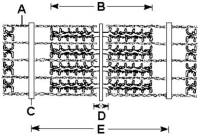 -The structure pictured in the figure is found in
 (Multiple Choice)
4.7/5 (93)
(93) The sand grains or other dense materials resting on mechanoreceptors used by most invertebrates to sense gravity are called
(Multiple Choice)
4.8/5 (86)
(86) Use the following information to answer the next few questions.
In science class,you are identifying and dissecting several fish species.In fish #1,you observe that the muscle tissue is primarily light coloured,while fish #2 has dark muscle tissue.
-What assumption can you make about fish #1?
I.The fish would fatigue quickly.
II.Muscle fibres have a large diameter.
III.Fibres have very little myoglobin.
(Multiple Choice)
4.9/5 (92)
(92) Sustained muscle contraction without relaxation between successive stimuli is called
(Multiple Choice)
4.9/5 (76)
(76) 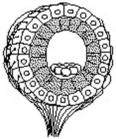 -The structure diagrammed in the figure is the
What is the function of the cochlea?
I.amplifies sound vibrations
II.collects sound pressure waves
III.detects the frequency of sounds
(Multiple Choice)
4.9/5 (78)
(78) The blind spot in the human retina is the location that has the collected axons of
(Multiple Choice)
4.9/5 (74)
(74) During the contraction of a vertebrate skeletal muscle fibre,calcium ions
(Multiple Choice)
4.9/5 (87)
(87) Use the following information to answer the questions below.
The migration path of monarch butterflies brings them from Eastern Canada to Mexico over a long,multi-generational journey.During a series of experiments in a chamber,monarchs were observed to fly in a southwest direction.When their circadian rhythms were altered by -6 and +6 hours,the monarchs flew in a southeast or northwest direction,respectively.
-Which direction would you expect the monarchs to fly if their circadian rhythm were changed by 12 hours?
(Multiple Choice)
4.9/5 (96)
(96) Use the following figure to answer the questions below.
-Myosin filaments without actin overlap are in which section of the figure?
-Myosin filaments without actin overlap are in which section of the figure? (Multiple Choice)
4.7/5 (92)
(92) Which sensory distinction is not encoded by a difference in neuron identity?
(Multiple Choice)
4.8/5 (73)
(73) 
Filters
- Essay(0)
- Multiple Choice(0)
- Short Answer(0)
- True False(0)
- Matching(0)