



 Chat with AI
Exam 50: Sensory and Motor Mechanisms

Exam 1: Introduction: Evolution and Themes of Biology77 Questions
Exam 2: The Chemical Context of Life98 Questions
Exam 3: Water and Life92 Questions
Exam 4: Carbon and the Molecular Diversity of Life86 Questions
Exam 5: The Structure and Function of Large Biological Molecules131 Questions
Exam 6: A Tour of the Cell111 Questions
Exam 7: Membrane Structure and Function88 Questions
Exam 8: An Introduction to Metabolism92 Questions
Exam 9: Cellular Respiration and Fermentation128 Questions
Exam 10: Photosynthesis103 Questions
Exam 11: Cell Communication85 Questions
Exam 12: The Cell Cycle98 Questions
Exam 13: Meiosis and Sexual Life Cycles90 Questions
Exam 14: Mendel and the Gene Idea92 Questions
Exam 15: The Chromosomal Basis of Inheritance75 Questions
Exam 16: The Molecular Basis of Inheritance84 Questions
Exam 17: From Gene to Protein106 Questions
Exam 18: Regulation of Gene Expression116 Questions
Exam 19: Viruses71 Questions
Exam 20: DNA Tools and Biotechnology78 Questions
Exam 21: Genomes and Their Evolution64 Questions
Exam 22: Descent with Modification: A Darwinian View of Life68 Questions
Exam 23: The Evolution of Populations92 Questions
Exam 24: The Origin of Species76 Questions
Exam 25: The History of Life on Earth89 Questions
Exam 26: Phylogeny and the Tree of Life91 Questions
Exam 27: Bacteria and Archaea96 Questions
Exam 28: Protists82 Questions
Exam 29: Plant Diversity I: How Plants Colonized Land93 Questions
Exam 30: Plant Diversity II: The Evolution of Seed Plants119 Questions
Exam 31: Fungi105 Questions
Exam 32: An Overview of Animal Diversity93 Questions
Exam 33: An Introduction to Invertebrates111 Questions
Exam 34: The Origin and Evolution of Vertebrates126 Questions
Exam 35: Plant Structure,Growth,and Development82 Questions
Exam 36: Resource Acquisition and Transport in Vascular Plants100 Questions
Exam 37: Soil and Plant Nutrition99 Questions
Exam 38: Angiosperm Reproduction and Biotechnology107 Questions
Exam 39: Plant Responses to Internal and External Signals137 Questions
Exam 40: Basic Principles of Animal Form and Function98 Questions
Exam 41: Animal Nutrition87 Questions
Exam 42: Circulation and Gas Exchange112 Questions
Exam 43: The Immune System123 Questions
Exam 44: Osmoregulation and Excretion91 Questions
Exam 45: Hormones and the Endocrine System92 Questions
Exam 46: Animal Reproduction104 Questions
Exam 47: Animal Development106 Questions
Exam 48: Neurons,Synapses,and Signalling93 Questions
Exam 49: Nervous Systems85 Questions
Exam 50: Sensory and Motor Mechanisms106 Questions
Exam 51: Animal Behaviour91 Questions
Exam 52: An Introduction to Ecology and the Biosphere90 Questions
Exam 53: Population Ecology89 Questions
Exam 54: Community Ecology97 Questions
Exam 55: Ecosystems and Restoration Ecology98 Questions
Exam 56: Conservation Biology and Global Change90 Questions
Select questions type


It can be very difficult to select an angle for sneaking up to a grasshopper to catch it because grasshoppers have
(Multiple Choice)
5.0/5  (76)
(76) Use the following information to answer the next few questions.
In science class,you are identifying and dissecting several fish species.In fish #1,you observe that the muscle tissue is primarily light coloured,while fish #2 has dark muscle tissue.
-What assumption can you make about the swimming behaviour of fish #2?
(Multiple Choice)
4.8/5 (72)
(72) Which of the following is the correct sequence that describes the excitation and contraction of a skeletal muscle fibre?
1)Tropomyosin shifts and unblocks the cross-bridge binding sites.
2)Calcium is released and binds to the troponin complex.
3)Transverse tubules depolarize the sarcoplasmic reticulum.
4)The thin filaments are ratcheted across the thick filaments by the heads of the myosin molecules using energy from ATP.
5)An action potential in a motor neuron causes the axon to release acetylcholine,which depolarizes the muscle cell membrane.
(Multiple Choice)
4.9/5 (85)
(85) A patient is hospitalized with muscle spasms caused by failure of back muscles to relax after contraction.Which of the following would be most likely to help?
(Multiple Choice)
4.8/5 (80)
(80) The following questions refer to this diagram of the ear.
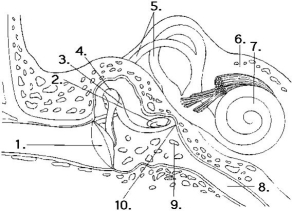 -Hair cells are found in structures represented by numbers
 (Multiple Choice)
4.8/5 (82)
(82) Choose the correct sequence of the following events leading to the sensory processing of a stimulus.
1)transmission
2)transduction
3)integration
4)amplification
(Multiple Choice)
5.0/5 (69)
(69) The generation of action potentials in olfactory neurons initiated by odours drawn in the nasal cavity is an example of
(Multiple Choice)
4.9/5 (81)
(81) Use the following figure to answer the questions below.
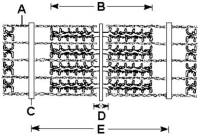 -Overlapping actin and myosin filaments are found in which section of the figure?
 (Multiple Choice)
4.9/5 (85)
(85) Skeletal muscle contraction begins when calcium ions bind to
(Multiple Choice)
4.9/5 (91)
(91) If you experimentally reduce the concentration of K⁺ in the extracellular fluid surrounding hair cells in the inner ear,the result would be like which of the following?
(Multiple Choice)
4.8/5 (87)
(87) Which of the following are present in high densities in both smooth and skeletal muscle cells?
I.cilia
II.mitochondria
III.nuclei
IV.endoplasmic reticulum
(Multiple Choice)
4.8/5 (85)
(85) How could you modify an animal so that it would distinguish more shades of green?
(Multiple Choice)
4.8/5 (69)
(69) Calcium ions regulate contraction of smooth muscle cells by binding to
(Multiple Choice)
4.7/5 (91)
(91) The cochlea is an organ of auditory transduction that contains
(Multiple Choice)
4.8/5 (71)
(71) Use the following information to answer the question(s) below.
"Marine cone snails from the genus Conus are estimated to consist of up to 700 species.These predatory molluscs have devised an efficient venom apparatus that allows them to successfully capture polychaete worms,other molluscs,or in some cases fish as their primary food sources.… conotoxins from Australian species of Conus … have the capacity to inhibit specifically the nicotinic acetylcholine receptors in higher animals." (B.G.Livett,K.R.Gayler,and Z.Khalil.2004.Drugs from the sea: Conopeptides as potential therapeutics.Current Medicinal Chemistry 11:1715-23.)
-What is the adaptive value of this toxin?
I.It would cause muscle spasms in the prey.
II.It would result in paralysis of the skeletal muscle of the prey.
III.It would stimulate digestive tract smooth muscle to cause nausea and vomiting of the prey.
(Multiple Choice)
4.7/5 (86)
(86) Although some sharks close their eyes just before they bite,their bites are on target.Researchers have noted that sharks often misdirect their bites at metal objects and that they can find batteries buried under sand.This evidence suggests that sharks keep track of their prey during the split second before they bite in the same way that
(Multiple Choice)
4.7/5 (75)
(75) 
Filters
- Essay(0)
- Multiple Choice(0)
- Short Answer(0)
- True False(0)
- Matching(0)