



 Chat with AI
Exam 21: Genomes and Their Evolution

Exam 1: Introduction: Evolution and Themes of Biology77 Questions
Exam 2: The Chemical Context of Life98 Questions
Exam 3: Water and Life92 Questions
Exam 4: Carbon and the Molecular Diversity of Life86 Questions
Exam 5: The Structure and Function of Large Biological Molecules131 Questions
Exam 6: A Tour of the Cell111 Questions
Exam 7: Membrane Structure and Function88 Questions
Exam 8: An Introduction to Metabolism92 Questions
Exam 9: Cellular Respiration and Fermentation128 Questions
Exam 10: Photosynthesis103 Questions
Exam 11: Cell Communication85 Questions
Exam 12: The Cell Cycle98 Questions
Exam 13: Meiosis and Sexual Life Cycles90 Questions
Exam 14: Mendel and the Gene Idea92 Questions
Exam 15: The Chromosomal Basis of Inheritance75 Questions
Exam 16: The Molecular Basis of Inheritance84 Questions
Exam 17: From Gene to Protein106 Questions
Exam 18: Regulation of Gene Expression116 Questions
Exam 19: Viruses71 Questions
Exam 20: DNA Tools and Biotechnology78 Questions
Exam 21: Genomes and Their Evolution64 Questions
Exam 22: Descent with Modification: A Darwinian View of Life68 Questions
Exam 23: The Evolution of Populations92 Questions
Exam 24: The Origin of Species76 Questions
Exam 25: The History of Life on Earth89 Questions
Exam 26: Phylogeny and the Tree of Life91 Questions
Exam 27: Bacteria and Archaea96 Questions
Exam 28: Protists82 Questions
Exam 29: Plant Diversity I: How Plants Colonized Land93 Questions
Exam 30: Plant Diversity II: The Evolution of Seed Plants119 Questions
Exam 31: Fungi105 Questions
Exam 32: An Overview of Animal Diversity93 Questions
Exam 33: An Introduction to Invertebrates111 Questions
Exam 34: The Origin and Evolution of Vertebrates126 Questions
Exam 35: Plant Structure,Growth,and Development82 Questions
Exam 36: Resource Acquisition and Transport in Vascular Plants100 Questions
Exam 37: Soil and Plant Nutrition99 Questions
Exam 38: Angiosperm Reproduction and Biotechnology107 Questions
Exam 39: Plant Responses to Internal and External Signals137 Questions
Exam 40: Basic Principles of Animal Form and Function98 Questions
Exam 41: Animal Nutrition87 Questions
Exam 42: Circulation and Gas Exchange112 Questions
Exam 43: The Immune System123 Questions
Exam 44: Osmoregulation and Excretion91 Questions
Exam 45: Hormones and the Endocrine System92 Questions
Exam 46: Animal Reproduction104 Questions
Exam 47: Animal Development106 Questions
Exam 48: Neurons,Synapses,and Signalling93 Questions
Exam 49: Nervous Systems85 Questions
Exam 50: Sensory and Motor Mechanisms106 Questions
Exam 51: Animal Behaviour91 Questions
Exam 52: An Introduction to Ecology and the Biosphere90 Questions
Exam 53: Population Ecology89 Questions
Exam 54: Community Ecology97 Questions
Exam 55: Ecosystems and Restoration Ecology98 Questions
Exam 56: Conservation Biology and Global Change90 Questions
Select questions type


Using modern techniques of sequencing by synthesis and the shotgun approach,how are sequences assembled into chromosomes?
(Multiple Choice)
4.7/5  (83)
(83) What is most likely if genes from different species are determined to be homologous?
(Multiple Choice)
4.8/5 (83)
(83) The biggest problem with the shotgun technique is its tendency to underestimate the size of the genome.Which of the following might best account for this?
(Multiple Choice)
4.9/5 (68)
(68) Use the following figure to answer the next few questions.
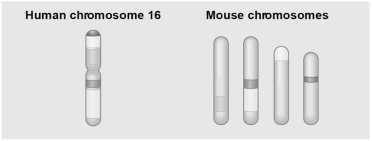 This figure shows a diagram of blocks of genes on human chromosome 16 and the locations of blocks of similar genes on four chromosomes of the mouse.
-Several of the different globin genes are expressed in humans,but at different times in development.What mechanism could allow for this?
This figure shows a diagram of blocks of genes on human chromosome 16 and the locations of blocks of similar genes on four chromosomes of the mouse.
-Several of the different globin genes are expressed in humans,but at different times in development.What mechanism could allow for this? (Multiple Choice)
4.9/5 (94)
(94) If genome size varies,with humans at 2900 Mb,a specific member of the lily family at 120 000 Mb,and a yeast at 13 Mb,what does this tell us?
(Multiple Choice)
4.9/5 (83)
(83) Use the following information to answer the questions below.
You have isolated a gene sequence from the mustard plant Arabidopsis and have BLAST searched the NCBI database.Your sequence hit several EST sequences that were identified as transcription factors.These sequences were found in E.coli,Chlamydomonas (a green algae),yeast,mice,and humans and only had a few base pair differences.
-What can be said about this sequence?
(Multiple Choice)
4.7/5 (77)
(77) The α-globin and β-globin gene families are found on different chromosomes in humans.What is the suspected reason for this?
(Multiple Choice)
4.9/5 (78)
(78) A consortium of 25 Canadian scientists,led by Dr.Rudnicki at the University of Ottawa,is looking at gene expression in both ________ cells.This is important in understanding regenerative medicine.
(Multiple Choice)
5.0/5 (87)
(87) How do transposable elements and short tandem repeats (STRs)differ?
(Multiple Choice)
4.8/5 (90)
(90) The large common repository for genetic sequences hosted by NCBI is called
(Multiple Choice)
4.9/5 (81)
(81) Fragments of DNA have been extracted from the remnants of extinct woolly mammoths,amplified,and sequenced.These can now be used to
(Multiple Choice)
4.8/5 (79)
(79) Which of the following studies would not likely be characterized as evo-devo?
(Multiple Choice)
4.9/5 (77)
(77) Why might the cricket genome have 11 times as many base pairs as that of Drosophila melanogaster?
(Multiple Choice)
4.9/5 (84)
(84) Alu elements account for about 10% of the human genome.What are Alu elements?
(Multiple Choice)
5.0/5 (76)
(76) Use the following information to answer the questions below.
You have isolated a gene sequence from the mustard plant Arabidopsis and have BLAST searched the NCBI database.Your sequence hit several EST sequences that were identified as transcription factors.These sequences were found in E.coli,Chlamydomonas (a green algae),yeast,mice,and humans and only had a few base pair differences.
-When you compared your sequence to the database,what were you practising?
(Multiple Choice)
4.8/5 (72)
(72) Bioinformatics can be used to scan sequences for probable genes looking for start and stop sites for transcription and for translation,for probable splice sites,and for sequences that specify known mRNAs.Such sequences containing these elements are called
(Multiple Choice)
4.7/5 (92)
(92) A project initiated at the University of Guelph is attempting to catalogue the differences of a short sequence within the mitochondrial DNA in all animal species.This ________ should allow the quick identification of a species.
(Multiple Choice)
4.8/5 (72)
(72) The comparison between the number of human genes and those of other animal species has led to many conclusions,including
(Multiple Choice)
4.7/5 (64)
(64) 
Filters
- Essay(0)
- Multiple Choice(0)
- Short Answer(0)
- True False(0)
- Matching(0)