



 Chat with AI
Exam 4: Carbon and the Molecular Diversity of Life

Exam 1: Introduction: Evolution and Themes of Biology77 Questions
Exam 2: The Chemical Context of Life98 Questions
Exam 3: Water and Life92 Questions
Exam 4: Carbon and the Molecular Diversity of Life86 Questions
Exam 5: The Structure and Function of Large Biological Molecules131 Questions
Exam 6: A Tour of the Cell111 Questions
Exam 7: Membrane Structure and Function88 Questions
Exam 8: An Introduction to Metabolism92 Questions
Exam 9: Cellular Respiration and Fermentation128 Questions
Exam 10: Photosynthesis103 Questions
Exam 11: Cell Communication85 Questions
Exam 12: The Cell Cycle98 Questions
Exam 13: Meiosis and Sexual Life Cycles90 Questions
Exam 14: Mendel and the Gene Idea92 Questions
Exam 15: The Chromosomal Basis of Inheritance75 Questions
Exam 16: The Molecular Basis of Inheritance84 Questions
Exam 17: From Gene to Protein106 Questions
Exam 18: Regulation of Gene Expression116 Questions
Exam 19: Viruses71 Questions
Exam 20: DNA Tools and Biotechnology78 Questions
Exam 21: Genomes and Their Evolution64 Questions
Exam 22: Descent with Modification: A Darwinian View of Life68 Questions
Exam 23: The Evolution of Populations92 Questions
Exam 24: The Origin of Species76 Questions
Exam 25: The History of Life on Earth89 Questions
Exam 26: Phylogeny and the Tree of Life91 Questions
Exam 27: Bacteria and Archaea96 Questions
Exam 28: Protists82 Questions
Exam 29: Plant Diversity I: How Plants Colonized Land93 Questions
Exam 30: Plant Diversity II: The Evolution of Seed Plants119 Questions
Exam 31: Fungi105 Questions
Exam 32: An Overview of Animal Diversity93 Questions
Exam 33: An Introduction to Invertebrates111 Questions
Exam 34: The Origin and Evolution of Vertebrates126 Questions
Exam 35: Plant Structure,Growth,and Development82 Questions
Exam 36: Resource Acquisition and Transport in Vascular Plants100 Questions
Exam 37: Soil and Plant Nutrition99 Questions
Exam 38: Angiosperm Reproduction and Biotechnology107 Questions
Exam 39: Plant Responses to Internal and External Signals137 Questions
Exam 40: Basic Principles of Animal Form and Function98 Questions
Exam 41: Animal Nutrition87 Questions
Exam 42: Circulation and Gas Exchange112 Questions
Exam 43: The Immune System123 Questions
Exam 44: Osmoregulation and Excretion91 Questions
Exam 45: Hormones and the Endocrine System92 Questions
Exam 46: Animal Reproduction104 Questions
Exam 47: Animal Development106 Questions
Exam 48: Neurons,Synapses,and Signalling93 Questions
Exam 49: Nervous Systems85 Questions
Exam 50: Sensory and Motor Mechanisms106 Questions
Exam 51: Animal Behaviour91 Questions
Exam 52: An Introduction to Ecology and the Biosphere90 Questions
Exam 53: Population Ecology89 Questions
Exam 54: Community Ecology97 Questions
Exam 55: Ecosystems and Restoration Ecology98 Questions
Exam 56: Conservation Biology and Global Change90 Questions
Select questions type


A carbon atom is most likely to form what kind of bond(s)with other atoms?
(Multiple Choice)
4.9/5  (76)
(76) Of the biologically important functional groups listed below,which acts as a base?
(Multiple Choice)
4.7/5 (76)
(76) Which pair of molecules shown below are not enantiomers of a single molecule?
(Multiple Choice)
4.9/5 (75)
(75) How many structural isomers are possible for a substance having the molecular formula C₄H₁₀?
(Multiple Choice)
4.8/5 (74)
(74) Use the following information to answer the questions below.
You are investigating the differences between three organic compounds.They all have the same carbon skeleton but have differences in their functional groups.
-You test for hydrophobicity and observe that one molecule type is extremely hydrophobic.Which of the following is the best possible conclusion?
(Multiple Choice)
4.7/5 (82)
(82) Testosterone and estradiol are male and female sex hormones,respectively,in many vertebrates.In what way(s)do these molecules differ from each other?
(Multiple Choice)
4.9/5 (71)
(71) Of the biologically important functional groups listed below,which is hydrophobic and can make cross-bridges?
(Multiple Choice)
4.8/5 (91)
(91) Use the following figure to answer the questions below.
 -Which functional group(s)shown above is (are)present in all amino acids?
 (Multiple Choice)
4.9/5 (81)
(81) A carbon skeleton is covalently bonded to both an amino group and a carboxyl group.When placed in water,it
(Multiple Choice)
5.0/5 (88)
(88) Use the following figure to answer the questions below.
 -A chemist wishes to make an organic molecule less acidic.Which of the following functional groups should be added to the molecule in order to do so?
 (Multiple Choice)
4.8/5 (78)
(78) Use the following figure to answer the questions below.
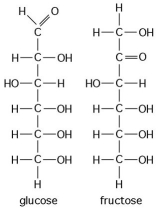 -The figure above shows the structures of glucose and fructose.These two molecules differ in the
 (Multiple Choice)
4.9/5 (92)
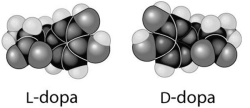
(92) D-dopa and L-dopa,shown below,are examples of pharmaceutical drugs that occur as enantiomers,or molecules that ________.
(Multiple Choice)
4.8/5 (67)
(67) Use the following figure to answer the questions below.
-Which of the groups shown above is a functional group that helps stabilize proteins by forming covalent cross-links within or between protein molecules?
-Which of the groups shown above is a functional group that helps stabilize proteins by forming covalent cross-links within or between protein molecules? (Multiple Choice)
4.9/5 (85)
(85) Use the following figure to answer the questions below.
 -Which molecule shown above has a carbonyl functional group in the form of a ketone?
 (Multiple Choice)
4.9/5 (77)
(77) Use the following figure to answer the questions below.
-Which of the groups above is an acidic functional group that can dissociate and release H⁺ into a solution?
-Which of the groups above is an acidic functional group that can dissociate and release H⁺ into a solution? (Multiple Choice)
4.8/5 (60)
(60) Which of the pairs of molecular structures shown below depict enantiomers (enantiomeric forms)of the same molecule?
(Multiple Choice)
4.8/5 (88)
(88) When Stanley Miller applied heat and electrical sparks to a mixture of simple inorganic compounds such as methane,hydrogen gas,ammonia,and water vapour,what compounds were produced?
(Multiple Choice)
4.9/5 (80)
(80) 
Filters
- Essay(0)
- Multiple Choice(0)
- Short Answer(0)
- True False(0)
- Matching(0)