



 Chat with AI
Exam 2: The Chemical Context of Life

Exam 1: Introduction: Evolution and Themes of Biology77 Questions
Exam 2: The Chemical Context of Life98 Questions
Exam 3: Water and Life92 Questions
Exam 4: Carbon and the Molecular Diversity of Life86 Questions
Exam 5: The Structure and Function of Large Biological Molecules131 Questions
Exam 6: A Tour of the Cell111 Questions
Exam 7: Membrane Structure and Function88 Questions
Exam 8: An Introduction to Metabolism92 Questions
Exam 9: Cellular Respiration and Fermentation128 Questions
Exam 10: Photosynthesis103 Questions
Exam 11: Cell Communication85 Questions
Exam 12: The Cell Cycle98 Questions
Exam 13: Meiosis and Sexual Life Cycles90 Questions
Exam 14: Mendel and the Gene Idea92 Questions
Exam 15: The Chromosomal Basis of Inheritance75 Questions
Exam 16: The Molecular Basis of Inheritance84 Questions
Exam 17: From Gene to Protein106 Questions
Exam 18: Regulation of Gene Expression116 Questions
Exam 19: Viruses71 Questions
Exam 20: DNA Tools and Biotechnology78 Questions
Exam 21: Genomes and Their Evolution64 Questions
Exam 22: Descent with Modification: A Darwinian View of Life68 Questions
Exam 23: The Evolution of Populations92 Questions
Exam 24: The Origin of Species76 Questions
Exam 25: The History of Life on Earth89 Questions
Exam 26: Phylogeny and the Tree of Life91 Questions
Exam 27: Bacteria and Archaea96 Questions
Exam 28: Protists82 Questions
Exam 29: Plant Diversity I: How Plants Colonized Land93 Questions
Exam 30: Plant Diversity II: The Evolution of Seed Plants119 Questions
Exam 31: Fungi105 Questions
Exam 32: An Overview of Animal Diversity93 Questions
Exam 33: An Introduction to Invertebrates111 Questions
Exam 34: The Origin and Evolution of Vertebrates126 Questions
Exam 35: Plant Structure,Growth,and Development82 Questions
Exam 36: Resource Acquisition and Transport in Vascular Plants100 Questions
Exam 37: Soil and Plant Nutrition99 Questions
Exam 38: Angiosperm Reproduction and Biotechnology107 Questions
Exam 39: Plant Responses to Internal and External Signals137 Questions
Exam 40: Basic Principles of Animal Form and Function98 Questions
Exam 41: Animal Nutrition87 Questions
Exam 42: Circulation and Gas Exchange112 Questions
Exam 43: The Immune System123 Questions
Exam 44: Osmoregulation and Excretion91 Questions
Exam 45: Hormones and the Endocrine System92 Questions
Exam 46: Animal Reproduction104 Questions
Exam 47: Animal Development106 Questions
Exam 48: Neurons,Synapses,and Signalling93 Questions
Exam 49: Nervous Systems85 Questions
Exam 50: Sensory and Motor Mechanisms106 Questions
Exam 51: Animal Behaviour91 Questions
Exam 52: An Introduction to Ecology and the Biosphere90 Questions
Exam 53: Population Ecology89 Questions
Exam 54: Community Ecology97 Questions
Exam 55: Ecosystems and Restoration Ecology98 Questions
Exam 56: Conservation Biology and Global Change90 Questions
Select questions type


Carbon-12 is the most common isotope of carbon,and has an atomic mass of 12 daltons.A mole of carbon in naturally occurring coal,however,weighs slightly more than 12 grams.Why?
(Multiple Choice)
5.0/5  (64)
(64) Knowing just the atomic mass of an element allows inferences about which of the following?
(Multiple Choice)
4.7/5 (75)
(75) Which of the following best describes the relationship between the atoms described below?
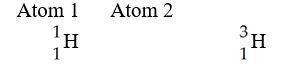
(Multiple Choice)
4.7/5 (87)
(87) The atomic number of nitrogen is 7.Nitrogen-15 is heavier than nitrogen-14 because the atomic nucleus of nitrogen-15 contains how many neutrons?
(Multiple Choice)
4.8/5 (74)
(74) Which of the following correctly describes chemical equilibrium?
(Multiple Choice)
4.9/5 (75)
(75) Electrons exist only at fixed levels of potential energy.However,if an atom absorbs sufficient energy,a possible result is that
(Multiple Choice)
4.8/5 (73)
(73) Which of the following molecules contains the most polar covalent bond?
(Multiple Choice)
4.8/5 (81)
(81) Use the following information to answer the questions below.
You are investigating how chemical reactions occur.You place two reactants together and measure the concentration of product at regular intervals.After a time,the amount of product becomes stable.
-If you add more product to the solution,you would expect to see
(Multiple Choice)
4.9/5 (85)
(85) What results from an unequal sharing of electrons between atoms?
(Multiple Choice)
4.9/5 (68)
(68) The organic molecules in living organisms have a measurably lower ratio of carbon-13/carbon-12,two stable isotopes of carbon that comprise approximately 1.1% and 98.9% of atmospheric carbon,respectively.What is a reasonable explanation for this phenomenon?
(Multiple Choice)
4.7/5 (87)
(87) What is the difference between covalent bonds and ionic bonds?
(Multiple Choice)
4.9/5 (91)
(91) The three types of subatomic particles pertinent to the study of biology are
(Multiple Choice)
4.9/5 (77)
(77) Which of the following statements correctly describes any chemical reaction that has reached equilibrium?
(Multiple Choice)
5.0/5 (80)
(80) The precise weight of a mole of some pure elements like silicon (Si)can vary slightly from the standard atomic mass,or even from sample to sample.Why?
(Multiple Choice)
4.9/5 (74)
(74) What is the maximum number of electrons in a single 2 p orbital of an atom?
(Multiple Choice)
4.8/5 (72)
(72) 
Filters
- Essay(0)
- Multiple Choice(0)
- Short Answer(0)
- True False(0)
- Matching(0)