



 Chat with AI
Exam 17: Genomes

Exam 1: Studying Life 97 Questions
Exam 2: Small Molecules and the Chemistry of Life145 Questions
Exam 3: Proteins, Carbohydrates, and Lipids145 Questions
Exam 4: Nucleic Acids and the Origin of Life117 Questions
Exam 5: Cells: the Working Units of Life153 Questions
Exam 6: Cell Membranes136 Questions
Exam 7: Cell Signaling and Communication150 Questions
Exam 8: Energy, Enzymes, and Metabolism153 Questions
Exam 9: Pathways That Harvest Chemical Energy154 Questions
Exam 10: Photosynthesis: Energy From Sunlight158 Questions
Exam 11: The Cell Cycle and Cell Division176 Questions
Exam 12: Inheritance, Genes, and Chromosomes150 Questions
Exam 13: Dna and Its Role in Heredity155 Questions
Exam 14: From Dna to Protein: Gene Expression151 Questions
Exam 15: Gene Mutation and Molecular Medicine141 Questions
Exam 16: Regulation of Gene Expression151 Questions
Exam 17: Genomes145 Questions
Exam 18: Recombinent Dna and Biotechnology141 Questions
Exam 19: Differential Gene Expression in Development147 Questions
Exam 20: Development and Evolutionary Change120 Questions
Exam 21: Evidence and Mechanisms of Evolution151 Questions
Exam 22: Reconstructing and Using Phylogenies137 Questions
Exam 23: Species and Their Formation140 Questions
Exam 24: Evolution of Genes and Genomes141 Questions
Exam 25: The History of Life on Earth145 Questions
Exam 26: Bacteria and Archaea: the Prokaryotic Domains156 Questions
Exam 27: The Origin and Diversification of Eukaryotes148 Questions
Exam 28: Plants Without Seeds: From Water to Land144 Questions
Exam 29: The Evolution of Seed Plants141 Questions
Exam 30: Fungi: Recyclers, Pathogens, Parasites, and Plant Partners144 Questions
Exam 31: Animal Origins and the Evolution of Body Plans122 Questions
Exam 32: Protostome Animals146 Questions
Exam 33: Deuterostome Animals150 Questions
Exam 34: The Plant Body132 Questions
Exam 35: Transport in Plants133 Questions
Exam 36: Plant Nutrition134 Questions
Exam 37: Regulation of Plant Growth137 Questions
Exam 38: Reproduction in Flowering Plants140 Questions
Exam 39: Plant Responses to Environmental Challenges131 Questions
Exam 40: Physiology, Homeostasis, and Temperature Regulation146 Questions
Exam 41: Animal Hormones147 Questions
Exam 42: Immunology: Animal Defense Systems150 Questions
Exam 43: Animal Reproduction150 Questions
Exam 44: Animal Development147 Questions
Exam 45: Neurons and Nervous Systems145 Questions
Exam 46: Sensory Systems150 Questions
Exam 47: The Mammalian Nervous System: Structure and Higher Function150 Questions
Exam 48: Musculoskeletal Systems150 Questions
Exam 49: Gas Exchange in Animals149 Questions
Exam 50: Circulatory Systems150 Questions
Exam 51: Nutrition, Digestion, and Absorption149 Questions
Exam 52: Salt and Water Balance and Nitrogen145 Questions
Exam 53: Animal Behavior149 Questions
Exam 54: Ecology and the Distribution of Life150 Questions
Exam 55: Population Ecology123 Questions
Exam 56: Species Interaction and Coevolution131 Questions
Exam 57: Community Ecology133 Questions
Exam 58: Ecosystems and Global Ecology142 Questions
Exam 59: Conservation Biology116 Questions
Select questions type


In August 2009, researchers announced the discovery that the success or failure of current treatments for hepatitis C is determined to a large extent by variants of the IL28B gene. This important finding is an example of the discoveries coming from the field of _______.
(Short Answer)
4.8/5  (90)
(90) The first free-living organism to have its complete genome sequenced was
(Multiple Choice)
4.7/5 (77)
(77) The most striking difference between the genomes of E. coli and S. cerevisae is that the yeast genome contains many more genes devoted to
(Multiple Choice)
4.9/5 (82)
(82) Use the following to answer questions
The diagram below shows the use of transposons as mutagens.
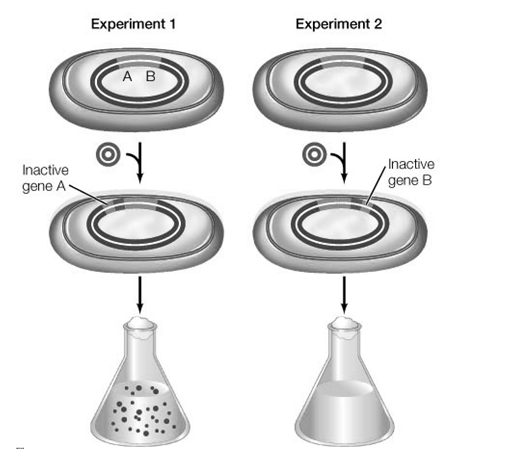 -Studies like those shown in the diagram would be most useful for questions related to
 (Multiple Choice)
4.9/5 (71)
(71) The usefulness of genomic scans for determining the likelihood that a person will eventually develop diabetes is limited because
(Multiple Choice)
4.8/5 (83)
(83) Suppose you use a radioactively labeled DNA probe to identify a DNA fragment from an EcoRI digestion of human DNA. When you complete your hybridization, you notice that the probe has hybridized to several different fragments in the DNA sample. How would you explain this result?
(Essay)
4.9/5 (78)
(78) The genes that encode estrogen receptors and those that encode adrenal steroid receptors evolved from an ancestral gene hundreds of millions of years ago. These genes are an example of a gene _______.
(Short Answer)
4.7/5 (80)
(80) Which of the following is least likely to be associated with metagenomics?
(Multiple Choice)
4.9/5 (76)
(76) Which of the following is used in massively parallel DNA sequencing but not in conventional sequencing?
(Multiple Choice)
4.9/5 (73)
(73) Eukaryotic protein-coding genes differ from their prokaryotic counterparts in that eukaryotic genes
(Multiple Choice)
4.9/5 (77)
(77) Which of the following was not a component of the sequencing of the human genome?
(Multiple Choice)
4.7/5 (76)
(76) Genomic information can be stored in a _______, which is a collection of many different cloned fragments of the genome.
(Short Answer)
4.9/5 (75)
(75) A piece of DNA that is 3 kb in length is found in many locations throughout the genome. How would you decide whether this was a LINE or a DNA transposon?
(Multiple Choice)
4.7/5 (74)
(74) What percentage of the human genome is DNA that codes for proteins?
(Multiple Choice)
4.9/5 (79)
(79) Segments of DNA that can move from place to place in the genome are collectively known as _______.
(Short Answer)
4.8/5 (78)
(78) Highly repetitive sequences are often found in the transcriptionally inactive and densely packed region of a chromosome called _______.
(Short Answer)
4.9/5 (77)
(77) Which of the following diseases is most unlike the others with respect to its genetic basis?
(Multiple Choice)
4.8/5 (77)
(77) 
Filters
- Essay(0)
- Multiple Choice(0)
- Short Answer(0)
- True False(0)
- Matching(0)