



 Chat with AI
Exam 55: Population Ecology

Exam 1: Studying Life 97 Questions
Exam 2: Small Molecules and the Chemistry of Life145 Questions
Exam 3: Proteins, Carbohydrates, and Lipids145 Questions
Exam 4: Nucleic Acids and the Origin of Life117 Questions
Exam 5: Cells: the Working Units of Life153 Questions
Exam 6: Cell Membranes136 Questions
Exam 7: Cell Signaling and Communication150 Questions
Exam 8: Energy, Enzymes, and Metabolism153 Questions
Exam 9: Pathways That Harvest Chemical Energy154 Questions
Exam 10: Photosynthesis: Energy From Sunlight158 Questions
Exam 11: The Cell Cycle and Cell Division176 Questions
Exam 12: Inheritance, Genes, and Chromosomes150 Questions
Exam 13: Dna and Its Role in Heredity155 Questions
Exam 14: From Dna to Protein: Gene Expression151 Questions
Exam 15: Gene Mutation and Molecular Medicine141 Questions
Exam 16: Regulation of Gene Expression151 Questions
Exam 17: Genomes145 Questions
Exam 18: Recombinent Dna and Biotechnology141 Questions
Exam 19: Differential Gene Expression in Development147 Questions
Exam 20: Development and Evolutionary Change120 Questions
Exam 21: Evidence and Mechanisms of Evolution151 Questions
Exam 22: Reconstructing and Using Phylogenies137 Questions
Exam 23: Species and Their Formation140 Questions
Exam 24: Evolution of Genes and Genomes141 Questions
Exam 25: The History of Life on Earth145 Questions
Exam 26: Bacteria and Archaea: the Prokaryotic Domains156 Questions
Exam 27: The Origin and Diversification of Eukaryotes148 Questions
Exam 28: Plants Without Seeds: From Water to Land144 Questions
Exam 29: The Evolution of Seed Plants141 Questions
Exam 30: Fungi: Recyclers, Pathogens, Parasites, and Plant Partners144 Questions
Exam 31: Animal Origins and the Evolution of Body Plans122 Questions
Exam 32: Protostome Animals146 Questions
Exam 33: Deuterostome Animals150 Questions
Exam 34: The Plant Body132 Questions
Exam 35: Transport in Plants133 Questions
Exam 36: Plant Nutrition134 Questions
Exam 37: Regulation of Plant Growth137 Questions
Exam 38: Reproduction in Flowering Plants140 Questions
Exam 39: Plant Responses to Environmental Challenges131 Questions
Exam 40: Physiology, Homeostasis, and Temperature Regulation146 Questions
Exam 41: Animal Hormones147 Questions
Exam 42: Immunology: Animal Defense Systems150 Questions
Exam 43: Animal Reproduction150 Questions
Exam 44: Animal Development147 Questions
Exam 45: Neurons and Nervous Systems145 Questions
Exam 46: Sensory Systems150 Questions
Exam 47: The Mammalian Nervous System: Structure and Higher Function150 Questions
Exam 48: Musculoskeletal Systems150 Questions
Exam 49: Gas Exchange in Animals149 Questions
Exam 50: Circulatory Systems150 Questions
Exam 51: Nutrition, Digestion, and Absorption149 Questions
Exam 52: Salt and Water Balance and Nitrogen145 Questions
Exam 53: Animal Behavior149 Questions
Exam 54: Ecology and the Distribution of Life150 Questions
Exam 55: Population Ecology123 Questions
Exam 56: Species Interaction and Coevolution131 Questions
Exam 57: Community Ecology133 Questions
Exam 58: Ecosystems and Global Ecology142 Questions
Exam 59: Conservation Biology116 Questions
Select questions type


A group of individuals born at the same time is known as a

Free
(Multiple Choice)
4.9/5  (74)
(74) Correct Answer: Verified
D
How do the demographic traits of fish and whales influence how these marine resources respond to overexploitation?
Free
(Essay)
4.9/5 (84)
(84) Correct Answer:Verified
VerifiedAlthough stocks of many fish and many whale species have been overexploited, the recovery of fish populations is potentially faster because most species of fish have high reproductive capacities. In contrast, whales, as marine mammals, reproduce at very low rates, and therefore recover more slowly from overexploitation (see Figure 55.13).
Which of the following statements about the intrinsic rate of increase is false?
Free
(Multiple Choice)
4.8/5 (94)
(94) Correct Answer:Verified
VerifiedC
If the birth rate is 0.05 and the death rate is 0.02, the intrinsic rate of increase (assuming that there is no immigration or emigration)
(Multiple Choice)
4.8/5 (80)
(80) Use the following to answer questions:
Suppose that of 300 mice in a mice colony born in January, 150 are still alive at the start of September, and 120 are still alive at the start of October.
-What is the survivorship up to the start of September?
(Multiple Choice)
4.8/5 (87)
(87) Use the following to answer questions :
Refer to the graph below. 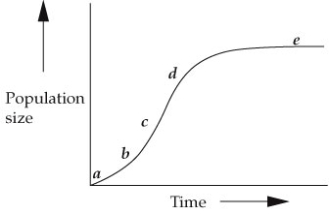 -At which point in the graph would there be zero population growth (dN/dt = 0)?
 (Short Answer)
4.8/5 (80)
(80) When a single bacterium is placed in a culture vessel, the resulting population at first grows very quickly; however, as the population expands and uses up its resources, the growth rate eventually slows down and stops. This growth pattern is best modeled mathematically as _______ growth.
(Short Answer)
4.7/5 (100)
(100) In an effort to measure the size of a bluegill population in a pond, you capture 40 bluegills and mark each with a tag on the tail fin and then release them. A week later you return to the pond and catch 40 more, of which 8 have a tag on the tail fin. What is the best estimate of the bluegill population in the pond?
(Multiple Choice)
4.9/5 (72)
(72) Which of the following attributes tends to promote stability in population numbers?
(Multiple Choice)
4.9/5 (79)
(79) Intensive fishing of the rockfish led to the evolution of _______ fish because _______ fish were selectively caught.
(Multiple Choice)
4.9/5 (77)
(77) Which of the following is not an assumption of the logistic growth equation?
(Multiple Choice)
4.8/5 (82)
(82) Use the following to answer questions:
Suppose that of 300 mice in a mice colony born in January, 150 are still alive at the start of September, and 120 are still alive at the start of October.
-What is the mortality rate during the month of September?
(Multiple Choice)
4.9/5 (96)
(96) Which of the following statements about the biotic potential of a population is true?
(Multiple Choice)
4.9/5 (91)
(91) Which of the following tends to be associated with the ability of a species to attain high population densities?
(Multiple Choice)
4.8/5 (85)
(85) Suppose that of 210 swan eggs that hatch in a population, 60 survive until the first year, and 36 survive to the next. The mortality rate between the first and second years is _______.
(Short Answer)
4.9/5 (71)
(71) A population whose size levels off at its carrying capacity is exhibiting
(Multiple Choice)
4.7/5 (83)
(83) Zebra mussels, which do not reach high densities in Europe, are a major pest in North America because they are
(Multiple Choice)
4.9/5 (88)
(88) Which of the following factors would be most conducive to conducting a full census of a population?
(Multiple Choice)
4.9/5 (76)
(76) Which of the following factors would make it more likely that an animal species could survive despite being harvested at a high rate?
(Multiple Choice)
5.0/5 (78)
(78) 
Filters
- Essay(0)
- Multiple Choice(0)
- Short Answer(0)
- True False(0)
- Matching(0)