



 Chat with AI
Exam 55: Population Ecology

Exam 1: Studying Life 97 Questions
Exam 2: Small Molecules and the Chemistry of Life145 Questions
Exam 3: Proteins, Carbohydrates, and Lipids145 Questions
Exam 4: Nucleic Acids and the Origin of Life117 Questions
Exam 5: Cells: the Working Units of Life153 Questions
Exam 6: Cell Membranes136 Questions
Exam 7: Cell Signaling and Communication150 Questions
Exam 8: Energy, Enzymes, and Metabolism153 Questions
Exam 9: Pathways That Harvest Chemical Energy154 Questions
Exam 10: Photosynthesis: Energy From Sunlight158 Questions
Exam 11: The Cell Cycle and Cell Division176 Questions
Exam 12: Inheritance, Genes, and Chromosomes150 Questions
Exam 13: Dna and Its Role in Heredity155 Questions
Exam 14: From Dna to Protein: Gene Expression151 Questions
Exam 15: Gene Mutation and Molecular Medicine141 Questions
Exam 16: Regulation of Gene Expression151 Questions
Exam 17: Genomes145 Questions
Exam 18: Recombinent Dna and Biotechnology141 Questions
Exam 19: Differential Gene Expression in Development147 Questions
Exam 20: Development and Evolutionary Change120 Questions
Exam 21: Evidence and Mechanisms of Evolution151 Questions
Exam 22: Reconstructing and Using Phylogenies137 Questions
Exam 23: Species and Their Formation140 Questions
Exam 24: Evolution of Genes and Genomes141 Questions
Exam 25: The History of Life on Earth145 Questions
Exam 26: Bacteria and Archaea: the Prokaryotic Domains156 Questions
Exam 27: The Origin and Diversification of Eukaryotes148 Questions
Exam 28: Plants Without Seeds: From Water to Land144 Questions
Exam 29: The Evolution of Seed Plants141 Questions
Exam 30: Fungi: Recyclers, Pathogens, Parasites, and Plant Partners144 Questions
Exam 31: Animal Origins and the Evolution of Body Plans122 Questions
Exam 32: Protostome Animals146 Questions
Exam 33: Deuterostome Animals150 Questions
Exam 34: The Plant Body132 Questions
Exam 35: Transport in Plants133 Questions
Exam 36: Plant Nutrition134 Questions
Exam 37: Regulation of Plant Growth137 Questions
Exam 38: Reproduction in Flowering Plants140 Questions
Exam 39: Plant Responses to Environmental Challenges131 Questions
Exam 40: Physiology, Homeostasis, and Temperature Regulation146 Questions
Exam 41: Animal Hormones147 Questions
Exam 42: Immunology: Animal Defense Systems150 Questions
Exam 43: Animal Reproduction150 Questions
Exam 44: Animal Development147 Questions
Exam 45: Neurons and Nervous Systems145 Questions
Exam 46: Sensory Systems150 Questions
Exam 47: The Mammalian Nervous System: Structure and Higher Function150 Questions
Exam 48: Musculoskeletal Systems150 Questions
Exam 49: Gas Exchange in Animals149 Questions
Exam 50: Circulatory Systems150 Questions
Exam 51: Nutrition, Digestion, and Absorption149 Questions
Exam 52: Salt and Water Balance and Nitrogen145 Questions
Exam 53: Animal Behavior149 Questions
Exam 54: Ecology and the Distribution of Life150 Questions
Exam 55: Population Ecology123 Questions
Exam 56: Species Interaction and Coevolution131 Questions
Exam 57: Community Ecology133 Questions
Exam 58: Ecosystems and Global Ecology142 Questions
Exam 59: Conservation Biology116 Questions
Select questions type


Use the following to answer questions :
Refer to the graph below, showing the population growth of two different colonies of 65 rabbits each over 10 years.  -Which population appears to be regulated by density-dependent factors?
 (Short Answer)
4.8/5  (83)
(83) Which of the following is an aspect of population structure studied by ecologists?
(Multiple Choice)
4.7/5 (72)
(72) The zebra mussel was not found in North America before 1985, yet it is now an abundant pest species in the Great Lakes region and Mississippi River drainage. What principles of species abundance would apply to the explosive increase of the zebra mussel?
(Essay)
4.8/5 (86)
(86) If four hundred robins are found in a ten-hectare plot, the density of robins in that plot is _______ robin(s)/ha.
(Multiple Choice)
4.9/5 (88)
(88) Individuals of a population that are all born at the same time are known as a
(Multiple Choice)
4.8/5 (84)
(84) In northern forests and tundra, the primary nonhuman predators of large grazing mammals such as reindeer are
(Multiple Choice)
5.0/5 (67)
(67) Suppose there are 150 female and 100 male baboons in a population. During one time period, 45 babies are born. The fecundity of the population for that time period is _______.
(Short Answer)
5.0/5 (71)
(71) Refer to the graph of age distributions below. For a population that is stable in size, the age distribution of the graph would indicate 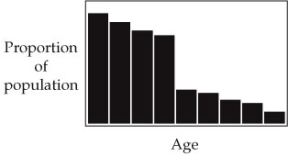
(Multiple Choice)
4.9/5 (66)
(66) According to the logistic equation for population growth, the birth rate equals the death rate when the population size is _______ the carrying capacity.
(Short Answer)
4.9/5 (81)
(81) Suppose seedlings of a plant emit a chemical that reduces the growth of other individuals around them. This would most likely result in the plants having a _______ dispersion pattern.
(Multiple Choice)
4.9/5 (91)
(91) As an alternative to chemical pesticides, ecologists have often recommended biological control: the introduction of predators or parasites of pests (especially exotic species) to bring an undesirable population under control. What are the risks of this strategy?
(Essay)
4.9/5 (67)
(67) Use the following to answer questions :
Refer to the graph below, showing the population growth of two different colonies of 65 rabbits each over 10 years.
-What type of population growth is occurring in population A? If it is logistic, what is the carrying capacity?
-What type of population growth is occurring in population A? If it is logistic, what is the carrying capacity? (Short Answer)
4.8/5 (80)
(80) Use the following to answer questions :
Refer to the graph below, showing the mortality rate of two species of mammals over the course of 9 months. 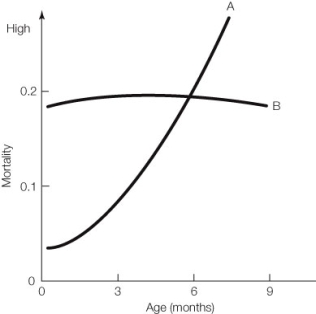 -Based on the mortality graph, which type of survivorship curve does species B have?
 (Multiple Choice)
4.9/5 (80)
(80) Use the following to answer questions:
Refer to the graph below. 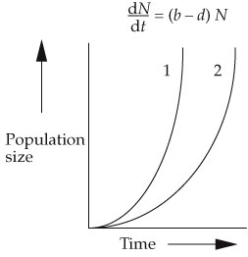 -The intrinsic rates of increase (r) of species A = 0.25 and of species B = 0.50. According to the graph, the population growth curve for A should be more like curve _______.
 (Short Answer)
4.8/5 (78)
(78) For which of the following could population densities be estimated most easily?
(Multiple Choice)
4.9/5 (81)
(81) Sustainable management of whale populations is generally more difficult than that of fish populations because
(Multiple Choice)
4.8/5 (74)
(74) Which of the following statements about carrying capacity (K) is true?
(Multiple Choice)
4.7/5 (80)
(80) The _______ of an environment is the maximum number of individuals of a given species that the environment can support.
(Short Answer)
4.9/5 (81)
(81) Connections between patches in a metapopulation, known as _______, generally _______ the extinction rate of patches.
(Short Answer)
4.9/5 (74)
(74) 
Filters
- Essay(0)
- Multiple Choice(0)
- Short Answer(0)
- True False(0)
- Matching(0)