



 Chat with AI
Exam 50: Circulatory Systems

Exam 1: Studying Life 97 Questions
Exam 2: Small Molecules and the Chemistry of Life145 Questions
Exam 3: Proteins, Carbohydrates, and Lipids145 Questions
Exam 4: Nucleic Acids and the Origin of Life117 Questions
Exam 5: Cells: the Working Units of Life153 Questions
Exam 6: Cell Membranes136 Questions
Exam 7: Cell Signaling and Communication150 Questions
Exam 8: Energy, Enzymes, and Metabolism153 Questions
Exam 9: Pathways That Harvest Chemical Energy154 Questions
Exam 10: Photosynthesis: Energy From Sunlight158 Questions
Exam 11: The Cell Cycle and Cell Division176 Questions
Exam 12: Inheritance, Genes, and Chromosomes150 Questions
Exam 13: Dna and Its Role in Heredity155 Questions
Exam 14: From Dna to Protein: Gene Expression151 Questions
Exam 15: Gene Mutation and Molecular Medicine141 Questions
Exam 16: Regulation of Gene Expression151 Questions
Exam 17: Genomes145 Questions
Exam 18: Recombinent Dna and Biotechnology141 Questions
Exam 19: Differential Gene Expression in Development147 Questions
Exam 20: Development and Evolutionary Change120 Questions
Exam 21: Evidence and Mechanisms of Evolution151 Questions
Exam 22: Reconstructing and Using Phylogenies137 Questions
Exam 23: Species and Their Formation140 Questions
Exam 24: Evolution of Genes and Genomes141 Questions
Exam 25: The History of Life on Earth145 Questions
Exam 26: Bacteria and Archaea: the Prokaryotic Domains156 Questions
Exam 27: The Origin and Diversification of Eukaryotes148 Questions
Exam 28: Plants Without Seeds: From Water to Land144 Questions
Exam 29: The Evolution of Seed Plants141 Questions
Exam 30: Fungi: Recyclers, Pathogens, Parasites, and Plant Partners144 Questions
Exam 31: Animal Origins and the Evolution of Body Plans122 Questions
Exam 32: Protostome Animals146 Questions
Exam 33: Deuterostome Animals150 Questions
Exam 34: The Plant Body132 Questions
Exam 35: Transport in Plants133 Questions
Exam 36: Plant Nutrition134 Questions
Exam 37: Regulation of Plant Growth137 Questions
Exam 38: Reproduction in Flowering Plants140 Questions
Exam 39: Plant Responses to Environmental Challenges131 Questions
Exam 40: Physiology, Homeostasis, and Temperature Regulation146 Questions
Exam 41: Animal Hormones147 Questions
Exam 42: Immunology: Animal Defense Systems150 Questions
Exam 43: Animal Reproduction150 Questions
Exam 44: Animal Development147 Questions
Exam 45: Neurons and Nervous Systems145 Questions
Exam 46: Sensory Systems150 Questions
Exam 47: The Mammalian Nervous System: Structure and Higher Function150 Questions
Exam 48: Musculoskeletal Systems150 Questions
Exam 49: Gas Exchange in Animals149 Questions
Exam 50: Circulatory Systems150 Questions
Exam 51: Nutrition, Digestion, and Absorption149 Questions
Exam 52: Salt and Water Balance and Nitrogen145 Questions
Exam 53: Animal Behavior149 Questions
Exam 54: Ecology and the Distribution of Life150 Questions
Exam 55: Population Ecology123 Questions
Exam 56: Species Interaction and Coevolution131 Questions
Exam 57: Community Ecology133 Questions
Exam 58: Ecosystems and Global Ecology142 Questions
Exam 59: Conservation Biology116 Questions
Select questions type


Blood pressure is controlled, in part, by

Free
(Multiple Choice)
4.9/5  (70)
(70) Correct Answer: Verified
C
Use the following to answer questions:
Refer to the diagram below of the mammalian circulatory system. 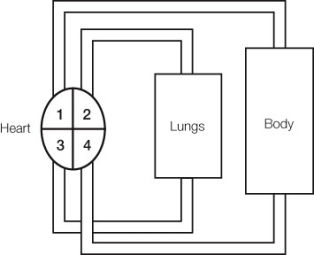 -Starting with chamber 4, in what order does blood pass through the four chambers in this diagram?
Free
(Short Answer)
4.8/5 (86)
(86) Correct Answer:Verified
Verified4, 2, 3, 1
Which of the following circulatory components is not normally found circulating in the plasma?
Free
(Multiple Choice)
4.8/5 (79)
(79) Correct Answer:Verified
VerifiedB
When reptiles stop breathing, for example on extended dives,
(Multiple Choice)
4.8/5 (85)
(85) Which of the following structures of the human lymphatic system acts primarily as a filter for detecting and destroying microorganisms in lymph traveling through major lymph vessels?
(Multiple Choice)
5.0/5 (86)
(86) In the human heart, blood is pumped from the left ventricle into the
(Multiple Choice)
4.8/5 (78)
(78) The left ventricle in humans is more muscular than the right ventricle because
(Multiple Choice)
4.8/5 (98)
(98) Which of the following is not one of the reasons that closed circulatory systems are more efficient than open circulatory systems?
(Multiple Choice)
4.9/5 (90)
(90) When a piece of thrombus breaks loose and lodges in a smaller vessel, blocking the flow of blood, the result is
(Multiple Choice)
4.7/5 (79)
(79) You are about to take a final exam in your freshman biology course and are very nervous. What responses will your circulatory system have to your nervousness?
(Essay)
4.7/5 (72)
(72) "Systole" and "diastole" describe the _______ and _______, respectively, of the _______ in mammals.
(Multiple Choice)
5.0/5 (80)
(80) Which of the following is not transported through a closed circulatory system?
(Multiple Choice)
4.7/5 (71)
(71) Which of the following vertebrates has a three-chambered heart with both pulmonary and systemic circuits?
(Multiple Choice)
4.9/5 (74)
(74) In humans, blood is pumped from heart to lungs and back through the _______ circuit.
(Short Answer)
4.9/5 (83)
(83) 
Filters
- Essay(0)
- Multiple Choice(0)
- Short Answer(0)
- True False(0)
- Matching(0)