



 Chat with AI
Exam 6: Cell Membranes

Exam 1: Studying Life 97 Questions
Exam 2: Small Molecules and the Chemistry of Life145 Questions
Exam 3: Proteins, Carbohydrates, and Lipids145 Questions
Exam 4: Nucleic Acids and the Origin of Life117 Questions
Exam 5: Cells: the Working Units of Life153 Questions
Exam 6: Cell Membranes136 Questions
Exam 7: Cell Signaling and Communication150 Questions
Exam 8: Energy, Enzymes, and Metabolism153 Questions
Exam 9: Pathways That Harvest Chemical Energy154 Questions
Exam 10: Photosynthesis: Energy From Sunlight158 Questions
Exam 11: The Cell Cycle and Cell Division176 Questions
Exam 12: Inheritance, Genes, and Chromosomes150 Questions
Exam 13: Dna and Its Role in Heredity155 Questions
Exam 14: From Dna to Protein: Gene Expression151 Questions
Exam 15: Gene Mutation and Molecular Medicine141 Questions
Exam 16: Regulation of Gene Expression151 Questions
Exam 17: Genomes145 Questions
Exam 18: Recombinent Dna and Biotechnology141 Questions
Exam 19: Differential Gene Expression in Development147 Questions
Exam 20: Development and Evolutionary Change120 Questions
Exam 21: Evidence and Mechanisms of Evolution151 Questions
Exam 22: Reconstructing and Using Phylogenies137 Questions
Exam 23: Species and Their Formation140 Questions
Exam 24: Evolution of Genes and Genomes141 Questions
Exam 25: The History of Life on Earth145 Questions
Exam 26: Bacteria and Archaea: the Prokaryotic Domains156 Questions
Exam 27: The Origin and Diversification of Eukaryotes148 Questions
Exam 28: Plants Without Seeds: From Water to Land144 Questions
Exam 29: The Evolution of Seed Plants141 Questions
Exam 30: Fungi: Recyclers, Pathogens, Parasites, and Plant Partners144 Questions
Exam 31: Animal Origins and the Evolution of Body Plans122 Questions
Exam 32: Protostome Animals146 Questions
Exam 33: Deuterostome Animals150 Questions
Exam 34: The Plant Body132 Questions
Exam 35: Transport in Plants133 Questions
Exam 36: Plant Nutrition134 Questions
Exam 37: Regulation of Plant Growth137 Questions
Exam 38: Reproduction in Flowering Plants140 Questions
Exam 39: Plant Responses to Environmental Challenges131 Questions
Exam 40: Physiology, Homeostasis, and Temperature Regulation146 Questions
Exam 41: Animal Hormones147 Questions
Exam 42: Immunology: Animal Defense Systems150 Questions
Exam 43: Animal Reproduction150 Questions
Exam 44: Animal Development147 Questions
Exam 45: Neurons and Nervous Systems145 Questions
Exam 46: Sensory Systems150 Questions
Exam 47: The Mammalian Nervous System: Structure and Higher Function150 Questions
Exam 48: Musculoskeletal Systems150 Questions
Exam 49: Gas Exchange in Animals149 Questions
Exam 50: Circulatory Systems150 Questions
Exam 51: Nutrition, Digestion, and Absorption149 Questions
Exam 52: Salt and Water Balance and Nitrogen145 Questions
Exam 53: Animal Behavior149 Questions
Exam 54: Ecology and the Distribution of Life150 Questions
Exam 55: Population Ecology123 Questions
Exam 56: Species Interaction and Coevolution131 Questions
Exam 57: Community Ecology133 Questions
Exam 58: Ecosystems and Global Ecology142 Questions
Exam 59: Conservation Biology116 Questions
Select questions type


Use the following to answer questions :
The graph below shows the relationship between glucose concentration outside a cell and the rate of glucose diffusion across a cell membrane that has carrier proteins to facilitate diffusion. 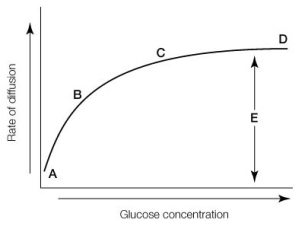 -According to the graph, as the number of glucose molecules increases, the rate of diffusion
Free
(Multiple Choice)
4.8/5  (66)
(66) Correct Answer: Verified
C
Primary and secondary active transport both
Free
(Multiple Choice)
4.8/5 (76)
(76) Correct Answer:Verified
VerifiedE
Cell adhesion molecules that are responsible for the binding together of mammalian egg and sperm cells are referred to as _______.
Free
(Short Answer)
4.9/5 (81)
(81) Correct Answer:Verified
Verifiedheterotypic
Membrane segments synthesized on the ER move to other points of the cell in the form of _______.
(Short Answer)
4.9/5 (86)
(86) The hydrophilic regions of a membrane protein are most likely to be found
(Multiple Choice)
4.8/5 (63)
(63) Barrier formation is only one function of the cell membrane. Describe some other functions of the membrane and discuss how the membrane is suited for those functions.
(Essay)
4.9/5 (81)
(81) Which of the following statements about peripheral membrane proteins is true?
(Multiple Choice)
4.9/5 (78)
(78) If a red blood cell is placed in an isotonic solution, it will
(Multiple Choice)
4.8/5 (73)
(73) The ability of some materials to move through biological membranes more readily than through others is called _______.
(Short Answer)
4.7/5 (73)
(73) In which of the following is solution X hypotonic relative to solution Y?
(Multiple Choice)
5.0/5 (66)
(66) An important function of specialized membranes found in certain organelles is to
(Multiple Choice)
4.9/5 (80)
(80) One result of the movement of ions through ion channels is the creation of a membrane potential. The membrane potential is
(Multiple Choice)
4.8/5 (93)
(93) Which of the following cell membrane components serve as recognition signals for interactions between cells?
(Multiple Choice)
4.9/5 (78)
(78) Which of the following statements regarding cellular membranes is false?
(Multiple Choice)
4.9/5 (87)
(87) Which of the following functions as a recognition signal for interactions between cells?
(Multiple Choice)
4.9/5 (80)
(80) The processes of cell recognition and cell adhesion are dependent upon _______ proteins.
(Short Answer)
4.9/5 (74)
(74) Muscle cells recognize and adhere to one another because of specific membrane proteins called
(Multiple Choice)
4.8/5 (79)
(79) 
Filters
- Essay(0)
- Multiple Choice(0)
- Short Answer(0)
- True False(0)
- Matching(0)