



 Chat with AI
Exam 3: Proteins, Carbohydrates, and Lipids

Exam 1: Studying Life 97 Questions
Exam 2: Small Molecules and the Chemistry of Life145 Questions
Exam 3: Proteins, Carbohydrates, and Lipids145 Questions
Exam 4: Nucleic Acids and the Origin of Life117 Questions
Exam 5: Cells: the Working Units of Life153 Questions
Exam 6: Cell Membranes136 Questions
Exam 7: Cell Signaling and Communication150 Questions
Exam 8: Energy, Enzymes, and Metabolism153 Questions
Exam 9: Pathways That Harvest Chemical Energy154 Questions
Exam 10: Photosynthesis: Energy From Sunlight158 Questions
Exam 11: The Cell Cycle and Cell Division176 Questions
Exam 12: Inheritance, Genes, and Chromosomes150 Questions
Exam 13: Dna and Its Role in Heredity155 Questions
Exam 14: From Dna to Protein: Gene Expression151 Questions
Exam 15: Gene Mutation and Molecular Medicine141 Questions
Exam 16: Regulation of Gene Expression151 Questions
Exam 17: Genomes145 Questions
Exam 18: Recombinent Dna and Biotechnology141 Questions
Exam 19: Differential Gene Expression in Development147 Questions
Exam 20: Development and Evolutionary Change120 Questions
Exam 21: Evidence and Mechanisms of Evolution151 Questions
Exam 22: Reconstructing and Using Phylogenies137 Questions
Exam 23: Species and Their Formation140 Questions
Exam 24: Evolution of Genes and Genomes141 Questions
Exam 25: The History of Life on Earth145 Questions
Exam 26: Bacteria and Archaea: the Prokaryotic Domains156 Questions
Exam 27: The Origin and Diversification of Eukaryotes148 Questions
Exam 28: Plants Without Seeds: From Water to Land144 Questions
Exam 29: The Evolution of Seed Plants141 Questions
Exam 30: Fungi: Recyclers, Pathogens, Parasites, and Plant Partners144 Questions
Exam 31: Animal Origins and the Evolution of Body Plans122 Questions
Exam 32: Protostome Animals146 Questions
Exam 33: Deuterostome Animals150 Questions
Exam 34: The Plant Body132 Questions
Exam 35: Transport in Plants133 Questions
Exam 36: Plant Nutrition134 Questions
Exam 37: Regulation of Plant Growth137 Questions
Exam 38: Reproduction in Flowering Plants140 Questions
Exam 39: Plant Responses to Environmental Challenges131 Questions
Exam 40: Physiology, Homeostasis, and Temperature Regulation146 Questions
Exam 41: Animal Hormones147 Questions
Exam 42: Immunology: Animal Defense Systems150 Questions
Exam 43: Animal Reproduction150 Questions
Exam 44: Animal Development147 Questions
Exam 45: Neurons and Nervous Systems145 Questions
Exam 46: Sensory Systems150 Questions
Exam 47: The Mammalian Nervous System: Structure and Higher Function150 Questions
Exam 48: Musculoskeletal Systems150 Questions
Exam 49: Gas Exchange in Animals149 Questions
Exam 50: Circulatory Systems150 Questions
Exam 51: Nutrition, Digestion, and Absorption149 Questions
Exam 52: Salt and Water Balance and Nitrogen145 Questions
Exam 53: Animal Behavior149 Questions
Exam 54: Ecology and the Distribution of Life150 Questions
Exam 55: Population Ecology123 Questions
Exam 56: Species Interaction and Coevolution131 Questions
Exam 57: Community Ecology133 Questions
Exam 58: Ecosystems and Global Ecology142 Questions
Exam 59: Conservation Biology116 Questions
Select questions type


Cholesterol is soluble in chloroform, an organic solvent, but it is not soluble in water. Based on this information, what class of biological macromolecules does cholesterol belong to?

Free
(Multiple Choice)
4.8/5  (86)
(86) Correct Answer: Verified
E
Complex carbohydrates should be a mainstay of one's diet. What properties of carbohydrates make them excellent food sources?
Free
(Essay)
4.9/5 (94)
(94) Correct Answer:Verified
VerifiedComplex carbohydrates are easily broken down into glucose monomers, which provide nearly all cellular energy. By storing glucose monomers in large carbohydrates, the osmotic strain on any given cell is reduced without sacrificing availability of energy.
A pleated sheet organization in a polypeptide chain is an example of _______ structure.
(Multiple Choice)
4.9/5 (76)
(76) Which of the following biological molecules is/are linked by covalent bonds formed by the removal of the elements of water from the reactants (a kind of condensation reaction)?
(Multiple Choice)
4.9/5 (90)
(90) Which of the following protein structures is destroyed by denaturation?
(Multiple Choice)
4.9/5 (74)
(74) Consider the following triglycerides (A and B)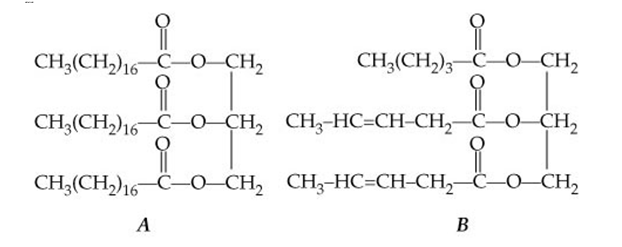 a. In B, circle the remnant of the glycerol portion of the triglyceride.
b. Which triglyceride (A or B) is probably a solid at room temperature? Explain your answer.
c. Which triglyceride (A or B) is probably derived from a plant? Explain your answer.
d. How many water molecules result from the formation of triglyceride B from glycerol and three fatty acids?
a. In B, circle the remnant of the glycerol portion of the triglyceride.
b. Which triglyceride (A or B) is probably a solid at room temperature? Explain your answer.
c. Which triglyceride (A or B) is probably derived from a plant? Explain your answer.
d. How many water molecules result from the formation of triglyceride B from glycerol and three fatty acids? (Essay)
4.8/5 (76)
(76) Starch and glycogen, which are both polysaccharides, differ structurally in that glycogen _______, whereas starch _______.
(Multiple Choice)
4.9/5 (73)
(73) Suppose that you have isolated a protein with the following amino acid sequence: RSCFLA. Refer to the diagrams in Table 3.1 of the textbook, and draw this protein. In your drawing, label the N terminus and the C terminus and show all peptide linkages. How many water molecules are generated in the synthesis of this protein?
(Essay)
5.0/5 (93)
(93) You look at the label on a container of shortening and see the words "hydrogenated vegetable oil." This means that during processing, the number of carbon-carbon double bonds in the oil was decreased. What is the result of decreasing the number of double bonds?
(Multiple Choice)
4.9/5 (82)
(82) Glucosamine and galactosamine are monosaccharides in which a hydroxyl group has been replaced by a(n) _______ group.
(Short Answer)
4.8/5 (75)
(75) The bonds that form between the atoms of polymeric macromolecules are _______ bonds.
(Multiple Choice)
4.9/5 (101)
(101) 
Filters
- Essay(0)
- Multiple Choice(0)
- Short Answer(0)
- True False(0)
- Matching(0)