



 Chat with AI
Exam 55: Population Ecology

Exam 1: Studying Life 97 Questions
Exam 2: Small Molecules and the Chemistry of Life145 Questions
Exam 3: Proteins, Carbohydrates, and Lipids145 Questions
Exam 4: Nucleic Acids and the Origin of Life117 Questions
Exam 5: Cells: the Working Units of Life153 Questions
Exam 6: Cell Membranes136 Questions
Exam 7: Cell Signaling and Communication150 Questions
Exam 8: Energy, Enzymes, and Metabolism153 Questions
Exam 9: Pathways That Harvest Chemical Energy154 Questions
Exam 10: Photosynthesis: Energy From Sunlight158 Questions
Exam 11: The Cell Cycle and Cell Division176 Questions
Exam 12: Inheritance, Genes, and Chromosomes150 Questions
Exam 13: Dna and Its Role in Heredity155 Questions
Exam 14: From Dna to Protein: Gene Expression151 Questions
Exam 15: Gene Mutation and Molecular Medicine141 Questions
Exam 16: Regulation of Gene Expression151 Questions
Exam 17: Genomes145 Questions
Exam 18: Recombinent Dna and Biotechnology141 Questions
Exam 19: Differential Gene Expression in Development147 Questions
Exam 20: Development and Evolutionary Change120 Questions
Exam 21: Evidence and Mechanisms of Evolution151 Questions
Exam 22: Reconstructing and Using Phylogenies137 Questions
Exam 23: Species and Their Formation140 Questions
Exam 24: Evolution of Genes and Genomes141 Questions
Exam 25: The History of Life on Earth145 Questions
Exam 26: Bacteria and Archaea: the Prokaryotic Domains156 Questions
Exam 27: The Origin and Diversification of Eukaryotes148 Questions
Exam 28: Plants Without Seeds: From Water to Land144 Questions
Exam 29: The Evolution of Seed Plants141 Questions
Exam 30: Fungi: Recyclers, Pathogens, Parasites, and Plant Partners144 Questions
Exam 31: Animal Origins and the Evolution of Body Plans122 Questions
Exam 32: Protostome Animals146 Questions
Exam 33: Deuterostome Animals150 Questions
Exam 34: The Plant Body132 Questions
Exam 35: Transport in Plants133 Questions
Exam 36: Plant Nutrition134 Questions
Exam 37: Regulation of Plant Growth137 Questions
Exam 38: Reproduction in Flowering Plants140 Questions
Exam 39: Plant Responses to Environmental Challenges131 Questions
Exam 40: Physiology, Homeostasis, and Temperature Regulation146 Questions
Exam 41: Animal Hormones147 Questions
Exam 42: Immunology: Animal Defense Systems150 Questions
Exam 43: Animal Reproduction150 Questions
Exam 44: Animal Development147 Questions
Exam 45: Neurons and Nervous Systems145 Questions
Exam 46: Sensory Systems150 Questions
Exam 47: The Mammalian Nervous System: Structure and Higher Function150 Questions
Exam 48: Musculoskeletal Systems150 Questions
Exam 49: Gas Exchange in Animals149 Questions
Exam 50: Circulatory Systems150 Questions
Exam 51: Nutrition, Digestion, and Absorption149 Questions
Exam 52: Salt and Water Balance and Nitrogen145 Questions
Exam 53: Animal Behavior149 Questions
Exam 54: Ecology and the Distribution of Life150 Questions
Exam 55: Population Ecology123 Questions
Exam 56: Species Interaction and Coevolution131 Questions
Exam 57: Community Ecology133 Questions
Exam 58: Ecosystems and Global Ecology142 Questions
Exam 59: Conservation Biology116 Questions
Select questions type


Which of the following statements about populations that follow logistic growth patterns is true?
(Multiple Choice)
4.9/5  (83)
(83) The population density is the number of individuals in the population _______ by the area of the space covered by the population.
(Short Answer)
4.9/5 (95)
(95) Eighty-one pocket gophers were present in Maddox Field at the start of 2006. During that year, 24 individuals were born, and 19 died. Twelve individuals immigrated, and 10 emigrated. How many pocket gophers were present in Maddox Field at the start of 2007?
(Multiple Choice)
4.9/5 (72)
(72) Use the following to answer questions :
Refer to the graph below. 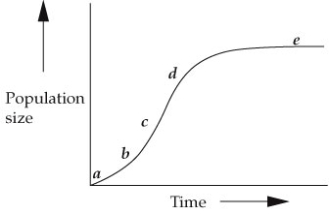 -In the logistic population growth curve shown in the graph, the rate of growth is greatest at which point?
 (Short Answer)
4.8/5 (95)
(95) If a certain age interval in a population contains ten individuals and has a mortality rate of 1.00, how many individuals will be in the next older age interval?
(Multiple Choice)
4.8/5 (84)
(84) The best way to reduce the population of an undesirable species in the long term is to
(Multiple Choice)
4.8/5 (76)
(76) Species such as humans, which can reproduce many times throughout their lives, are called _______.
(Short Answer)
4.8/5 (85)
(85) Biologists construct _______ tables to display information about births and deaths in a population over long periods of time.
(Short Answer)
5.0/5 (80)
(80) Births, deaths, and patterns of migration are all considered _______ events.
(Short Answer)
4.9/5 (65)
(65) In the Grants' 1978 study, the most important environmental factor affecting survival in cactus finches on Isla Daphne was discovered to be
(Multiple Choice)
4.8/5 (91)
(91) If birth rates exceed death rates and both rates are relatively constant, a population will experience _______ growth.
(Short Answer)
4.9/5 (86)
(86) Which of the following is not typical of a K-strategy species?
(Multiple Choice)
4.9/5 (95)
(95) How does the division of some populations into discrete subpopulations relate to the process known as the rescue effect? How do barriers to immigration influence the rescue effect?
(Essay)
4.8/5 (93)
(93) Which of the following is an example of density-independent population regulation?
(Multiple Choice)
5.0/5 (81)
(81) For which of the following populations would biologists most likely use number per unit of volume, rather than number per unit of area, in measuring population density?
(Multiple Choice)
4.8/5 (73)
(73) We would expect populations to grow close to or at their intrinsic rate of growth when
(Multiple Choice)
5.0/5 (74)
(74) A greater likelihood of parasite infestation as population numbers increase is an example of a density-_______ factor in population growth.
(Short Answer)
4.8/5 (83)
(83) Suppose that in a species of beetle, close proximity to another individual of the same species enhances survival. This phenomenon would likely lead to a _______ dispersion pattern for the species.
(Short Answer)
4.7/5 (76)
(76) Some species of fish in the salmon family (called salmonids) are anadromous, meaning that they mature in salt water but migrate to bodies of fresh water to breed. These species are usually semelparous. Other nonanadromous species in this family live their entire lives in bodies of fresh water and are generally iteroparous. What might be the explanation for the difference in the life history patterns of these two groups of salmonids?
(Essay)
4.8/5 (72)
(72) 
Filters
- Essay(0)
- Multiple Choice(0)
- Short Answer(0)
- True False(0)
- Matching(0)