



 Chat with AI
Exam 20: Development and Evolutionary Change

Exam 1: Studying Life 97 Questions
Exam 2: Small Molecules and the Chemistry of Life145 Questions
Exam 3: Proteins, Carbohydrates, and Lipids145 Questions
Exam 4: Nucleic Acids and the Origin of Life117 Questions
Exam 5: Cells: the Working Units of Life153 Questions
Exam 6: Cell Membranes136 Questions
Exam 7: Cell Signaling and Communication150 Questions
Exam 8: Energy, Enzymes, and Metabolism153 Questions
Exam 9: Pathways That Harvest Chemical Energy154 Questions
Exam 10: Photosynthesis: Energy From Sunlight158 Questions
Exam 11: The Cell Cycle and Cell Division176 Questions
Exam 12: Inheritance, Genes, and Chromosomes150 Questions
Exam 13: Dna and Its Role in Heredity155 Questions
Exam 14: From Dna to Protein: Gene Expression151 Questions
Exam 15: Gene Mutation and Molecular Medicine141 Questions
Exam 16: Regulation of Gene Expression151 Questions
Exam 17: Genomes145 Questions
Exam 18: Recombinent Dna and Biotechnology141 Questions
Exam 19: Differential Gene Expression in Development147 Questions
Exam 20: Development and Evolutionary Change120 Questions
Exam 21: Evidence and Mechanisms of Evolution151 Questions
Exam 22: Reconstructing and Using Phylogenies137 Questions
Exam 23: Species and Their Formation140 Questions
Exam 24: Evolution of Genes and Genomes141 Questions
Exam 25: The History of Life on Earth145 Questions
Exam 26: Bacteria and Archaea: the Prokaryotic Domains156 Questions
Exam 27: The Origin and Diversification of Eukaryotes148 Questions
Exam 28: Plants Without Seeds: From Water to Land144 Questions
Exam 29: The Evolution of Seed Plants141 Questions
Exam 30: Fungi: Recyclers, Pathogens, Parasites, and Plant Partners144 Questions
Exam 31: Animal Origins and the Evolution of Body Plans122 Questions
Exam 32: Protostome Animals146 Questions
Exam 33: Deuterostome Animals150 Questions
Exam 34: The Plant Body132 Questions
Exam 35: Transport in Plants133 Questions
Exam 36: Plant Nutrition134 Questions
Exam 37: Regulation of Plant Growth137 Questions
Exam 38: Reproduction in Flowering Plants140 Questions
Exam 39: Plant Responses to Environmental Challenges131 Questions
Exam 40: Physiology, Homeostasis, and Temperature Regulation146 Questions
Exam 41: Animal Hormones147 Questions
Exam 42: Immunology: Animal Defense Systems150 Questions
Exam 43: Animal Reproduction150 Questions
Exam 44: Animal Development147 Questions
Exam 45: Neurons and Nervous Systems145 Questions
Exam 46: Sensory Systems150 Questions
Exam 47: The Mammalian Nervous System: Structure and Higher Function150 Questions
Exam 48: Musculoskeletal Systems150 Questions
Exam 49: Gas Exchange in Animals149 Questions
Exam 50: Circulatory Systems150 Questions
Exam 51: Nutrition, Digestion, and Absorption149 Questions
Exam 52: Salt and Water Balance and Nitrogen145 Questions
Exam 53: Animal Behavior149 Questions
Exam 54: Ecology and the Distribution of Life150 Questions
Exam 55: Population Ecology123 Questions
Exam 56: Species Interaction and Coevolution131 Questions
Exam 57: Community Ecology133 Questions
Exam 58: Ecosystems and Global Ecology142 Questions
Exam 59: Conservation Biology116 Questions
Select questions type


Which of the following statements about sticklebacks is false?
(Multiple Choice)
4.9/5  (77)
(77) Use the following to answer questions :
Below is a diagram of a Drosophila larva. H represents the head segments region; T1, T2, and T3 represent the first, second, and third thoracic segments respectively; and A represents the abdominal segments region. 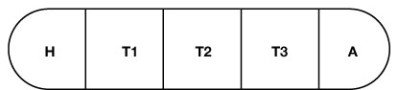 -Indicate on the diagram where wings normally would form.
 (Essay)
4.8/5 (74)
(74) The extent to which a developmental gene affects phenotype is limited, because most such genes affect only one _______ and not the whole organism.
(Short Answer)
4.7/5 (85)
(85) The difference in appearance of Nemoria arizonaria caterpillars in spring and summer is triggered by
(Multiple Choice)
5.0/5 (75)
(75) Which of the following principles of evo-devo is not stated properly?
(Multiple Choice)
4.9/5 (72)
(72) Which of the following best contradicts Francois Jacob's view of evolution as a tinker?
(Multiple Choice)
4.9/5 (71)
(71) Which of the following examples of evolutionary change do not involve Hox genes?
(Multiple Choice)
4.8/5 (76)
(76) Which of the following techniques or tools was instrumental in the studies performed by Gehring and his colleagues demonstrating that eyeless is a transcription factor involved in eye development?
(Multiple Choice)
4.8/5 (82)
(82) Moss gametophytes are haploid and each cell has an identical genetic make up. Yet, different branches of the same plant can produce either female or male reproductive structures. What phenomenon do you think is demonstrated in this case?
(Multiple Choice)
4.7/5 (78)
(78) Use the following to answer questions :
The diagram below shows the association of phenotype and gene expression patterns in five different species. The top portion shows the phylogeny of the five species; below the phylogeny are the phenotypes of the five species; and at the bottom are the expression patterns for three different genes (genes 1, 2, and 3) at two different time points in development (early and late), and in two different locations in the embryo (top and bottom). 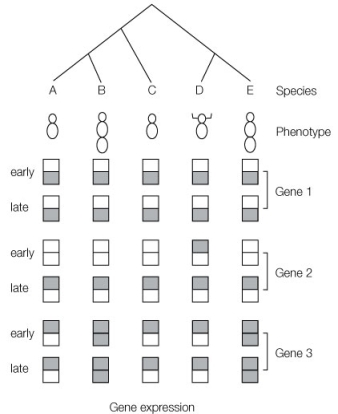 -The additional segment in species B and E is most likely associated with which process?
 (Multiple Choice)
4.9/5 (68)
(68) Which of the following is true about temperature determination of sex in some reptiles?
(Multiple Choice)
4.9/5 (78)
(78) Use the following to answer questions :
The diagram below shows the association of phenotype and gene expression patterns in five different species. The top portion shows the phylogeny of the five species; below the phylogeny are the phenotypes of the five species; and at the bottom are the expression patterns for three different genes (genes 1, 2, and 3) at two different time points in development (early and late), and in two different locations in the embryo (top and bottom).
-Which gene's expression is associated with the appendage growing in the top segment of species D?
-Which gene's expression is associated with the appendage growing in the top segment of species D? (Multiple Choice)
4.9/5 (87)
(87) The process by which the relative timing of different developmental processes is altered is called
(Multiple Choice)
5.0/5 (94)
(94) Genes that regulate development are highly conserved. This means that
(Multiple Choice)
4.9/5 (78)
(78) Use the following to answer questions :
The diagram below shows the association of phenotype and gene expression patterns in five different species. The top portion shows the phylogeny of the five species; below the phylogeny are the phenotypes of the five species; and at the bottom are the expression patterns for three different genes (genes 1, 2, and 3) at two different time points in development (early and late), and in two different locations in the embryo (top and bottom).
-The phenotypes of species B and E illustrate the phenomenon of
-The phenotypes of species B and E illustrate the phenomenon of (Multiple Choice)
4.9/5 (65)
(65) Which of the following is not a general principle of evo-devo?
(Multiple Choice)
4.7/5 (77)
(77) Webbing in ducks occurs because the _______ protein is expressed in the webbing cells. This protein prevents the _______ protein from signaling for apoptosis.
(Multiple Choice)
4.8/5 (79)
(79) 
Filters
- Essay(0)
- Multiple Choice(0)
- Short Answer(0)
- True False(0)
- Matching(0)