



 Chat with AI
Exam 49: Gas Exchange in Animals

Exam 1: Studying Life 97 Questions
Exam 2: Small Molecules and the Chemistry of Life145 Questions
Exam 3: Proteins, Carbohydrates, and Lipids145 Questions
Exam 4: Nucleic Acids and the Origin of Life117 Questions
Exam 5: Cells: the Working Units of Life153 Questions
Exam 6: Cell Membranes136 Questions
Exam 7: Cell Signaling and Communication150 Questions
Exam 8: Energy, Enzymes, and Metabolism153 Questions
Exam 9: Pathways That Harvest Chemical Energy154 Questions
Exam 10: Photosynthesis: Energy From Sunlight158 Questions
Exam 11: The Cell Cycle and Cell Division176 Questions
Exam 12: Inheritance, Genes, and Chromosomes150 Questions
Exam 13: Dna and Its Role in Heredity155 Questions
Exam 14: From Dna to Protein: Gene Expression151 Questions
Exam 15: Gene Mutation and Molecular Medicine141 Questions
Exam 16: Regulation of Gene Expression151 Questions
Exam 17: Genomes145 Questions
Exam 18: Recombinent Dna and Biotechnology141 Questions
Exam 19: Differential Gene Expression in Development147 Questions
Exam 20: Development and Evolutionary Change120 Questions
Exam 21: Evidence and Mechanisms of Evolution151 Questions
Exam 22: Reconstructing and Using Phylogenies137 Questions
Exam 23: Species and Their Formation140 Questions
Exam 24: Evolution of Genes and Genomes141 Questions
Exam 25: The History of Life on Earth145 Questions
Exam 26: Bacteria and Archaea: the Prokaryotic Domains156 Questions
Exam 27: The Origin and Diversification of Eukaryotes148 Questions
Exam 28: Plants Without Seeds: From Water to Land144 Questions
Exam 29: The Evolution of Seed Plants141 Questions
Exam 30: Fungi: Recyclers, Pathogens, Parasites, and Plant Partners144 Questions
Exam 31: Animal Origins and the Evolution of Body Plans122 Questions
Exam 32: Protostome Animals146 Questions
Exam 33: Deuterostome Animals150 Questions
Exam 34: The Plant Body132 Questions
Exam 35: Transport in Plants133 Questions
Exam 36: Plant Nutrition134 Questions
Exam 37: Regulation of Plant Growth137 Questions
Exam 38: Reproduction in Flowering Plants140 Questions
Exam 39: Plant Responses to Environmental Challenges131 Questions
Exam 40: Physiology, Homeostasis, and Temperature Regulation146 Questions
Exam 41: Animal Hormones147 Questions
Exam 42: Immunology: Animal Defense Systems150 Questions
Exam 43: Animal Reproduction150 Questions
Exam 44: Animal Development147 Questions
Exam 45: Neurons and Nervous Systems145 Questions
Exam 46: Sensory Systems150 Questions
Exam 47: The Mammalian Nervous System: Structure and Higher Function150 Questions
Exam 48: Musculoskeletal Systems150 Questions
Exam 49: Gas Exchange in Animals149 Questions
Exam 50: Circulatory Systems150 Questions
Exam 51: Nutrition, Digestion, and Absorption149 Questions
Exam 52: Salt and Water Balance and Nitrogen145 Questions
Exam 53: Animal Behavior149 Questions
Exam 54: Ecology and the Distribution of Life150 Questions
Exam 55: Population Ecology123 Questions
Exam 56: Species Interaction and Coevolution131 Questions
Exam 57: Community Ecology133 Questions
Exam 58: Ecosystems and Global Ecology142 Questions
Exam 59: Conservation Biology116 Questions
Select questions type


In Fick's law of diffusion, the term (P1 - P2)/L refers to the _______ gradient.
(Short Answer)
4.8/5  (82)
(82) Which of the following statements about the structure of the fish gill is false?
(Multiple Choice)
4.7/5 (85)
(85) There are no active transport mechanisms for respiratory gases. Therefore, the only means by which respiratory gases are exchanged is _______.
(Short Answer)
4.8/5 (76)
(76) Which of the following would increase the amount of oxygen diffusing from the lungs into the blood?
(Multiple Choice)
4.8/5 (91)
(91) Which of the following statements about the binding of oxygen by hemoglobin is false?
(Multiple Choice)
4.9/5 (83)
(83) Air flows into the lungs of mammals during inhalation because the
(Multiple Choice)
4.8/5 (88)
(88) Refer to the graph below. Curve _______ would most likely belong to a fetus, curve _______ would most likely belong to an adult human with blood at pH 7.2, and curve _______ would most likely belong to a human with blood at pH 7.4. 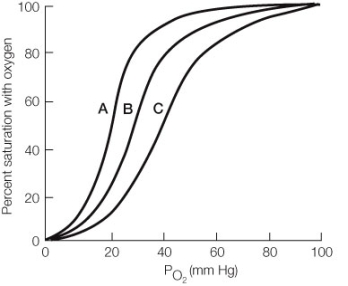
(Multiple Choice)
4.8/5 (72)
(72) The movement of O2 and CO2 between the blood in the tissue capillaries and the cells in tissues depends most directly upon
(Multiple Choice)
4.8/5 (84)
(84) If the O2-binding curves were plotted for the following molecules, which curve would be to the left of all the others?
(Multiple Choice)
4.9/5 (66)
(66) A large drop in arterial O2 has a (large or small) _______ effect on breathing rate.
(Short Answer)
4.7/5 (77)
(77) Which of the following statements about the mechanics of ventilation is false?
(Multiple Choice)
4.8/5 (84)
(84) Respiratory gases are exchanged between the body fluids of an animal and its environment by
(Multiple Choice)
4.9/5 (93)
(93) C. R. Bainton conducted an experiment in which he increased the workload of dogs by having them run on inclined treadmills and showed that respiratory rate responded to CO2 levels. However, this success story followed an earlier experiment that did not support his hypothesis. In the earlier study, he
(Multiple Choice)
4.7/5 (77)
(77) Which of the following statements about the air sacs of birds is false?
(Multiple Choice)
4.8/5 (72)
(72) Our sensors for detecting PO2 levels are found in blood vessels leaving the _______.
(Short Answer)
4.8/5 (88)
(88) Unlike humans and other mammals, fishes respond to _______ to adjust their respiratory rate.
(Multiple Choice)
4.9/5 (80)
(80) At sea level, atmospheric pressure is about _______ mm mercury.
(Multiple Choice)
4.9/5 (80)
(80) If the thoracic wall is punctured, air leaking in will cause the lung to collapse. Thus, in the normal, intact thoracic cavity,
(Multiple Choice)
4.9/5 (77)
(77) 
Filters
- Essay(0)
- Multiple Choice(0)
- Short Answer(0)
- True False(0)
- Matching(0)