



 Chat with AI
Exam 49: Gas Exchange in Animals

Exam 1: Studying Life 97 Questions
Exam 2: Small Molecules and the Chemistry of Life145 Questions
Exam 3: Proteins, Carbohydrates, and Lipids145 Questions
Exam 4: Nucleic Acids and the Origin of Life117 Questions
Exam 5: Cells: the Working Units of Life153 Questions
Exam 6: Cell Membranes136 Questions
Exam 7: Cell Signaling and Communication150 Questions
Exam 8: Energy, Enzymes, and Metabolism153 Questions
Exam 9: Pathways That Harvest Chemical Energy154 Questions
Exam 10: Photosynthesis: Energy From Sunlight158 Questions
Exam 11: The Cell Cycle and Cell Division176 Questions
Exam 12: Inheritance, Genes, and Chromosomes150 Questions
Exam 13: Dna and Its Role in Heredity155 Questions
Exam 14: From Dna to Protein: Gene Expression151 Questions
Exam 15: Gene Mutation and Molecular Medicine141 Questions
Exam 16: Regulation of Gene Expression151 Questions
Exam 17: Genomes145 Questions
Exam 18: Recombinent Dna and Biotechnology141 Questions
Exam 19: Differential Gene Expression in Development147 Questions
Exam 20: Development and Evolutionary Change120 Questions
Exam 21: Evidence and Mechanisms of Evolution151 Questions
Exam 22: Reconstructing and Using Phylogenies137 Questions
Exam 23: Species and Their Formation140 Questions
Exam 24: Evolution of Genes and Genomes141 Questions
Exam 25: The History of Life on Earth145 Questions
Exam 26: Bacteria and Archaea: the Prokaryotic Domains156 Questions
Exam 27: The Origin and Diversification of Eukaryotes148 Questions
Exam 28: Plants Without Seeds: From Water to Land144 Questions
Exam 29: The Evolution of Seed Plants141 Questions
Exam 30: Fungi: Recyclers, Pathogens, Parasites, and Plant Partners144 Questions
Exam 31: Animal Origins and the Evolution of Body Plans122 Questions
Exam 32: Protostome Animals146 Questions
Exam 33: Deuterostome Animals150 Questions
Exam 34: The Plant Body132 Questions
Exam 35: Transport in Plants133 Questions
Exam 36: Plant Nutrition134 Questions
Exam 37: Regulation of Plant Growth137 Questions
Exam 38: Reproduction in Flowering Plants140 Questions
Exam 39: Plant Responses to Environmental Challenges131 Questions
Exam 40: Physiology, Homeostasis, and Temperature Regulation146 Questions
Exam 41: Animal Hormones147 Questions
Exam 42: Immunology: Animal Defense Systems150 Questions
Exam 43: Animal Reproduction150 Questions
Exam 44: Animal Development147 Questions
Exam 45: Neurons and Nervous Systems145 Questions
Exam 46: Sensory Systems150 Questions
Exam 47: The Mammalian Nervous System: Structure and Higher Function150 Questions
Exam 48: Musculoskeletal Systems150 Questions
Exam 49: Gas Exchange in Animals149 Questions
Exam 50: Circulatory Systems150 Questions
Exam 51: Nutrition, Digestion, and Absorption149 Questions
Exam 52: Salt and Water Balance and Nitrogen145 Questions
Exam 53: Animal Behavior149 Questions
Exam 54: Ecology and the Distribution of Life150 Questions
Exam 55: Population Ecology123 Questions
Exam 56: Species Interaction and Coevolution131 Questions
Exam 57: Community Ecology133 Questions
Exam 58: Ecosystems and Global Ecology142 Questions
Exam 59: Conservation Biology116 Questions
Select questions type


Breathing rhythm is generated in the _______ and modified by neurons either in or above the _______.
(Multiple Choice)
4.8/5  (87)
(87) If the O2-binding curves were plotted for adult hemoglobin under the following conditions, which curve would be to the right of all the others?
(Multiple Choice)
4.9/5 (82)
(82) In the following equation, which quantity represents the volume of your normal breath? Total lung capacity = residual volume + expiratory reserve volume + inspiratory reserve volume + tidal volume
(Multiple Choice)
4.9/5 (76)
(76) In the respiratory cycle of birds, air flows through the trachea, to the bronchi, and then
(Multiple Choice)
4.9/5 (77)
(77) The oxygen-binding molecule that is abundant in muscle is _______.
(Short Answer)
4.8/5 (87)
(87) Refer to the diagram below of a countercurrent exchanger from a fish gill. The values represent percent saturation of O2. Based on this information alone, which of the following statements is true? 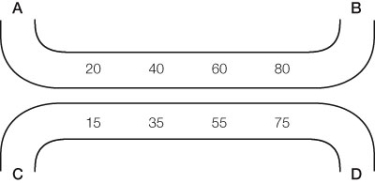
(Multiple Choice)
4.9/5 (70)
(70) An unusual feature of the lungs of _______ is that they expand and contract relatively little during a breathing cycle. They also contract during inhalation and expand during exhalation.
(Short Answer)
4.9/5 (77)
(77) Because of the relatively high altitude of Antonito, Colorado, the town has a normal barometric pressure of about 600 mm Hg rather than 760 mm Hg as at sea level. The partial pressure of O2 in Antonito's air is approximately _______ mm Hg.
(Multiple Choice)
4.9/5 (87)
(87) Mammalian lungs have two adaptive features: the production of mucus and _______, a substance that reduces the surface tension of the liquid lining the insides of the alveoli.
(Short Answer)
4.8/5 (79)
(79) Carbonic anhydrase is an enzyme in red blood cells that catalyzes a reaction between CO2 and
(Multiple Choice)
4.9/5 (73)
(73) The lungs of _______ are the most efficient lungs of vertebrates.
(Short Answer)
4.9/5 (76)
(76) In mammalian lungs, the gas exchange surface area provided by _______ is enormous.
(Multiple Choice)
4.7/5 (94)
(94) Which of the following statements is not one of the reasons that diffusion of O2 into an animal is more problematic than diffusion of CO2 from an animal?
(Multiple Choice)
4.7/5 (79)
(79) 
Filters
- Essay(0)
- Multiple Choice(0)
- Short Answer(0)
- True False(0)
- Matching(0)