



 Chat with AI
Exam 55: Ecosystems

Exam 1: Introduction: Themes in the Study of Life66 Questions
Exam 2: The Chemical Context of Life83 Questions
Exam 3: Water and the Fitness of the Environment66 Questions
Exam 4: Carbon and the Molecular Diversity of Life68 Questions
Exam 5: The Structure and Function of Large Biological Molecules109 Questions
Exam 6: A Tour of the Cell75 Questions
Exam 7: Membrane Structure and Function75 Questions
Exam 8: An Introduction to Metabolism79 Questions
Exam 9: Cellular Respiration: Harvesting Chemical Energy103 Questions
Exam 10: Photosynthesis74 Questions
Exam 11: Cell Communication62 Questions
Exam 12: The Cell Cycle80 Questions
Exam 13: Meiosis and Sexual Life Cycles68 Questions
Exam 14: Mendel and the Gene Idea90 Questions
Exam 15: The Chromosomal Basis of Inheritance75 Questions
Exam 16: The Molecular Basis of Inheritance72 Questions
Exam 17: From Gene to Protein84 Questions
Exam 18: Control of Gene Expression101 Questions
Exam 19: Viruses38 Questions
Exam 20: Biotechnology70 Questions
Exam 21: Genomes and Their Evolution37 Questions
Exam 22: Descent With Modification: a Darwinian View of Life57 Questions
Exam 23: The Evolution of Populations84 Questions
Exam 24: The Origin of Species60 Questions
Exam 25: The History of Life on Earth85 Questions
Exam 26: Phylogeny and the Tree of Life90 Questions
Exam 27: Bacteria and Archaea78 Questions
Exam 28: Protists79 Questions
Exam 29: Plant Diversity I: How Plants Colonized Land74 Questions
Exam 30: Plant Diversity Ii: the Evolution of Seed Plants101 Questions
Exam 31: Fungi87 Questions
Exam 32: An Introduction to Animal Diversity82 Questions
Exam 33: Invertebrates98 Questions
Exam 34: Vertebrates112 Questions
Exam 35: Plant Structure, Growth, and Development77 Questions
Exam 36: Transport in Vascular Plants84 Questions
Exam 37: Soil and Plant Nutrition85 Questions
Exam 38: Angiosperm Reproduction and Biotechnology86 Questions
Exam 39: Plant Responses to Internal and External Signals111 Questions
Exam 40: Basic Principles of Animal Form and Function74 Questions
Exam 41: Animal Nutrition68 Questions
Exam 42: Circulation and Gas Exchange78 Questions
Exam 43: The Immune System85 Questions
Exam 44: Osmoregulation and Excretion49 Questions
Exam 45: Hormones and the Endocrine System71 Questions
Exam 46: Animal Reproduction85 Questions
Exam 47: Animal Development75 Questions
Exam 48: Neurons, Synapses, and Signaling52 Questions
Exam 49: Nervous Systems48 Questions
Exam 50: Sensory and Motor Mechanisms59 Questions
Exam 51: Animal Behavior74 Questions
Exam 52: An Introduction to Ecology and the Biosphere71 Questions
Exam 53: Population Ecology80 Questions
Exam 54: Community Ecology74 Questions
Exam 55: Ecosystems79 Questions
Exam 56: Conservation Biology and Restoration Ecology65 Questions
Select questions type


How is it that satellites can detect differences in primary productivity on Earth?
(Multiple Choice)
4.8/5  (73)
(73) You have a friend who is wary of environmentalists' claims that global warming could lead to major biological change on Earth. Which of the following statements can you truthfully make in response to your friend's suspicions?
(Multiple Choice)
4.8/5 (84)
(84) As big as it is, the ocean is nutrient-limited. If you wanted to investigate this, one reasonable avenue would be to
(Multiple Choice)
4.7/5 (79)
(79) Use Figure 55.2 to answer the following questions. Examine this food web for a particular terrestrial ecosystem. Each letter is a species. The arrows represent energy flow.
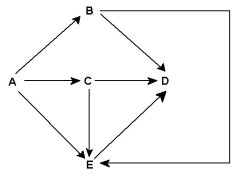 Figure 55.2
-Which species is most likely the decomposer?
Figure 55.2
-Which species is most likely the decomposer? (Short Answer)
4.7/5 (82)
(82) Which of the following properly links the nutrient to its reservoir?
(Multiple Choice)
4.9/5 (92)
(92) The high levels of pesticides found in birds of prey is an example of
(Multiple Choice)
4.8/5 (81)
(81) Use Figure 55.2 to answer the following questions. Examine this food web for a particular terrestrial ecosystem. Each letter is a species. The arrows represent energy flow.
Figure 55.2
-Which species is most likely an omnivore?
Figure 55.2
-Which species is most likely an omnivore? (Short Answer)
4.8/5 (84)
(84) The producers in aquatic ecosystems include organisms in which of the following groups?
(Multiple Choice)
4.9/5 (89)
(89) In terms of nutrient cycling, why does timber harvesting in a temperate forest cause less ecological devastation than timber harvesting in tropical rain forests?
(Multiple Choice)
4.8/5 (81)
(81) Use the information below to answer the following questions.
Flycatcher birds that migrate from Africa to Europe feed their nestlings mostly with moth caterpillars. The data presented show the mean dates of egg laying, hatching, and fledging of flycatcher young, and the 1980 and 2000 peak mass of caterpillars.
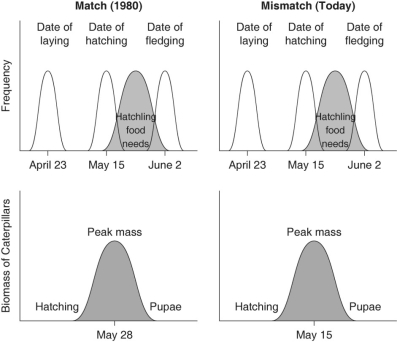 Figure 55.4
-The most likely cause for the shift in caterpillar peak mass is
Figure 55.4
-The most likely cause for the shift in caterpillar peak mass is (Multiple Choice)
4.9/5 (87)
(87) To recycle nutrients, the minimum an ecosystem must have is
(Multiple Choice)
5.0/5 (82)
(82) Which of the following are responsible for the conversion of most organic material into CO2, which can be utilized in primary production?
(Multiple Choice)
4.9/5 (95)
(95) Use Figure 55.2 to answer the following questions. Examine this food web for a particular terrestrial ecosystem. Each letter is a species. The arrows represent energy flow.
Figure 55.2
-Species C is toxic to predators. Which species is most likely to benefit from being a mimic of C?
Figure 55.2
-Species C is toxic to predators. Which species is most likely to benefit from being a mimic of C? (Short Answer)
4.8/5 (67)
(67) Refer to Figure 55.1, a diagram of a food web, for the following questions. (Arrows represent energy flow and letters represent species.)
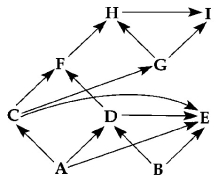 Figure 55.1
-If this were a terrestrial food web, the combined biomass of C + D would probably be
Figure 55.1
-If this were a terrestrial food web, the combined biomass of C + D would probably be (Multiple Choice)
4.8/5 (84)
(84) When levels of CO2 are experimentally increased, C3 plants generally respond with a greater increase in productivity than C4 plants. This is because
(Multiple Choice)
5.0/5 (77)
(77) The total biomass of photosynthetic autotrophs present in an ecosystem is known as
(Multiple Choice)
4.9/5 (72)
(72) The Hubbard Brook watershed deforestation experiment yielded all of the following results except that
(Multiple Choice)
4.8/5 (92)
(92) Which of the following is caused by excessive nutrient runoff into lakes?
(Multiple Choice)
4.8/5 (82)
(82) 
Filters
- Essay(0)
- Multiple Choice(0)
- Short Answer(0)
- True False(0)
- Matching(0)