



 Chat with AI
Exam 55: Ecosystems

Exam 1: Introduction: Themes in the Study of Life66 Questions
Exam 2: The Chemical Context of Life83 Questions
Exam 3: Water and the Fitness of the Environment66 Questions
Exam 4: Carbon and the Molecular Diversity of Life68 Questions
Exam 5: The Structure and Function of Large Biological Molecules109 Questions
Exam 6: A Tour of the Cell75 Questions
Exam 7: Membrane Structure and Function75 Questions
Exam 8: An Introduction to Metabolism79 Questions
Exam 9: Cellular Respiration: Harvesting Chemical Energy103 Questions
Exam 10: Photosynthesis74 Questions
Exam 11: Cell Communication62 Questions
Exam 12: The Cell Cycle80 Questions
Exam 13: Meiosis and Sexual Life Cycles68 Questions
Exam 14: Mendel and the Gene Idea90 Questions
Exam 15: The Chromosomal Basis of Inheritance75 Questions
Exam 16: The Molecular Basis of Inheritance72 Questions
Exam 17: From Gene to Protein84 Questions
Exam 18: Control of Gene Expression101 Questions
Exam 19: Viruses38 Questions
Exam 20: Biotechnology70 Questions
Exam 21: Genomes and Their Evolution37 Questions
Exam 22: Descent With Modification: a Darwinian View of Life57 Questions
Exam 23: The Evolution of Populations84 Questions
Exam 24: The Origin of Species60 Questions
Exam 25: The History of Life on Earth85 Questions
Exam 26: Phylogeny and the Tree of Life90 Questions
Exam 27: Bacteria and Archaea78 Questions
Exam 28: Protists79 Questions
Exam 29: Plant Diversity I: How Plants Colonized Land74 Questions
Exam 30: Plant Diversity Ii: the Evolution of Seed Plants101 Questions
Exam 31: Fungi87 Questions
Exam 32: An Introduction to Animal Diversity82 Questions
Exam 33: Invertebrates98 Questions
Exam 34: Vertebrates112 Questions
Exam 35: Plant Structure, Growth, and Development77 Questions
Exam 36: Transport in Vascular Plants84 Questions
Exam 37: Soil and Plant Nutrition85 Questions
Exam 38: Angiosperm Reproduction and Biotechnology86 Questions
Exam 39: Plant Responses to Internal and External Signals111 Questions
Exam 40: Basic Principles of Animal Form and Function74 Questions
Exam 41: Animal Nutrition68 Questions
Exam 42: Circulation and Gas Exchange78 Questions
Exam 43: The Immune System85 Questions
Exam 44: Osmoregulation and Excretion49 Questions
Exam 45: Hormones and the Endocrine System71 Questions
Exam 46: Animal Reproduction85 Questions
Exam 47: Animal Development75 Questions
Exam 48: Neurons, Synapses, and Signaling52 Questions
Exam 49: Nervous Systems48 Questions
Exam 50: Sensory and Motor Mechanisms59 Questions
Exam 51: Animal Behavior74 Questions
Exam 52: An Introduction to Ecology and the Biosphere71 Questions
Exam 53: Population Ecology80 Questions
Exam 54: Community Ecology74 Questions
Exam 55: Ecosystems79 Questions
Exam 56: Conservation Biology and Restoration Ecology65 Questions
Select questions type


What is the most important role of photosynthetic organisms in an ecosystem?
(Multiple Choice)
4.8/5  (64)
(64) Which of the following lists of organisms is ranked in correct order from lowest to highest percent in production efficiency?
(Multiple Choice)
4.8/5 (68)
(68) Use Figure 55.2 to answer the following questions. Examine this food web for a particular terrestrial ecosystem. Each letter is a species. The arrows represent energy flow.
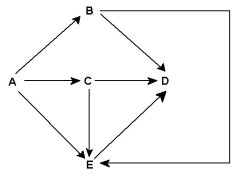 Figure 55.2
-A toxic pollutant would probably reach its highest concentration in which species?
Figure 55.2
-A toxic pollutant would probably reach its highest concentration in which species? (Short Answer)
5.0/5 (79)
(79) Agricultural lands frequently require nutritional supplementation because
(Multiple Choice)
4.8/5 (76)
(76) The difference between net and gross primary productivity would likely be greatest for
(Multiple Choice)
5.0/5 (82)
(82) If the Sun were to suddenly stop providing energy to Earth, most ecosystems would vanish. Which of the following ecosystems would likely survive the longest after this hypothetical disaster?
(Multiple Choice)
4.8/5 (82)
(82) In general, the total biomass in a terrestrial ecosystem will be greatest for which trophic level?
(Multiple Choice)
4.9/5 (74)
(74) Which of the following probably contains the highest concentration of toxic pollutants (biological magnification)?
(Multiple Choice)
4.8/5 (84)
(84) Which of the following terms encompasses all of the others?
(Multiple Choice)
4.9/5 (96)
(96) A secondary consumer, such as a fox, receives what percent of the energy fixed by primary producers in a typical field ecosystem?
(Multiple Choice)
4.9/5 (75)
(75) Aquatic ecosystems are least likely to be limited by which of the following nutrients?
(Multiple Choice)
4.9/5 (84)
(84) Suppose you are studying the nitrogen cycling in a pond ecosystem over the course of a year. While you are collecting data, a flock of 100 Canada geese lands and spends the night during a fall migration. What could you do to eliminate error in your study as a result of this event?
(Multiple Choice)
4.8/5 (95)
(95) Which statement best describes what ultimately happens to the chemical energy that is not converted to new biomass in the process of energy transfer between trophic levels in an ecosystem?
(Multiple Choice)
4.7/5 (75)
(75) Which of these ecosystems has the highest net primary productivity per square meter?
(Multiple Choice)
4.9/5 (71)
(71) A porcupine eats 3,000 J of plant material. 1,600 J is indigestible and is eliminated as feces. 1,300 J are used in cellular respiration. What is the approximate production efficiency of this animal?
(Multiple Choice)
4.9/5 (56)
(56) Use Figure 55.2 to answer the following questions. Examine this food web for a particular terrestrial ecosystem. Each letter is a species. The arrows represent energy flow.
Figure 55.2
-Which species is autotrophic?
Figure 55.2
-Which species is autotrophic? (Short Answer)
4.9/5 (79)
(79) Aquatic primary productivity is most limited by which of the following?
(Multiple Choice)
4.8/5 (80)
(80) Use the incomplete diagram below, illustrating some of the steps involved in eutrophication to answer the following questions.
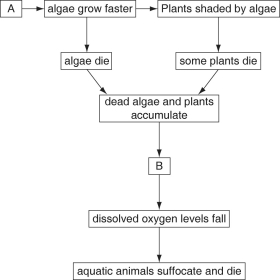 Figure 55.3
-What would be a likely entry for box A?
Figure 55.3
-What would be a likely entry for box A? (Multiple Choice)
5.0/5 (86)
(86) Which of the following has the greatest effect on the rate of chemical cycling in an ecosystem?
(Multiple Choice)
4.8/5 (78)
(78) 
Filters
- Essay(0)
- Multiple Choice(0)
- Short Answer(0)
- True False(0)
- Matching(0)