



 Chat with AI
Exam 17: From Gene to Protein

Exam 1: Introduction: Themes in the Study of Life66 Questions
Exam 2: The Chemical Context of Life83 Questions
Exam 3: Water and the Fitness of the Environment66 Questions
Exam 4: Carbon and the Molecular Diversity of Life68 Questions
Exam 5: The Structure and Function of Large Biological Molecules109 Questions
Exam 6: A Tour of the Cell75 Questions
Exam 7: Membrane Structure and Function75 Questions
Exam 8: An Introduction to Metabolism79 Questions
Exam 9: Cellular Respiration: Harvesting Chemical Energy103 Questions
Exam 10: Photosynthesis74 Questions
Exam 11: Cell Communication62 Questions
Exam 12: The Cell Cycle80 Questions
Exam 13: Meiosis and Sexual Life Cycles68 Questions
Exam 14: Mendel and the Gene Idea90 Questions
Exam 15: The Chromosomal Basis of Inheritance75 Questions
Exam 16: The Molecular Basis of Inheritance72 Questions
Exam 17: From Gene to Protein84 Questions
Exam 18: Control of Gene Expression101 Questions
Exam 19: Viruses38 Questions
Exam 20: Biotechnology70 Questions
Exam 21: Genomes and Their Evolution37 Questions
Exam 22: Descent With Modification: a Darwinian View of Life57 Questions
Exam 23: The Evolution of Populations84 Questions
Exam 24: The Origin of Species60 Questions
Exam 25: The History of Life on Earth85 Questions
Exam 26: Phylogeny and the Tree of Life90 Questions
Exam 27: Bacteria and Archaea78 Questions
Exam 28: Protists79 Questions
Exam 29: Plant Diversity I: How Plants Colonized Land74 Questions
Exam 30: Plant Diversity Ii: the Evolution of Seed Plants101 Questions
Exam 31: Fungi87 Questions
Exam 32: An Introduction to Animal Diversity82 Questions
Exam 33: Invertebrates98 Questions
Exam 34: Vertebrates112 Questions
Exam 35: Plant Structure, Growth, and Development77 Questions
Exam 36: Transport in Vascular Plants84 Questions
Exam 37: Soil and Plant Nutrition85 Questions
Exam 38: Angiosperm Reproduction and Biotechnology86 Questions
Exam 39: Plant Responses to Internal and External Signals111 Questions
Exam 40: Basic Principles of Animal Form and Function74 Questions
Exam 41: Animal Nutrition68 Questions
Exam 42: Circulation and Gas Exchange78 Questions
Exam 43: The Immune System85 Questions
Exam 44: Osmoregulation and Excretion49 Questions
Exam 45: Hormones and the Endocrine System71 Questions
Exam 46: Animal Reproduction85 Questions
Exam 47: Animal Development75 Questions
Exam 48: Neurons, Synapses, and Signaling52 Questions
Exam 49: Nervous Systems48 Questions
Exam 50: Sensory and Motor Mechanisms59 Questions
Exam 51: Animal Behavior74 Questions
Exam 52: An Introduction to Ecology and the Biosphere71 Questions
Exam 53: Population Ecology80 Questions
Exam 54: Community Ecology74 Questions
Exam 55: Ecosystems79 Questions
Exam 56: Conservation Biology and Restoration Ecology65 Questions
Select questions type


The genetic code is essentially the same for all organisms. From this, one can logically assume all of the following except
(Multiple Choice)
4.7/5  (70)
(70) In which of the following actions does RNA polymerase differ from DNA polymerase?
(Multiple Choice)
4.9/5 (97)
(97) The following questions refer to Figure 17.2, a table of codons.
 -What amino acid sequence will be generated, based on the following mRNA codon sequence?
5' AUG-UCU-UCG-UUA-UCC-UUG 3'
-What amino acid sequence will be generated, based on the following mRNA codon sequence?
5' AUG-UCU-UCG-UUA-UCC-UUG 3' (Multiple Choice)
4.8/5 (88)
(88) What type of bonding is responsible for maintaining the shape of the tRNA molecule?
(Multiple Choice)
4.9/5 (88)
(88) During splicing, which molecular component of the spliceosome catalyzes the excision reaction?
(Multiple Choice)
4.8/5 (65)
(65) There are 61 mRNA codons that specify an amino acid, but only 45 tRNAs. This is best explained by the fact that
(Multiple Choice)
4.8/5 (80)
(80) A transcription unit that is 8,000 nucleotides long may use 1,200 nucleotides to make a protein consisting of approximately 400 amino acids. This is best explained by the fact that
(Multiple Choice)
4.9/5 (75)
(75) Which of the following is True for both prokaryotic and eukaryotic gene expression?
(Multiple Choice)
4.9/5 (81)
(81) The following questions refer to Figure 17.5, a table of codons.
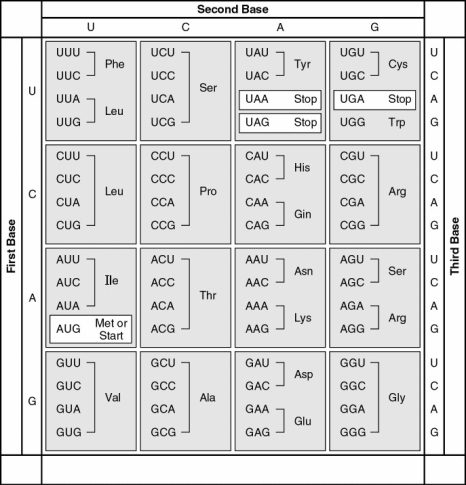 Figure 17.5
-Using Figure 17.5, identify a 5' → 3' sequence of nucleotides in the DNA template strand for an mRNA coding for the polypeptide sequence Phe-Pro-Lys.
Figure 17.5
-Using Figure 17.5, identify a 5' → 3' sequence of nucleotides in the DNA template strand for an mRNA coding for the polypeptide sequence Phe-Pro-Lys. (Multiple Choice)
4.7/5 (87)
(87) Choose the answer that has these events of protein synthesis in the proper sequence. 1. An aminoacyl-tRNA binds to the A site.
2) A peptide bond forms between the new amino acid and a polypeptide chain.
3) tRNA leaves the P site, and the P site remains vacant.
4) A small ribosomal subunit binds with mRNA.
5) tRNA translocates to the P site.
(Multiple Choice)
4.8/5 (58)
(58) Accuracy in the translation of mRNA into the primary structure of a polypeptide depends on specificity in the
(Multiple Choice)
4.7/5 (73)
(73) Use the following information to answer the following questions.
A transfer RNA (#1) attached to the amino acid lysine enters the ribosome. The lysine binds to the growing polypeptide on the other tRNA (#2) in the ribosome already.
-Why might a point mutation in DNA make a difference in the level of protein's activity?
(Multiple Choice)
4.8/5 (83)
(83) Use the following information to answer the following questions.
A transfer RNA (#1) attached to the amino acid lysine enters the ribosome. The lysine binds to the growing polypeptide on the other tRNA (#2) in the ribosome already.
-When the ribosome reaches a stop codon on the mRNA, no corresponding tRNA enters the A site. If the translation reaction were to be experimentally stopped at this point, which of the following would you be able to isolate?
(Multiple Choice)
5.0/5 (72)
(72) Which of the following DNA mutations is the most likely to be damaging to the protein it specifies?
(Multiple Choice)
4.8/5 (67)
(67) When translating secretory or membrane proteins, ribosomes are directed to the ER membrane by
(Multiple Choice)
4.9/5 (71)
(71) Use the following information to answer the following questions.
A transfer RNA (#1) attached to the amino acid lysine enters the ribosome. The lysine binds to the growing polypeptide on the other tRNA (#2) in the ribosome already.
-Where does tRNA #2 move to after this bonding of lysine to the polypeptide?
(Multiple Choice)
4.8/5 (83)
(83) Garrod hypothesized that "inborn errors of metabolism" such as alkaptonuria occur because
(Multiple Choice)
4.8/5 (85)
(85) 
Filters
- Essay(0)
- Multiple Choice(0)
- Short Answer(0)
- True False(0)
- Matching(0)