



 Chat with AI
Exam 39: Plant Sensory Systems, signals, and Responses

Exam 1: Biology and the Tree of Life40 Questions
Exam 2: Water and Carbon: the Chemical Basis of Life50 Questions
Exam 3: Protein Structure and Function47 Questions
Exam 4: Nucleic Acids and the Rna World33 Questions
Exam 5: An Introduction to Carbohydrates30 Questions
Exam 6: Lipids, membranes, and the First Cells47 Questions
Exam 7: Inside the Cell28 Questions
Exam 8: Cell-Cell Interactions27 Questions
Exam 9: Cellular Respiration and Fermentation27 Questions
Exam 10: Photosynthesis32 Questions
Exam 11: The Cell Cycle31 Questions
Exam 12: Meiosis34 Questions
Exam 13: Mendel and the Gene32 Questions
Exam 14: Dna and the Gene: Synthesis and Repair37 Questions
Exam 15: How Genes Work34 Questions
Exam 16: Transcription and Translation38 Questions
Exam 17: Control of Gene Expression in Bacteria31 Questions
Exam 18: Control of Gene Expression in Eukaryotes37 Questions
Exam 19: Analyzing and Engineering Genes40 Questions
Exam 20: Genomics38 Questions
Exam 21: Principles of Development25 Questions
Exam 22: An Introduction to Animal Development22 Questions
Exam 23: An Introduction to Plant Development21 Questions
Exam 24: Evolution by Natural Selection32 Questions
Exam 25: Evolutionary Processes32 Questions
Exam 26: Speciation33 Questions
Exam 27: Phylogenies and the History of Life38 Questions
Exam 28: Bacteria and Archaea38 Questions
Exam 29: Protists34 Questions
Exam 30: Green Plants49 Questions
Exam 31: Fungi37 Questions
Exam 32: An Introduction to Animals38 Questions
Exam 33: Protostome Animals38 Questions
Exam 34: Deuterostome Animals46 Questions
Exam 35: Viruses31 Questions
Exam 36: Plant Form and Function39 Questions
Exam 37: Water and Sugar Transport in Plants42 Questions
Exam 38: Plant Nutrition36 Questions
Exam 39: Plant Sensory Systems, signals, and Responses66 Questions
Exam 40: Plant Reproduction41 Questions
Exam 41: Animal Form and Function29 Questions
Exam 42: Water and Electrolyte Balance in Animals38 Questions
Exam 43: Animal Nutrition37 Questions
Exam 44: Gas Exchange and Circulation37 Questions
Exam 45: Electrical Signals in Animals33 Questions
Exam 46: Animal Sensory Systems and Movement36 Questions
Exam 47: Chemical Signals in Animals33 Questions
Exam 48: Animal Reproduction34 Questions
Exam 49: The Immune System in Animals32 Questions
Exam 50: An Introduction to Ecology38 Questions
Exam 51: Behavioral Ecology37 Questions
Exam 52: Population Ecology46 Questions
Exam 53: Community Ecology39 Questions
Exam 54: Ecosystems41 Questions
Exam 55: Biodiversity and Conservation Biology39 Questions
Select questions type


The cells that have phosphorylated phototropin receptors elongate in response to blue light.
(True/False)
4.7/5  (76)
(76) Which of the following is the strongest evidence that cytokinins regulate cell divisions?
(Multiple Choice)
4.9/5 (97)
(97) You discover a chemical that inhibits the conversion of starch to sugar and inhibits the breakdown of chlorophyll and cellulose in fruit.Who might be interested in buying this chemical?
(Multiple Choice)
4.8/5 (79)
(79) Table 39.1
 -Refer to Table 39.1.Plant B is a short-day flower.Why did it fail to flower?
 (Multiple Choice)
4.9/5 (71)
(71) A caterpillar eats a leaf of a plant.The next day it crawls to a nearby leaf to eat.But after eating the second leaf,the caterpillar gets very sick and falls off the plant.Which of the following molecules were involved in the plant's ability to defend itself against the second attack?
(Multiple Choice)
4.8/5 (72)
(72) Use the following information when answering the corresponding question(s).
Researchers found that high doses of nitric oxide were not lethal to soybean cells.Likewise,high doses of reactive oxygen intermediates were not lethal to soybean cells.However,when combined,nitric oxide and reactive oxygen intermediates were very lethal to soybean cells.(M.Delledonne et al.2001.Signal interactions between nitric oxide and reactive oxygen intermediates in the plant hypersensitive response.Proceedings of the National Academy of Sciences,USA 98(23):13454-59. )
-Refer to the paragraph on Delledonne et al.Based on the findings presented in the paragraph,combined with what you have learned about the hypersensitive response,which sequence of events occurs when a pathogen infects a plant cell? (Only some of the events will be used. )
1)The R protein binds to the avr protein.
2)The pathogen releases avr proteins.
3)The plant cell produces nitric oxide.
4)The pathogen produces reactive oxygen intermediates.
5)A signal transduction cascade occurs.
6)The plant cell and the pathogen die.
7)The pathogen dies,the plant cell lives.
8)The plant cell produces both nitric oxide and reactive oxygen intermediates.
(Multiple Choice)
4.8/5 (81)
(81) Which of the following is not a characteristic of plant hormones?
(Multiple Choice)
4.9/5 (82)
(82) Suppose a plant had a nonsense mutation in a gene that encodes for an enzyme required for the synthesis of gibberellic acid.If the plant is homozygous at this locus,what will its phenotype be?
(Multiple Choice)
4.9/5 (90)
(90) Figure 39.2
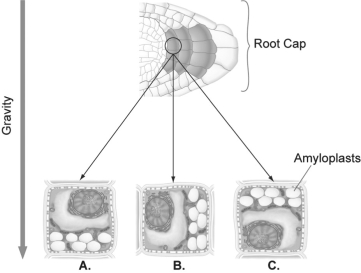 -Suppose you laid a seedling on its side so that the root was parallel to the ground.Immediately after the change in position,where in the root cells (position A,B,or C in Figure 39.2)would you find the amyloplasts? The answer should be one of the positions shown in Figure 39.2.
 (Multiple Choice)
4.9/5 (77)
(77) The addition of a phosphate group to a protein is called _____,and it usually results in _____.
(Multiple Choice)
4.9/5 (76)
(76) Why does auxin move through the plant slower than sucrose does?
(Multiple Choice)
4.8/5 (77)
(77) You buy some fresh fruit at the grocery store.When you get home you are in a hurry,and you put the fresh fruit in the crisper with some overripe fruit.At the end of the week you are disappointed to find that your new fruit has already become overripe.What happened?
(Multiple Choice)
4.9/5 (92)
(92) Use the following information when answering the corresponding question(s).
Some plants have continually produced secondary defense compounds.Other plants are induced to form secondary defense compounds when they are injured.Corn seedling leaves that are chewed on by the caterpillars of a type of cutworm moth emit immediate volatile chemicals (LOX products),and after 6 hours large amounts of terpenoid compounds are released into the air.The terpenoids are released not only from the leaf being chewed,but from all leaves of the plant.The terpenoid compounds attract a parasitoid wasp female that lays her eggs on the caterpillar.When the wasp larvae hatch,they eat and kill the moth caterpillar.(T.C.J.Turlings,J.H.Loughrin,P.J.McCall,U.S.R.Rose,W.J.Lewis,and J.H.Tumlinson.1995.How caterpillar-damaged plants protect themselves by attracting parasitic wasps.Proceedings of the National Academy of Sciences 92:4169-74. )
-Refer to the paragraph on how caterpillar-damaged plants protect themselves by attracting parasitic wasps.How could you test the hypothesis that compounds from the caterpillar alone do not attract parasitoid wasps?
(Multiple Choice)
4.9/5 (75)
(75) A particular species of virus carries a gene for salicylate hydroxylase,an enzyme that breaks down salicylic acid.Will this virus be more or less virulent to plants than other viruses?
(Multiple Choice)
4.8/5 (85)
(85) Figure 39.2
-Suppose you laid a seedling on its side so that the root was parallel to the ground.Several hours after the change in position,where in the root cells (position A,B,or C in Figure 39.2)would you find the amyloplasts?
-Suppose you laid a seedling on its side so that the root was parallel to the ground.Several hours after the change in position,where in the root cells (position A,B,or C in Figure 39.2)would you find the amyloplasts? (Multiple Choice)
4.8/5 (74)
(74) A certain bacterium infects a plant's upper leaves.A few days later,bacteria of the same species attempt to infect the same plant's roots but are unsuccessful.What process is responsible for the plant's ability to prevent this infection?
(Multiple Choice)
4.9/5 (58)
(58) Shoots that grow vertically toward the Sun can be characterized as _____.
(Multiple Choice)
4.8/5 (86)
(86) In the fall,the leaves of some trees change color.This happens because chlorophyll breaks down and the accessory pigments become visible.What hormone is responsible for this?
(Multiple Choice)
4.9/5 (82)
(82) 
Filters
- Essay(0)
- Multiple Choice(0)
- Short Answer(0)
- True False(0)
- Matching(0)