



 Chat with AI
Exam 34: Deuterostome Animals

Exam 1: Biology and the Tree of Life40 Questions
Exam 2: Water and Carbon: the Chemical Basis of Life50 Questions
Exam 3: Protein Structure and Function47 Questions
Exam 4: Nucleic Acids and the Rna World33 Questions
Exam 5: An Introduction to Carbohydrates30 Questions
Exam 6: Lipids, membranes, and the First Cells47 Questions
Exam 7: Inside the Cell28 Questions
Exam 8: Cell-Cell Interactions27 Questions
Exam 9: Cellular Respiration and Fermentation27 Questions
Exam 10: Photosynthesis32 Questions
Exam 11: The Cell Cycle31 Questions
Exam 12: Meiosis34 Questions
Exam 13: Mendel and the Gene32 Questions
Exam 14: Dna and the Gene: Synthesis and Repair37 Questions
Exam 15: How Genes Work34 Questions
Exam 16: Transcription and Translation38 Questions
Exam 17: Control of Gene Expression in Bacteria31 Questions
Exam 18: Control of Gene Expression in Eukaryotes37 Questions
Exam 19: Analyzing and Engineering Genes40 Questions
Exam 20: Genomics38 Questions
Exam 21: Principles of Development25 Questions
Exam 22: An Introduction to Animal Development22 Questions
Exam 23: An Introduction to Plant Development21 Questions
Exam 24: Evolution by Natural Selection32 Questions
Exam 25: Evolutionary Processes32 Questions
Exam 26: Speciation33 Questions
Exam 27: Phylogenies and the History of Life38 Questions
Exam 28: Bacteria and Archaea38 Questions
Exam 29: Protists34 Questions
Exam 30: Green Plants49 Questions
Exam 31: Fungi37 Questions
Exam 32: An Introduction to Animals38 Questions
Exam 33: Protostome Animals38 Questions
Exam 34: Deuterostome Animals46 Questions
Exam 35: Viruses31 Questions
Exam 36: Plant Form and Function39 Questions
Exam 37: Water and Sugar Transport in Plants42 Questions
Exam 38: Plant Nutrition36 Questions
Exam 39: Plant Sensory Systems, signals, and Responses66 Questions
Exam 40: Plant Reproduction41 Questions
Exam 41: Animal Form and Function29 Questions
Exam 42: Water and Electrolyte Balance in Animals38 Questions
Exam 43: Animal Nutrition37 Questions
Exam 44: Gas Exchange and Circulation37 Questions
Exam 45: Electrical Signals in Animals33 Questions
Exam 46: Animal Sensory Systems and Movement36 Questions
Exam 47: Chemical Signals in Animals33 Questions
Exam 48: Animal Reproduction34 Questions
Exam 49: The Immune System in Animals32 Questions
Exam 50: An Introduction to Ecology38 Questions
Exam 51: Behavioral Ecology37 Questions
Exam 52: Population Ecology46 Questions
Exam 53: Community Ecology39 Questions
Exam 54: Ecosystems41 Questions
Exam 55: Biodiversity and Conservation Biology39 Questions
Select questions type


Which of the following have distinct central disks and long,flexible arms?

Free
(Multiple Choice)
4.7/5  (79)
(79) Correct Answer: Verified
E
In what way are monotremes similar to more ancestral chordate lineages,as opposed to more recently evolved mammals?
Free
(Multiple Choice)
4.7/5 (89)
(89) Correct Answer:Verified
VerifiedA
Suppose,while out camping in a forest,you found a chordate with a long,slender,limbless body slithering across the ground near your tent.To which of the following lineages could it belong?
Free
(Multiple Choice)
4.8/5 (84)
(84) Correct Answer:Verified
VerifiedD
Which of the following is a characteristic of all chordates at some point during their life cycle?
(Multiple Choice)
4.9/5 (80)
(80) The presence of vestigial hip and leg bones in boas and pythons is considered evidence for what evolutionary link?
(Multiple Choice)
4.8/5 (86)
(86) Which of the following classes is comprised of carnivorous predators that are able to extend their stomachs through their mouths to feed?
(Multiple Choice)
4.8/5 (82)
(82) Why do adult urochordates (tunicates)lack notochords,even though larval urochordates have them?
(Multiple Choice)
4.9/5 (80)
(80) What would you expect to happen if the midbrain of a fish became damaged?
(Multiple Choice)
4.9/5 (81)
(81) 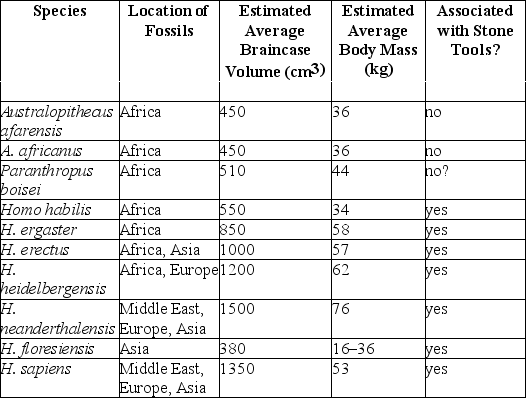 -Refer to the paragraph on Brown et al.and Morwood et al.It is speculated that H.floresiensis and H.sapiens may have lived on Flores concurrently.Suppose researchers obtained mitochondrial DNA samples from the H.floresiensis remains,amplified a 1000-base-pair sequence via PCR,and compared it to that of several currently living H.sapiens native to Indonesia,North Africa,and North America.Also suppose H.floresiensis were found to differ from the average Indonesian H.sapiens in 28 base pairs,from the average North African H.sapiens in 51 base pairs,and from the average North American H.sapiens in 53 base pairs,while two randomly selected H.sapiens differed from each other in an average of 21 base pairs.What would you surmise from these data?
 (Multiple Choice)
4.9/5 (74)
(74)
-The table above is a comparison of several characteristics of H.floresiensis to those of nine other hominin species (arranged roughly from oldest to most recent).What do these data suggest?
-The table above is a comparison of several characteristics of H.floresiensis to those of nine other hominin species (arranged roughly from oldest to most recent).What do these data suggest? (Multiple Choice)
4.8/5 (89)
(89) What would be the result(s)if a tunicate's pharyngeal gill slits were suddenly blocked?
(Multiple Choice)
4.9/5 (94)
(94) Which of the following is found in tetrapods and not in fish?
(Multiple Choice)
4.8/5 (77)
(77) The fishes form a(n)_____,a sequence of paraphyletic lineages.
(Multiple Choice)
4.8/5 (69)
(69) What is the best evidence currently available that tetrapod limbs evolved from fish fins?
(Multiple Choice)
4.7/5 (80)
(80) In what respect do hominins differ from all other anthropoids?
(Multiple Choice)
4.8/5 (83)
(83) Which of the following characteristics would not be helpful in distinguishing between a hagfish and a lamprey?
(Multiple Choice)
4.9/5 (73)
(73) When bone first evolved in vertebrates,what structure did it form?
(Multiple Choice)
4.9/5 (86)
(86) Why do skates and rays have flattened bodies,while sharks are torpedo shaped?
(Multiple Choice)
4.9/5 (93)
(93) Use the following information when answering the corresponding question(s).
Brown et al.and Morwood et al.reported in 2004 that they had found skeletal remains of a previously unknown type of hominin,now dubbed Homo floresiensis,on the Indonesian island of Flores.These hominins were small (approximately 1 m tall),with small braincases (approximately 380 cm³),as compared with other hominins.The remains of H.floresiensis were found alongside handmade stone tools and the remains of dwarf elephants that also inhabited the island,suggesting that H.floresiensis was able both to make tools and to coordinate the hunting of animals much larger than itself.H.floresiensis is estimated to have lived at the site where the remains were found from at least 38,000 years ago to 18,000 years ago.
-Refer to the paragraph on Brown et al.and Morwood et al.Which would be the most feasible method of figuring out to which other hominin species H.floresiensis was most closely related?
(Multiple Choice)
4.8/5 (83)
(83) Which evolutionary innovation was most significant in helping tetrapods move to dry terrestrial environments?
(Multiple Choice)
4.9/5 (74)
(74) 
Filters
- Essay(0)
- Multiple Choice(0)
- Short Answer(0)
- True False(0)
- Matching(0)