



 Chat with AI
Exam 24: Evolution by Natural Selection

Exam 1: Biology and the Tree of Life40 Questions
Exam 2: Water and Carbon: the Chemical Basis of Life50 Questions
Exam 3: Protein Structure and Function47 Questions
Exam 4: Nucleic Acids and the Rna World33 Questions
Exam 5: An Introduction to Carbohydrates30 Questions
Exam 6: Lipids, membranes, and the First Cells47 Questions
Exam 7: Inside the Cell28 Questions
Exam 8: Cell-Cell Interactions27 Questions
Exam 9: Cellular Respiration and Fermentation27 Questions
Exam 10: Photosynthesis32 Questions
Exam 11: The Cell Cycle31 Questions
Exam 12: Meiosis34 Questions
Exam 13: Mendel and the Gene32 Questions
Exam 14: Dna and the Gene: Synthesis and Repair37 Questions
Exam 15: How Genes Work34 Questions
Exam 16: Transcription and Translation38 Questions
Exam 17: Control of Gene Expression in Bacteria31 Questions
Exam 18: Control of Gene Expression in Eukaryotes37 Questions
Exam 19: Analyzing and Engineering Genes40 Questions
Exam 20: Genomics38 Questions
Exam 21: Principles of Development25 Questions
Exam 22: An Introduction to Animal Development22 Questions
Exam 23: An Introduction to Plant Development21 Questions
Exam 24: Evolution by Natural Selection32 Questions
Exam 25: Evolutionary Processes32 Questions
Exam 26: Speciation33 Questions
Exam 27: Phylogenies and the History of Life38 Questions
Exam 28: Bacteria and Archaea38 Questions
Exam 29: Protists34 Questions
Exam 30: Green Plants49 Questions
Exam 31: Fungi37 Questions
Exam 32: An Introduction to Animals38 Questions
Exam 33: Protostome Animals38 Questions
Exam 34: Deuterostome Animals46 Questions
Exam 35: Viruses31 Questions
Exam 36: Plant Form and Function39 Questions
Exam 37: Water and Sugar Transport in Plants42 Questions
Exam 38: Plant Nutrition36 Questions
Exam 39: Plant Sensory Systems, signals, and Responses66 Questions
Exam 40: Plant Reproduction41 Questions
Exam 41: Animal Form and Function29 Questions
Exam 42: Water and Electrolyte Balance in Animals38 Questions
Exam 43: Animal Nutrition37 Questions
Exam 44: Gas Exchange and Circulation37 Questions
Exam 45: Electrical Signals in Animals33 Questions
Exam 46: Animal Sensory Systems and Movement36 Questions
Exam 47: Chemical Signals in Animals33 Questions
Exam 48: Animal Reproduction34 Questions
Exam 49: The Immune System in Animals32 Questions
Exam 50: An Introduction to Ecology38 Questions
Exam 51: Behavioral Ecology37 Questions
Exam 52: Population Ecology46 Questions
Exam 53: Community Ecology39 Questions
Exam 54: Ecosystems41 Questions
Exam 55: Biodiversity and Conservation Biology39 Questions
Select questions type


Who proposed that organisms could be organized into a great chain of being?

Free
(Multiple Choice)
4.7/5  (88)
(88) Correct Answer: Verified
A
Many crustaceans (e.g. ,lobsters,shrimp,and crayfish)use their tails to swim,but crabs have reduced tails that curl under their shells and are not used in swimming.This is an example of _____.
Free
(Multiple Choice)
4.8/5 (75)
(75) Correct Answer:Verified
VerifiedD
The Irish "elk" described by Georges Cuvier suggests that _____.
Free
(Multiple Choice)
4.9/5 (80)
(80) Correct Answer:Verified
VerifiedB
Which of the following scientists argued that variation among individuals allows evolution to occur?
(Multiple Choice)
4.9/5 (68)
(68) Use the following information when answering the corresponding question(s).
The following question(s)are based on information from Frank M.Frey,"Opposing Natural Selection from Herbivores and Pathogens May Maintain Floral-Color Variation in Claytonia virginica (Portulacaceae)," Evolution 58(11),2004: 2426-37.
-Claytonia virginica is a woodland spring herb with flowers that vary from white to pale pink to bright pink.Slugs prefer to eat pink-flowering over white-flowering plants (due to chemical differences between the two),and plants experiencing severe herbivory were more likely to die.The bees that pollinate this plant also prefer pink to white flowers,so that Claytonia with pink flowers have greater relative fruit set than Claytonia with white flowers.A researcher observes that the percentage of different flower colors remains stable in the study population from year to year.Given no other information,if the researcher removes all slugs from the study population,what do you expect to happen to the distribution of flower colors in the population over time?
(Multiple Choice)
4.9/5 (70)
(70) A farmer uses triazine herbicide to control pigweed in his field.For the first few years,the triazine works well and almost all the pigweed dies;but after several years,the farmer sees more and more pigweed.Which of these explanations best describes this observation?
(Multiple Choice)
4.9/5 (73)
(73) Which of the following statements is an example of typological thinking?
(Multiple Choice)
4.9/5 (78)
(78) An individual with a novel adaptation has evolved that adaptation.
(True/False)
4.8/5 (72)
(72) There is a population of beetles that typically have black wings.A scientist studying these beetles knows that their eggs hatch in early spring,the baby insects grow through the late spring and summer,they lay eggs in the early fall,and die in the early winter.Recently some beetles have been born with white wings.Early in life the black and white winged beetles seem to be very similar in number of mating events,eggs laid,and survival rates,but shortly after laying their eggs the white beetles die and there are only black winged beetles during the late fall.Which of the following is a true statement about the beetles?
(Multiple Choice)
4.8/5 (87)
(87) Fossils of Thrinaxodon,a species that lived during the Triassic period,have been found in both South Africa and Antarctica.Thrinaxodon had a reptile-like skeleton and laid eggs,but small depressions on the front of its skull suggest it had whiskers and,therefore,fur.Thrinaxodon may have been warm-blooded.Thrinaxodon shows _____.
(Multiple Choice)
4.8/5 (72)
(72) Figure 24.3
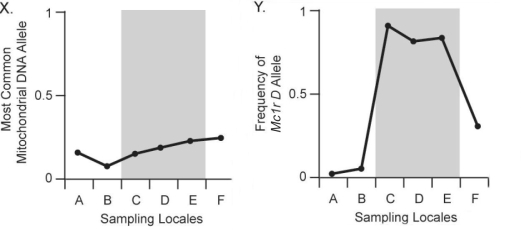 -In Figure 24.3,chart X above shows the frequency of the most common neutral mitochondrial DNA allele (an allele for a gene that does not affect and is not linked to coat color)across six pocket-mouse populations.Populations C,D,and E live on dark volcanic rock;populations A,B,and F live on light-colored granite.Compare this figure with chart Y above.What should you conclude after comparing these two figures?
 (Multiple Choice)
4.8/5 (77)
(77) Gill pouches in chick,human,and house-cat embryos are an example of _____.
(Multiple Choice)
4.9/5 (75)
(75) Which of the following,if discovered,could refute our current understanding of the theory of evolution?
(Multiple Choice)
4.9/5 (74)
(74) Tourist companies start visiting Island X,where a population of medium ground finches (see question 20)feeds on the tough-fruited Tribulus cistoides.The tourist companies set up reliable feeding stations with a variety of bird seeds (different types and sizes),so that tourists can get a better look at the finches.Which of these events is now most likely to occur to finch beaks on Island X?
(Multiple Choice)
4.8/5 (80)
(80) Figure 24.1
The following question(s)are based on information in Hopi E.Hoekstra,Kristen E.Drumm,and Michael W.Nachman,"Ecological Genetics of Adaptive Color Polymorphism in Pocket Mice: Geographic Variation in Selected and Neutral Genes," Evolution 58(6),2004: 1329-41.
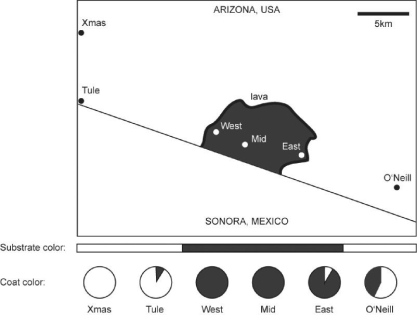 -The figure above shows the distribution of pocket-mouse coat colors in several Arizona populations found either on light-colored granite substrate or on dark volcanic rock (dark substrate).The Melanocortin-1 receptor (Mc1r)alleles,D and d,differ by four amino acids.Mice with DD and Dd genotypes have dark coats,whereas mice with the dd genotype are light colored.What sort of genotype frequencies might you expect to find in the Xmas,Mid,and O'Neill populations?
 (Multiple Choice)
4.8/5 (86)
(86) Why was Darwin and Wallace's theory of evolution by natural selection revolutionary?
(Multiple Choice)
4.9/5 (88)
(88) Which of these conditions are always true of populations evolving due to natural selection?
Condition 1:
The population must vary in traits that are heritable.
Condition 2:
Some heritable traits must increase reproductive success.
Condition 3:
Individuals pass on all traits they acquire during their lifetime.
(Multiple Choice)
4.8/5 (80)
(80) Evolutionary theory predicts that species are related,not independent.Four of the following examples provide support for this prediction.Which one of these examples does not support the claim that species are related?
(Multiple Choice)
4.8/5 (81)
(81) Vestigial traits and neutral changes in DNA sequences are good examples of _____.
(Multiple Choice)
4.8/5 (77)
(77) Which of the following is the best modern definition of evolution?
(Multiple Choice)
4.8/5 (95)
(95) 
Filters
- Essay(0)
- Multiple Choice(0)
- Short Answer(0)
- True False(0)
- Matching(0)