



 Chat with AI
Exam 52: Population Ecology

Exam 1: Biology and the Tree of Life40 Questions
Exam 2: Water and Carbon: the Chemical Basis of Life50 Questions
Exam 3: Protein Structure and Function47 Questions
Exam 4: Nucleic Acids and the Rna World33 Questions
Exam 5: An Introduction to Carbohydrates30 Questions
Exam 6: Lipids, membranes, and the First Cells47 Questions
Exam 7: Inside the Cell28 Questions
Exam 8: Cell-Cell Interactions27 Questions
Exam 9: Cellular Respiration and Fermentation27 Questions
Exam 10: Photosynthesis32 Questions
Exam 11: The Cell Cycle31 Questions
Exam 12: Meiosis34 Questions
Exam 13: Mendel and the Gene32 Questions
Exam 14: Dna and the Gene: Synthesis and Repair37 Questions
Exam 15: How Genes Work34 Questions
Exam 16: Transcription and Translation38 Questions
Exam 17: Control of Gene Expression in Bacteria31 Questions
Exam 18: Control of Gene Expression in Eukaryotes37 Questions
Exam 19: Analyzing and Engineering Genes40 Questions
Exam 20: Genomics38 Questions
Exam 21: Principles of Development25 Questions
Exam 22: An Introduction to Animal Development22 Questions
Exam 23: An Introduction to Plant Development21 Questions
Exam 24: Evolution by Natural Selection32 Questions
Exam 25: Evolutionary Processes32 Questions
Exam 26: Speciation33 Questions
Exam 27: Phylogenies and the History of Life38 Questions
Exam 28: Bacteria and Archaea38 Questions
Exam 29: Protists34 Questions
Exam 30: Green Plants49 Questions
Exam 31: Fungi37 Questions
Exam 32: An Introduction to Animals38 Questions
Exam 33: Protostome Animals38 Questions
Exam 34: Deuterostome Animals46 Questions
Exam 35: Viruses31 Questions
Exam 36: Plant Form and Function39 Questions
Exam 37: Water and Sugar Transport in Plants42 Questions
Exam 38: Plant Nutrition36 Questions
Exam 39: Plant Sensory Systems, signals, and Responses66 Questions
Exam 40: Plant Reproduction41 Questions
Exam 41: Animal Form and Function29 Questions
Exam 42: Water and Electrolyte Balance in Animals38 Questions
Exam 43: Animal Nutrition37 Questions
Exam 44: Gas Exchange and Circulation37 Questions
Exam 45: Electrical Signals in Animals33 Questions
Exam 46: Animal Sensory Systems and Movement36 Questions
Exam 47: Chemical Signals in Animals33 Questions
Exam 48: Animal Reproduction34 Questions
Exam 49: The Immune System in Animals32 Questions
Exam 50: An Introduction to Ecology38 Questions
Exam 51: Behavioral Ecology37 Questions
Exam 52: Population Ecology46 Questions
Exam 53: Community Ecology39 Questions
Exam 54: Ecosystems41 Questions
Exam 55: Biodiversity and Conservation Biology39 Questions
Select questions type


Why can't a female lizard have both high fecundity and high survival?

Free
(Multiple Choice)
4.8/5  (77)
(77) Correct Answer: Verified
D
Which of the following statements regarding the future of populations in developing countries is false?
Free
(Multiple Choice)
4.9/5 (72)
(72) Correct Answer:Verified
VerifiedC
Figure 52.8 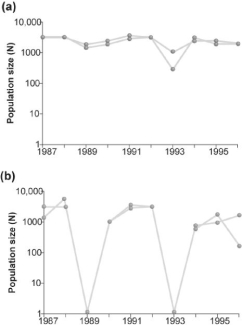 -The graph (b)in Figure 52.8 shows the normal fluctuations of a population of grouse.Assuming graph (a)in Figure 52.8 is the result of some experimental treatment in the grouse population,what can be concluded?
Free
(Multiple Choice)
5.0/5 (60)
(60) Correct Answer:Verified
VerifiedC
Figure 52.3  -In Figure 52.3,which of the lines represents exponential growth?
 (Multiple Choice)
4.9/5 (76)
(76) 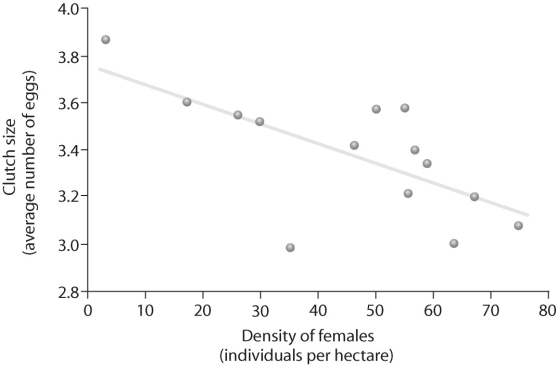 -Which statement about K is false?
Conservationists will take snow geese off the endangered species list when the population hits 10,000.If populations are sustaining growth at r = 0.088 and the population in 2001 is 3000 individuals,in what year will snow geese be taken off the endangered species list?
(Multiple Choice)
4.9/5 (73)
(73) Figure 52.9 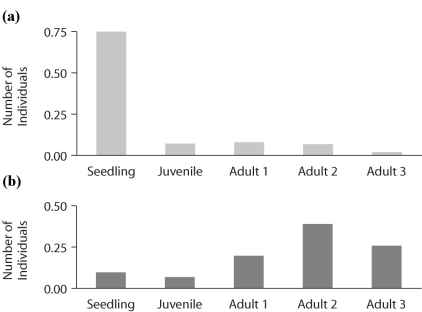 -Which of the following statements about the graphs in Figure 52.9 is false?
 (Multiple Choice)
4.8/5 (76)
(76) What is the primary limiting factor that determines why no female animal can produce a very large number of very large eggs?
(Multiple Choice)
4.7/5 (87)
(87) What can we not determine from examining age pyramids of human populations?
(Multiple Choice)
4.9/5 (83)
(83) Which of these terms defines how the organism allocates resources to growth,reproduction,and activities or structures related to survival?
(Multiple Choice)
4.9/5 (94)
(94) The study of factors that determine the size and structure of populations through time is called _____.
(Multiple Choice)
4.9/5 (68)
(68) Figure 52.4 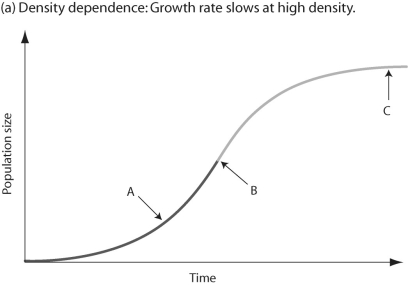 -In Figure 52.4,which of the arrows represents the carrying capacity?
 (Multiple Choice)
4.8/5 (77)
(77) Use the following abstract from Theoretical Population Biology to answer the corresponding question(s).
Abstract:
We derive measures for assessing the value of an individual habitat fragment for the dynamics and persistence of a metapopulation living in a network of many fragments.We demonstrate that the most appropriate measure of fragment value depends on the question asked.Specifically,we analyse four alternative measures: the contribution of a fragment to the metapopulation capacity of the network,to the equilibrium metapopulation size,to the expected time to metapopulation extinction and the long-term contribution of a fragment to colonization events in the network.The latter measure is comparable to density-dependent measures in general matrix population theory,though some differences are introduced by the fact that "density dependence" is spatially localized in the metapopulation context.We show that the value of a fragment depends not only on the properties of the landscape but also on the properties of the species.Most importantly,variation in fragment values between the habitat fragments is greatest in the case of rare species that occur close to the extinction threshold,as these species are likely to be restricted to the most favorable parts of the landscape.We expect that the measures of habitat fragment described and analysed here have applications in landscape ecology and in conservation biology.
-Based on the information in the abstract,which of the following statements is the most correct?
(Multiple Choice)
4.9/5 (84)
(84) Given that fertility rate is defined as each woman producing exactly enough offspring to replace herself and her offspring's father,if the fertility rate is sustained for a generation _____.
(Multiple Choice)
4.8/5 (93)
(93) Use the following abstract from Theoretical Population Biology to answer the corresponding question(s).
Abstract:
We derive measures for assessing the value of an individual habitat fragment for the dynamics and persistence of a metapopulation living in a network of many fragments.We demonstrate that the most appropriate measure of fragment value depends on the question asked.Specifically,we analyse four alternative measures: the contribution of a fragment to the metapopulation capacity of the network,to the equilibrium metapopulation size,to the expected time to metapopulation extinction and the long-term contribution of a fragment to colonization events in the network.The latter measure is comparable to density-dependent measures in general matrix population theory,though some differences are introduced by the fact that "density dependence" is spatially localized in the metapopulation context.We show that the value of a fragment depends not only on the properties of the landscape but also on the properties of the species.Most importantly,variation in fragment values between the habitat fragments is greatest in the case of rare species that occur close to the extinction threshold,as these species are likely to be restricted to the most favorable parts of the landscape.We expect that the measures of habitat fragment described and analysed here have applications in landscape ecology and in conservation biology.
-One measure for the value of the patch was given by the long-term contribution of a fragment to colonization events in the network.How do the properties of a landscape and the properties of a species affect the value of a patch?
(Multiple Choice)
4.9/5 (92)
(92) During the Lacerta vivipara lizard study,researchers monitored individuals on a daily basis to document the number of young produced by each female in the wild.What would be the best way to obtain the same type of data but not have to visit the site every day?
(Multiple Choice)
4.8/5 (85)
(85) Figure 52.13 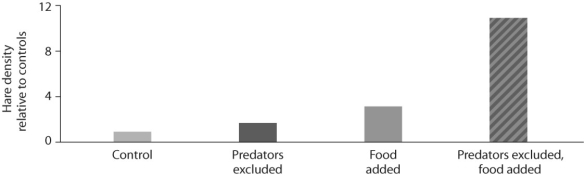 -Looking at the data in Figure 52.13 from the hare/lynx experiment,what conclusion can you draw?
 (Multiple Choice)
4.8/5 (84)
(84) Figure 52.1  -In Figure 52.1,which of the following survivorship curves applies to most plant species?
 (Multiple Choice)
4.7/5 (88)
(88) The regular fluctuations in size of animal populations are termed _____.
(Multiple Choice)
4.7/5 (72)
(72) 
Filters
- Essay(0)
- Multiple Choice(0)
- Short Answer(0)
- True False(0)
- Matching(0)