



 Chat with AI
Exam 14: Dna and the Gene: Synthesis and Repair

Exam 1: Biology and the Tree of Life40 Questions
Exam 2: Water and Carbon: the Chemical Basis of Life50 Questions
Exam 3: Protein Structure and Function47 Questions
Exam 4: Nucleic Acids and the Rna World33 Questions
Exam 5: An Introduction to Carbohydrates30 Questions
Exam 6: Lipids, membranes, and the First Cells47 Questions
Exam 7: Inside the Cell28 Questions
Exam 8: Cell-Cell Interactions27 Questions
Exam 9: Cellular Respiration and Fermentation27 Questions
Exam 10: Photosynthesis32 Questions
Exam 11: The Cell Cycle31 Questions
Exam 12: Meiosis34 Questions
Exam 13: Mendel and the Gene32 Questions
Exam 14: Dna and the Gene: Synthesis and Repair37 Questions
Exam 15: How Genes Work34 Questions
Exam 16: Transcription and Translation38 Questions
Exam 17: Control of Gene Expression in Bacteria31 Questions
Exam 18: Control of Gene Expression in Eukaryotes37 Questions
Exam 19: Analyzing and Engineering Genes40 Questions
Exam 20: Genomics38 Questions
Exam 21: Principles of Development25 Questions
Exam 22: An Introduction to Animal Development22 Questions
Exam 23: An Introduction to Plant Development21 Questions
Exam 24: Evolution by Natural Selection32 Questions
Exam 25: Evolutionary Processes32 Questions
Exam 26: Speciation33 Questions
Exam 27: Phylogenies and the History of Life38 Questions
Exam 28: Bacteria and Archaea38 Questions
Exam 29: Protists34 Questions
Exam 30: Green Plants49 Questions
Exam 31: Fungi37 Questions
Exam 32: An Introduction to Animals38 Questions
Exam 33: Protostome Animals38 Questions
Exam 34: Deuterostome Animals46 Questions
Exam 35: Viruses31 Questions
Exam 36: Plant Form and Function39 Questions
Exam 37: Water and Sugar Transport in Plants42 Questions
Exam 38: Plant Nutrition36 Questions
Exam 39: Plant Sensory Systems, signals, and Responses66 Questions
Exam 40: Plant Reproduction41 Questions
Exam 41: Animal Form and Function29 Questions
Exam 42: Water and Electrolyte Balance in Animals38 Questions
Exam 43: Animal Nutrition37 Questions
Exam 44: Gas Exchange and Circulation37 Questions
Exam 45: Electrical Signals in Animals33 Questions
Exam 46: Animal Sensory Systems and Movement36 Questions
Exam 47: Chemical Signals in Animals33 Questions
Exam 48: Animal Reproduction34 Questions
Exam 49: The Immune System in Animals32 Questions
Exam 50: An Introduction to Ecology38 Questions
Exam 51: Behavioral Ecology37 Questions
Exam 52: Population Ecology46 Questions
Exam 53: Community Ecology39 Questions
Exam 54: Ecosystems41 Questions
Exam 55: Biodiversity and Conservation Biology39 Questions
Select questions type


Watson and Crick elucidated the structure of DNA in 1953.Their research built on and helped explain the findings of other scientists before them,including _____.

Free
(Multiple Choice)
5.0/5  (95)
(95) Correct Answer: Verified
A
Who performed the classic experiments that proved DNA was copied by semiconservative replication?
Free
(Multiple Choice)
5.0/5 (89)
(89) Correct Answer:Verified
VerifiedB
Which of the following are important in reducing the errors in DNA replication in E.coli organisms?
Free
(Multiple Choice)
4.8/5 (74)
(74) Correct Answer:Verified
VerifiedD
In a healthy cell,the rate of DNA repair is equal to the rate of DNA mutation.When the rate of repair lags behind the rate of mutation,what is a possible fate of the cell?
(Multiple Choice)
4.9/5 (84)
(84) What is a major difference between eukaryotic DNA replication and prokaryotic DNA replication?
(Multiple Choice)
4.8/5 (69)
(69) 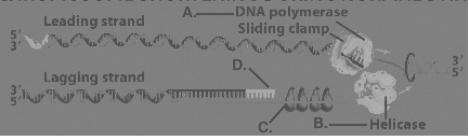 Figure 14.3
-Refer to Figure 14.3.Which of the structures in the figure breaks hydrogen bonds between complementary bases?
Figure 14.3
-Refer to Figure 14.3.Which of the structures in the figure breaks hydrogen bonds between complementary bases? (Short Answer)
4.8/5 (76)
(76) 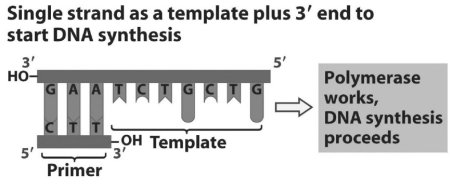 Figure 14.1
-Refer to Figure 14.1.What bases will be added to the primer as DNA replication proceeds? The bases should appear in the order that they will be added starting at the 5' end of the new strand.
Figure 14.1
-Refer to Figure 14.1.What bases will be added to the primer as DNA replication proceeds? The bases should appear in the order that they will be added starting at the 5' end of the new strand. (Multiple Choice)
4.8/5 (75)
(75) Hereditary nonpolyposis colorectal cancer (HNPCC)is an inherited disorder.The genetic defect identified is an error in the mismatch repair mechanism.Which of the following would be an expected result of this mutation?
(Multiple Choice)
4.9/5 (79)
(79) The epsilon (ε)subunit of DNA polymerase III of E.coli has exonuclease activity.How does it function in the proofreading process?
(Multiple Choice)
4.7/5 (72)
(72) DNA replication is highly accurate.It results in about one mistake per billion nucleotides.For the human genome,how often would errors occur?
(Multiple Choice)
4.8/5 (82)
(82) What is the difference between the leading strand and the lagging strand in DNA replication?
(Multiple Choice)
4.7/5 (81)
(81) DNA contains the template needed to copy itself,but as you learned in Chapter 4,it has no catalytic activity.What catalyzes the formation of phosphodiester bonds between adjacent nucleotides in the DNA polymer being formed?
(Multiple Choice)
4.8/5 (80)
(80) 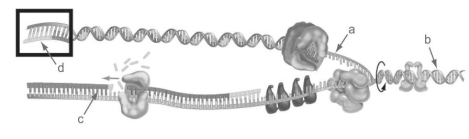 Figure 14.2
-Identify the lagging strand during duplication of DNA starting from a double helix in Figure 14.2.
Figure 14.2
-Identify the lagging strand during duplication of DNA starting from a double helix in Figure 14.2. (Multiple Choice)
4.9/5 (97)
(97) Which of the following would be least likely to cause DNA damage in an individual suffering from xeroderma pigmentosum?
(Multiple Choice)
4.7/5 (77)
(77) Semiconservative replication involves a template.What is the template?
(Multiple Choice)
4.8/5 (69)
(69) Which of the following cells do not have active telomerase activity?
(Multiple Choice)
4.9/5 (69)
(69) In the mismatch repair process,enzyme complexes replace bases that were incorrectly inserted into the newly synthesized DNA strand.To function,they must be able to distinguish between the parent DNA strand and the new strand.How is this accomplished?
(Multiple Choice)
4.9/5 (80)
(80) 
Filters
- Essay(0)
- Multiple Choice(0)
- Short Answer(0)
- True False(0)
- Matching(0)