



 Chat with AI
Exam 20: Genomics

Exam 1: Biology and the Tree of Life40 Questions
Exam 2: Water and Carbon: the Chemical Basis of Life50 Questions
Exam 3: Protein Structure and Function47 Questions
Exam 4: Nucleic Acids and the Rna World33 Questions
Exam 5: An Introduction to Carbohydrates30 Questions
Exam 6: Lipids, membranes, and the First Cells47 Questions
Exam 7: Inside the Cell28 Questions
Exam 8: Cell-Cell Interactions27 Questions
Exam 9: Cellular Respiration and Fermentation27 Questions
Exam 10: Photosynthesis32 Questions
Exam 11: The Cell Cycle31 Questions
Exam 12: Meiosis34 Questions
Exam 13: Mendel and the Gene32 Questions
Exam 14: Dna and the Gene: Synthesis and Repair37 Questions
Exam 15: How Genes Work34 Questions
Exam 16: Transcription and Translation38 Questions
Exam 17: Control of Gene Expression in Bacteria31 Questions
Exam 18: Control of Gene Expression in Eukaryotes37 Questions
Exam 19: Analyzing and Engineering Genes40 Questions
Exam 20: Genomics38 Questions
Exam 21: Principles of Development25 Questions
Exam 22: An Introduction to Animal Development22 Questions
Exam 23: An Introduction to Plant Development21 Questions
Exam 24: Evolution by Natural Selection32 Questions
Exam 25: Evolutionary Processes32 Questions
Exam 26: Speciation33 Questions
Exam 27: Phylogenies and the History of Life38 Questions
Exam 28: Bacteria and Archaea38 Questions
Exam 29: Protists34 Questions
Exam 30: Green Plants49 Questions
Exam 31: Fungi37 Questions
Exam 32: An Introduction to Animals38 Questions
Exam 33: Protostome Animals38 Questions
Exam 34: Deuterostome Animals46 Questions
Exam 35: Viruses31 Questions
Exam 36: Plant Form and Function39 Questions
Exam 37: Water and Sugar Transport in Plants42 Questions
Exam 38: Plant Nutrition36 Questions
Exam 39: Plant Sensory Systems, signals, and Responses66 Questions
Exam 40: Plant Reproduction41 Questions
Exam 41: Animal Form and Function29 Questions
Exam 42: Water and Electrolyte Balance in Animals38 Questions
Exam 43: Animal Nutrition37 Questions
Exam 44: Gas Exchange and Circulation37 Questions
Exam 45: Electrical Signals in Animals33 Questions
Exam 46: Animal Sensory Systems and Movement36 Questions
Exam 47: Chemical Signals in Animals33 Questions
Exam 48: Animal Reproduction34 Questions
Exam 49: The Immune System in Animals32 Questions
Exam 50: An Introduction to Ecology38 Questions
Exam 51: Behavioral Ecology37 Questions
Exam 52: Population Ecology46 Questions
Exam 53: Community Ecology39 Questions
Exam 54: Ecosystems41 Questions
Exam 55: Biodiversity and Conservation Biology39 Questions
Select questions type


If alternative splicing did not occur,a prediction would be that _____.

Free
(Multiple Choice)
4.8/5  (68)
(68) Correct Answer: Verified
A
A DNA microarray is a tool that owes its existence to earlier genomics investigations.What essential contribution of genomics makes microarrays possible?
Free
(Multiple Choice)
4.7/5 (81)
(81) Correct Answer:Verified
VerifiedD
In what sense are studies by 19th-century naturalists and those by early 21st-century genomic biologists similar?
Free
(Multiple Choice)
4.9/5 (90)
(90) Correct Answer:Verified
VerifiedD
Which of the following makes it difficult to identify eukaryotic genes?
(Multiple Choice)
4.8/5 (83)
(83) In eukaryotes,the major mechanism of introducing new genes into the genome is _____.
(Multiple Choice)
4.9/5 (82)
(82) Even though bacteria are more simple than eukaryotes,genomic data on bacteria was surprising because _____.
(Multiple Choice)
4.9/5 (73)
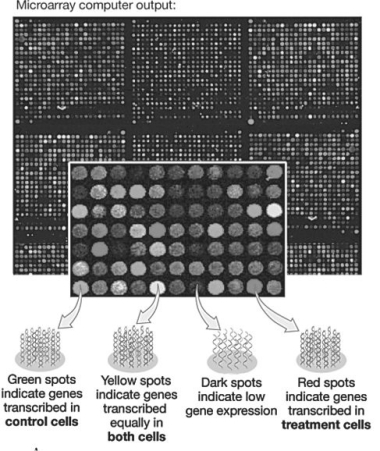
(73) Like DNA microarrays,Northern blots analyze the levels of mRNA.However,Northern blots are almost always prepared with a probe tagged with one label,whereas DNA microarrays almost always use two groups of probes,each one tagged with a different fluorescent label.What advantage is conferred by using two labels for the microarray probes?
(Multiple Choice)
4.9/5 (91)
(91) In comparing DNA sequences from two different eukaryotic organisms,which do you expect to vary the most?
(Multiple Choice)
4.7/5 (63)
(63) The following table from the Venter et al.paper presents the numbers of different types of genes discovered in this study.
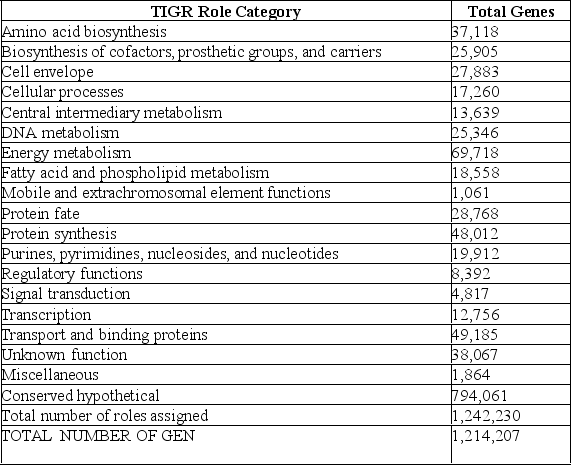 -Refer to the paragraph on the Venter et al.paper and Table 20.1 Because DNAs for sequencing were chosen at random with no way of knowing which organism they came from,how could genes be identified?
 (Multiple Choice)
4.9/5 (69)
(69)  -Refer to the paragraph on the Venter et al.paper.Why would any sequence assembly program be written so as to ignore repeated sequences?
 (Multiple Choice)
4.8/5 (78)
(78) In establishing paternity by DNA fingerprinting,what proportion of microsatellite repeat alleles in a child come from the father?
(Multiple Choice)
4.9/5 (81)
(81) A scientist needs to find a collaborating scientist to help her with organizing a large amount of sequence data from the genome of a previously unsequenced and rare plant.This scientist should find a collaborator who specializes in _____,
(Multiple Choice)
5.0/5 (80)
(80)
-Refer to the paragraph on the Venter et al.paper.Why was it necessary to modify the standard sequence assembly algorithms when analyzing DNAs from many different pooled species?
-Refer to the paragraph on the Venter et al.paper.Why was it necessary to modify the standard sequence assembly algorithms when analyzing DNAs from many different pooled species? (Multiple Choice)
4.9/5 (74)
(74) Why are transposable elements considered to be selfish genes?
(Multiple Choice)
4.8/5 (70)
(70) If the sequence of a cDNA matches a DNA sequence in the genome,then this genomic DNA is likely to _____.
(Multiple Choice)
4.7/5 (81)
(81) Mutations that occur in one member of a gene pair that arose from gene duplication may create _____.
(Multiple Choice)
4.9/5 (87)
(87) The following table from the Venter et al.paper presents the numbers of different types of genes discovered in this study.
-Refer to the paragraph on the Venter et al.paper and Table 20.1 How do you think putative genes were placed into the categories shown in the preceding table?
-Refer to the paragraph on the Venter et al.paper and Table 20.1 How do you think putative genes were placed into the categories shown in the preceding table? (Multiple Choice)
4.9/5 (71)
(71) Sequencing eukaryotic genomes is more difficult than sequencing genomes of bacteria or archaea because of _____.
(Multiple Choice)
4.8/5 (71)
(71) 
Filters
- Essay(0)
- Multiple Choice(0)
- Short Answer(0)
- True False(0)
- Matching(0)