



 Chat with AI
Exam 43: Animal Nutrition

Exam 1: Biology and the Tree of Life40 Questions
Exam 2: Water and Carbon: the Chemical Basis of Life50 Questions
Exam 3: Protein Structure and Function47 Questions
Exam 4: Nucleic Acids and the Rna World33 Questions
Exam 5: An Introduction to Carbohydrates30 Questions
Exam 6: Lipids, membranes, and the First Cells47 Questions
Exam 7: Inside the Cell28 Questions
Exam 8: Cell-Cell Interactions27 Questions
Exam 9: Cellular Respiration and Fermentation27 Questions
Exam 10: Photosynthesis32 Questions
Exam 11: The Cell Cycle31 Questions
Exam 12: Meiosis34 Questions
Exam 13: Mendel and the Gene32 Questions
Exam 14: Dna and the Gene: Synthesis and Repair37 Questions
Exam 15: How Genes Work34 Questions
Exam 16: Transcription and Translation38 Questions
Exam 17: Control of Gene Expression in Bacteria31 Questions
Exam 18: Control of Gene Expression in Eukaryotes37 Questions
Exam 19: Analyzing and Engineering Genes40 Questions
Exam 20: Genomics38 Questions
Exam 21: Principles of Development25 Questions
Exam 22: An Introduction to Animal Development22 Questions
Exam 23: An Introduction to Plant Development21 Questions
Exam 24: Evolution by Natural Selection32 Questions
Exam 25: Evolutionary Processes32 Questions
Exam 26: Speciation33 Questions
Exam 27: Phylogenies and the History of Life38 Questions
Exam 28: Bacteria and Archaea38 Questions
Exam 29: Protists34 Questions
Exam 30: Green Plants49 Questions
Exam 31: Fungi37 Questions
Exam 32: An Introduction to Animals38 Questions
Exam 33: Protostome Animals38 Questions
Exam 34: Deuterostome Animals46 Questions
Exam 35: Viruses31 Questions
Exam 36: Plant Form and Function39 Questions
Exam 37: Water and Sugar Transport in Plants42 Questions
Exam 38: Plant Nutrition36 Questions
Exam 39: Plant Sensory Systems, signals, and Responses66 Questions
Exam 40: Plant Reproduction41 Questions
Exam 41: Animal Form and Function29 Questions
Exam 42: Water and Electrolyte Balance in Animals38 Questions
Exam 43: Animal Nutrition37 Questions
Exam 44: Gas Exchange and Circulation37 Questions
Exam 45: Electrical Signals in Animals33 Questions
Exam 46: Animal Sensory Systems and Movement36 Questions
Exam 47: Chemical Signals in Animals33 Questions
Exam 48: Animal Reproduction34 Questions
Exam 49: The Immune System in Animals32 Questions
Exam 50: An Introduction to Ecology38 Questions
Exam 51: Behavioral Ecology37 Questions
Exam 52: Population Ecology46 Questions
Exam 53: Community Ecology39 Questions
Exam 54: Ecosystems41 Questions
Exam 55: Biodiversity and Conservation Biology39 Questions
Select questions type


A major enzyme involved in protein digestion is _____.

Free
(Multiple Choice)
4.9/5  (79)
(79) Correct Answer: Verified
C
You are most likely to observe coprophagy in which of the following animals?
Free
(Multiple Choice)
4.9/5 (79)
(79) Correct Answer:Verified
VerifiedB
What is the importance of consuming an adequate amount of proteins in the diet?
Free
(Multiple Choice)
4.8/5 (81)
(81) Correct Answer:Verified
VerifiedB
The pancreas is involved in the digestion of which of the following?
(Multiple Choice)
4.9/5 (89)
(89) Refer to the following nutrition label for the corresponding question(s).Apple juice has the following nutrition label:
Contains 100% Juice
 -How many food calories does the jug of apple juice contain?
 (Multiple Choice)
4.8/5 (70)
(70) Figure 43.3
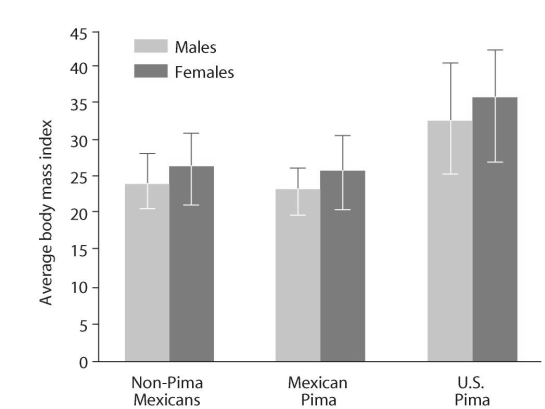 -The Pimas are a group of people living in the southwestern U.S.and Mexico.Although Pima Indians living in the U.S.and Mexico have a similar genetic background,a five-fold increase in the incidence of type II diabetes mellitus among U.S.Pima has been reported.The body mass index of Mexicans of non-Pima descent,Mexicans of Pima descent,and Pimas living in the U.S.is shown in Figure 43.3.Based on this graph,what can you infer about the incidence of type II diabetes mellitus?
 (Multiple Choice)
4.8/5 (80)
(80) Aquaporins have been identified in the epithelium of the large intestine.What is the function of these aquaporins?
(Multiple Choice)
4.8/5 (85)
(85) Why did scientists originally hypothesize that proteolytic enzymes like pepsin and trypsin are secreted in inactive form?
(Multiple Choice)
4.7/5 (80)
(80) Figure 43.2
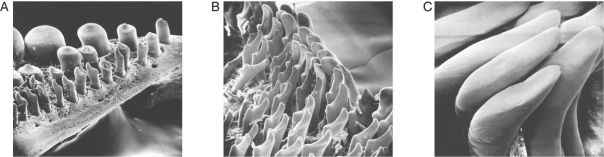 -The electron micrograms in Figure 43.2 are images of mouthparts of different animals.Which of the mouthparts are specialized for crushing and grinding?
 (Short Answer)
4.9/5 (74)
(74) Refer to the following nutrition label for the corresponding question(s).Apple juice has the following nutrition label:
Contains 100% Juice
-If the person consumes 2500 calories daily to maintain body weight,what percentage of the RDA for iron would this person receive from a serving of apple juice?
-If the person consumes 2500 calories daily to maintain body weight,what percentage of the RDA for iron would this person receive from a serving of apple juice? (Multiple Choice)
4.7/5 (77)
(77) Which of the following molecules are absorbed from the lumen of the small intestine into epithelial cells through simple diffusion?
(Multiple Choice)
4.8/5 (84)
(84) Figure 43.1
 -What can the mouthparts of an animal tell you about its diet?
 (Multiple Choice)
4.8/5 (78)
(78) Refer to the following nutrition label for the corresponding question(s).Apple juice has the following nutrition label:
Contains 100% Juice
-From the nutrition information contained on the label above,you can infer that apple juice would be useful in the treatment of which of the following vitamin deficiencies?
-From the nutrition information contained on the label above,you can infer that apple juice would be useful in the treatment of which of the following vitamin deficiencies? (Multiple Choice)
4.9/5 (69)
(69) The function of mechanical digestion is to break down large chunks of food into smaller pieces.Why is this important?
(Multiple Choice)
4.7/5 (82)
(82) What is the purpose of the villi and microvilli in the small intestine?
(Multiple Choice)
4.8/5 (80)
(80) Over-the-counter medications for acid reflux or heartburn block the production of stomach acid.Which of the following cells are directly affected by this medication?
(Multiple Choice)
4.7/5 (78)
(78) A major risk factor for atherosclerosis is high levels of dietary cholesterol.If you get your lipid levels checked regularly,which of the following,when elevated,most significantly increases your risk for developing atherosclerosis?
(Multiple Choice)
4.8/5 (64)
(64) After a large meal the production of _____ will increase.After fasting the production of _____ will increase.
(Multiple Choice)
4.7/5 (92)
(92) If there is a strong genetic link for type II diabetes mellitus in your family,how might you minimize your risk of developing the disorder?
(Multiple Choice)
4.8/5 (89)
(89) If you place a small piece of a salted cracker on your tongue,what would you expect to happen?
(Multiple Choice)
4.8/5 (82)
(82) 
Filters
- Essay(0)
- Multiple Choice(0)
- Short Answer(0)
- True False(0)
- Matching(0)