



 Chat with AI
Exam 15: How Genes Work

Exam 1: Biology and the Tree of Life40 Questions
Exam 2: Water and Carbon: the Chemical Basis of Life50 Questions
Exam 3: Protein Structure and Function47 Questions
Exam 4: Nucleic Acids and the Rna World33 Questions
Exam 5: An Introduction to Carbohydrates30 Questions
Exam 6: Lipids, membranes, and the First Cells47 Questions
Exam 7: Inside the Cell28 Questions
Exam 8: Cell-Cell Interactions27 Questions
Exam 9: Cellular Respiration and Fermentation27 Questions
Exam 10: Photosynthesis32 Questions
Exam 11: The Cell Cycle31 Questions
Exam 12: Meiosis34 Questions
Exam 13: Mendel and the Gene32 Questions
Exam 14: Dna and the Gene: Synthesis and Repair37 Questions
Exam 15: How Genes Work34 Questions
Exam 16: Transcription and Translation38 Questions
Exam 17: Control of Gene Expression in Bacteria31 Questions
Exam 18: Control of Gene Expression in Eukaryotes37 Questions
Exam 19: Analyzing and Engineering Genes40 Questions
Exam 20: Genomics38 Questions
Exam 21: Principles of Development25 Questions
Exam 22: An Introduction to Animal Development22 Questions
Exam 23: An Introduction to Plant Development21 Questions
Exam 24: Evolution by Natural Selection32 Questions
Exam 25: Evolutionary Processes32 Questions
Exam 26: Speciation33 Questions
Exam 27: Phylogenies and the History of Life38 Questions
Exam 28: Bacteria and Archaea38 Questions
Exam 29: Protists34 Questions
Exam 30: Green Plants49 Questions
Exam 31: Fungi37 Questions
Exam 32: An Introduction to Animals38 Questions
Exam 33: Protostome Animals38 Questions
Exam 34: Deuterostome Animals46 Questions
Exam 35: Viruses31 Questions
Exam 36: Plant Form and Function39 Questions
Exam 37: Water and Sugar Transport in Plants42 Questions
Exam 38: Plant Nutrition36 Questions
Exam 39: Plant Sensory Systems, signals, and Responses66 Questions
Exam 40: Plant Reproduction41 Questions
Exam 41: Animal Form and Function29 Questions
Exam 42: Water and Electrolyte Balance in Animals38 Questions
Exam 43: Animal Nutrition37 Questions
Exam 44: Gas Exchange and Circulation37 Questions
Exam 45: Electrical Signals in Animals33 Questions
Exam 46: Animal Sensory Systems and Movement36 Questions
Exam 47: Chemical Signals in Animals33 Questions
Exam 48: Animal Reproduction34 Questions
Exam 49: The Immune System in Animals32 Questions
Exam 50: An Introduction to Ecology38 Questions
Exam 51: Behavioral Ecology37 Questions
Exam 52: Population Ecology46 Questions
Exam 53: Community Ecology39 Questions
Exam 54: Ecosystems41 Questions
Exam 55: Biodiversity and Conservation Biology39 Questions
Select questions type


Figure 15.4.
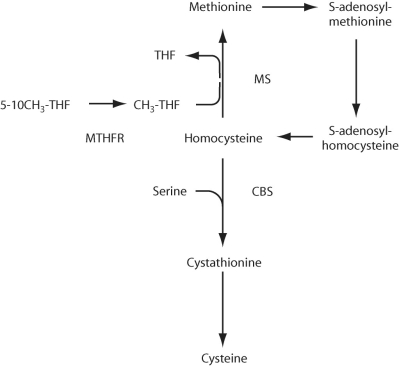 -Refer to Figure 15.4.Homocystinuria is a genetic disorder that results from a defect in one of the enzymes of the metabolic pathway shown.The gene for which enzyme/molecule is most likely defective?
Free
(Multiple Choice)
4.8/5  (78)
(78) Correct Answer: Verified
D
What does it mean when we say the genetic code is redundant?
Free
(Multiple Choice)
4.8/5 (82)
(82) Correct Answer:Verified
VerifiedD
What molecule serves as a link between the information-containing macromolecule,DNA,and protein synthesis?
Free
(Multiple Choice)
4.7/5 (84)
(84) Correct Answer:Verified
VerifiedC
Figure 15.2
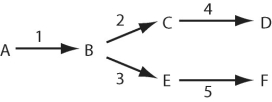 -Refer to Figure 15.2.A branched metabolic pathway synthesizes two related amino acids (D and F).If there is a genetic defect,resulting in a nonfunctional enzyme (3),how could you ensure that adequate amounts of the amino acid F are synthesized?
 (Multiple Choice)
4.7/5 (87)
(87) 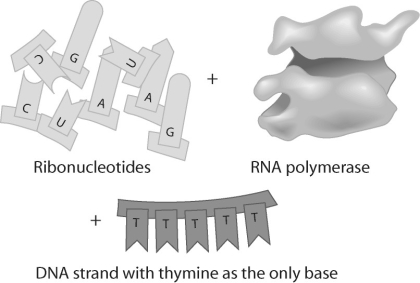 -Given the DNA template shown above,which of the following bases would you find in a complementary RNA strand and where would they be synthesized?
 (Multiple Choice)
4.9/5 (85)
(85) Once researchers identified DNA as the unit of inheritance,they asked how information was transferred from the DNA in the nucleus to the site of protein synthesis in the cytoplasm.What is the mechanism of information transfer?
(Multiple Choice)
4.9/5 (94)
(94) Beadle discovered that metabolic pathways are studied most effectively using which of the following techniques?
(Multiple Choice)
4.8/5 (81)
(81) The proteome is all the proteins produced by an organism.The genome is the totality of all genes of an organism.If the proteome is much larger than the genome,which of the following statements would be accurate?
(Multiple Choice)
4.8/5 (75)
(75) There are three stop codons (nonsense codons);all remaining codons specify addition of an amino acid (sense codons).How many sense codons are there?
(Multiple Choice)
4.7/5 (74)
(74) The HIV virus that causes AIDS is an RNA virus.What is an RNA virus?
(Multiple Choice)
4.9/5 (76)
(76) Knockout mice have been genetically altered to knock out specific genes.How are these mice most often used in research?
(Multiple Choice)
5.0/5 (78)
(78) In the Morse code,a series of dots and dashes code for letters of the alphabet.How is this analogous to the genetic code?
(Multiple Choice)
4.8/5 (91)
(91) The original DNA has the base sequence AGCGTTACCGT;a mutation in the DNA strand results in the base sequence AGGCGTTACCGT.What does this tell you about the mutation?
(Multiple Choice)
4.9/5 (85)
(85) Which of the following molecules is not required for translation?
(Multiple Choice)
4.9/5 (69)
(69) According to the central dogma,what molecule should go in the blank?
DNA → _____ → Proteins
(Multiple Choice)
4.8/5 (82)
(82) Codons,the three base sequences that code for specific amino acids,are part of _____.
(Multiple Choice)
4.8/5 (85)
(85) Which of the following is not synthesized from a DNA template?
(Multiple Choice)
4.9/5 (92)
(92) 
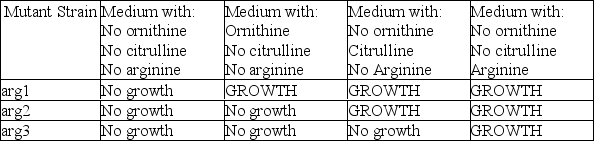 -According to the table and figure above,which enzyme is defective in the strain with the arg2 mutation?
 (Multiple Choice)
4.8/5 (73)
(73) 
Filters
- Essay(0)
- Multiple Choice(0)
- Short Answer(0)
- True False(0)
- Matching(0)