



 Chat with AI
Exam 25: Evolutionary Processes

Exam 1: Biology and the Tree of Life40 Questions
Exam 2: Water and Carbon: the Chemical Basis of Life50 Questions
Exam 3: Protein Structure and Function47 Questions
Exam 4: Nucleic Acids and the Rna World33 Questions
Exam 5: An Introduction to Carbohydrates30 Questions
Exam 6: Lipids, membranes, and the First Cells47 Questions
Exam 7: Inside the Cell28 Questions
Exam 8: Cell-Cell Interactions27 Questions
Exam 9: Cellular Respiration and Fermentation27 Questions
Exam 10: Photosynthesis32 Questions
Exam 11: The Cell Cycle31 Questions
Exam 12: Meiosis34 Questions
Exam 13: Mendel and the Gene32 Questions
Exam 14: Dna and the Gene: Synthesis and Repair37 Questions
Exam 15: How Genes Work34 Questions
Exam 16: Transcription and Translation38 Questions
Exam 17: Control of Gene Expression in Bacteria31 Questions
Exam 18: Control of Gene Expression in Eukaryotes37 Questions
Exam 19: Analyzing and Engineering Genes40 Questions
Exam 20: Genomics38 Questions
Exam 21: Principles of Development25 Questions
Exam 22: An Introduction to Animal Development22 Questions
Exam 23: An Introduction to Plant Development21 Questions
Exam 24: Evolution by Natural Selection32 Questions
Exam 25: Evolutionary Processes32 Questions
Exam 26: Speciation33 Questions
Exam 27: Phylogenies and the History of Life38 Questions
Exam 28: Bacteria and Archaea38 Questions
Exam 29: Protists34 Questions
Exam 30: Green Plants49 Questions
Exam 31: Fungi37 Questions
Exam 32: An Introduction to Animals38 Questions
Exam 33: Protostome Animals38 Questions
Exam 34: Deuterostome Animals46 Questions
Exam 35: Viruses31 Questions
Exam 36: Plant Form and Function39 Questions
Exam 37: Water and Sugar Transport in Plants42 Questions
Exam 38: Plant Nutrition36 Questions
Exam 39: Plant Sensory Systems, signals, and Responses66 Questions
Exam 40: Plant Reproduction41 Questions
Exam 41: Animal Form and Function29 Questions
Exam 42: Water and Electrolyte Balance in Animals38 Questions
Exam 43: Animal Nutrition37 Questions
Exam 44: Gas Exchange and Circulation37 Questions
Exam 45: Electrical Signals in Animals33 Questions
Exam 46: Animal Sensory Systems and Movement36 Questions
Exam 47: Chemical Signals in Animals33 Questions
Exam 48: Animal Reproduction34 Questions
Exam 49: The Immune System in Animals32 Questions
Exam 50: An Introduction to Ecology38 Questions
Exam 51: Behavioral Ecology37 Questions
Exam 52: Population Ecology46 Questions
Exam 53: Community Ecology39 Questions
Exam 54: Ecosystems41 Questions
Exam 55: Biodiversity and Conservation Biology39 Questions
Select questions type


Two frog populations (same species)living in two neighboring lakes sing slightly different courtship songs.Increased irrigation makes the land between the two lakes wetter,allowing frogs to expand their ranges to the area between the lakes.Females in both populations prefer loud frogs to quieter frogs,but do not distinguish between the two slightly different songs.Assuming that courtship song differences have a genetic basis,predict what will likely happen to the songs of the two frog populations.

Free
(Multiple Choice)
4.8/5  (76)
(76) Correct Answer: Verified
A
Genetic drift occurs in a population.Which of the following statements might be true?
Free
(Multiple Choice)
4.9/5 (92)
(92) Correct Answer:Verified
VerifiedE
The Dunkers are a religious group that moved from Germany to Pennsylvania in the mid-1700s.They do not marry with members outside their own immediate community.Today,the Dunkers are genetically unique and differ in gene frequencies,at many loci,from all other populations including those in their original homeland.Which of the following likely explains the genetic uniqueness of this population?
Free
(Multiple Choice)
4.9/5 (71)
(71) Correct Answer:Verified
VerifiedE
Figure 25.1.
Use the following information when answering the following question(s).
Researchers studying a small milkweed population note that some plants produce a toxin and other plants do not.They identify the gene responsible for toxin production.The dominant allele (T)codes for an enzyme that makes the toxin,and the recessive allele (t)codes for a nonfunctional enzyme that cannot produce the toxin.Heterozygotes produce an intermediate amount of toxin.The genotypes of all individuals in the population are determined (see chart)and used to determine the actual allele frequencies in the population.
 -Based on whether the population in Figure 25.1 is in Hardy-Weinberg equilibrium,the researchers had already noted that negligible mutation and migration existed in this milkweed population,and the toxin does not affect the butterflies that pollinate these plants.Which of the following would be a logical conclusion about this milkweed population?
 (Multiple Choice)
4.9/5 (80)
(80) Figure 25.3
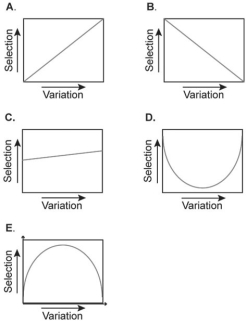 -Which of the graphs (Fig 25.3)best represents the relationship between the intensity of directional selection and the genetic variation present within a population?
 (Multiple Choice)
4.9/5 (75)
(75) Figure 25.1.
Use the following information when answering the following question(s).
Researchers studying a small milkweed population note that some plants produce a toxin and other plants do not.They identify the gene responsible for toxin production.The dominant allele (T)codes for an enzyme that makes the toxin,and the recessive allele (t)codes for a nonfunctional enzyme that cannot produce the toxin.Heterozygotes produce an intermediate amount of toxin.The genotypes of all individuals in the population are determined (see chart)and used to determine the actual allele frequencies in the population.
-Refer to Figure 25.1.Is this population in Hardy-Weinberg equilibrium?
-Refer to Figure 25.1.Is this population in Hardy-Weinberg equilibrium? (Multiple Choice)
4.9/5 (73)
(73) In Kerr and Wright's experiment with 96 fruit-fly populations,only 4 males and 4 females bred in each generation.After 16 generations,73% of their populations had only one allele present for the bristle morphology gene.Which of the following would you expect to occur if they allowed 10 males and 10 females to breed in each generation?
(Multiple Choice)
4.9/5 (73)
(73) Which sex typically has more extreme sex-selected characteristics:
males or females? Why? Give an example.
(Short Answer)
4.7/5 (87)
(87) Three-spined stickleback fish (Gasterosteus aculeatus)show substantial heritable variation in gill-raker length.Fish caught in open water tend to have longer gill rakers and eat different foods than do those caught in shallower water.Longer gill rakers appear to function better for capturing open-water prey,while shorter gill rakers function better for capturing shallow-water prey.Which of the following types of selection is most likely to be found in a large lake (open water in middle and shallow water around the sides)with a high density of these fish?
(Multiple Choice)
4.8/5 (69)
(69) Use the following information when answering the corresponding question(s).
In 1983 a population of dark-eyed junco birds became established on the campus of the University of California,San Diego (UCSD),which is located many miles from the junco's normal habitat in the mixed-coniferous temperate forests in the mountains.Juncos have white outer tail feathers that the males display during aggressive interactions and during courtship displays.Males with more white in their tail are more likely to win aggressive interactions,and females prefer to mate with males with more white in their tails.Females have less white in their tails than do males,and display it less often.(Pamela J.Yeh.2004.Rapid evolution of a sexually selected trait following population establishment in a novel habitat.Evolution 58[1]:166-74. )
-Refer to the paragraph on dark-eyed junco birds.The UCSD campus male junco population tails were,on average,36% white,whereas the tails of males from nearby mountain populations averaged 40-45% white.If this observed trait difference were due to a difference in the original colonizing population,it would most likely be due to _____.
(Multiple Choice)
4.9/5 (90)
(90) In 1986 a nuclear power accident in Chernobyl,USSR (now Ukraine),led to high radiation levels for miles surrounding the plant.The high levels of radiation caused elevated mutation rates in the surviving organisms,and evolutionary biologists have been studying rodent populations in the Chernobyl area ever since.Based on your understanding of evolutionary mechanisms,which of the following most likely occurred in the rodent populations following the accident?
(Multiple Choice)
4.9/5 (71)
(71) In a small population of alpine foxes,you observe increased ear length over a 10-year period.Can you conclude that increase in ear length is advantageous in this population?
(Multiple Choice)
4.9/5 (84)
(84) A rare species of newt is being studied by a young evolutionary biologist.She observes that female newts lay unusually large yolky eggs,but they abandon their nests as soon as the eggs are laid.Males,on the other hand,defend the territory around the nest and regularly bring the baby newts insects to feed on.The males also sleep with the babies to keep them warmer during cool nights.Which of the following statements is MOST LIKELY to be true of these newts?
(Multiple Choice)
4.9/5 (83)
(83) Currently the only predators of Galápagos marine iguanas are Galápagos hawks.Iguana body size is not correlated with risk of hawk predation,although small iguanas can sprint faster than large iguanas.If predators (e.g. ,cats)that preferably catch and eat slower iguanas are introduced to the island,iguana body size is likely to _____ in the absence of other factors;the iguanas would then be under _____ selection.
(Multiple Choice)
4.9/5 (69)
(69) An earthquake decimates a ground-squirrel population.The surviving population happens to have broader stripes on average than the initial population.If broadness of stripes is genetically determined,what effect has the ground-squirrel population experienced during the earthquake?
(Multiple Choice)
4.8/5 (80)
(80) Cystic fibrosis is a genetic disorder in homozygous recessive (ff)humans that typically causes death in the early 30s.Over time,we would expect the f allele frequency to _____ for this trait.
(Multiple Choice)
4.7/5 (78)
(78) A beneficial point mutation occurs in a plant ovule,which is fertilized.The seed matures,falls to the ground,and starts to grow.Is the plant's population likely to show evolutionary change as a result of this mutation? Why or why not?
(Essay)
4.8/5 (95)
(95) A biologist doing a long-term study on a wild spider population observes increased variation in silk thickness.Which of the following could the spider population be experiencing?
(Multiple Choice)
4.9/5 (75)
(75) In some jacana species,males take care of the eggs and young,and females compete among themselves for territories that contain one to several males.Female jacanas are significantly larger than males.Which of these statements would you predict to be true of this bird species?
1)Male jacana fitness is primarily limited by ability to take care of eggs and raise young.
2)Female jacana fitness is limited by the number of males in her territory with which a female mates.
3)Variation in reproductive success should be greater in male jacanas than in females.
4)Variation in reproductive success should be greater in female jacanas than in males.
5)Males and females have equal variation in reproductive success.
(Multiple Choice)
4.7/5 (72)
(72) Why doesn't inbreeding depression,by itself,cause evolution?
(Multiple Choice)
4.7/5 (84)
(84) 
Filters
- Essay(0)
- Multiple Choice(0)
- Short Answer(0)
- True False(0)
- Matching(0)