



 Chat with AI
Exam 25: Evolutionary Processes

Exam 1: Biology and the Tree of Life40 Questions
Exam 2: Water and Carbon: the Chemical Basis of Life50 Questions
Exam 3: Protein Structure and Function47 Questions
Exam 4: Nucleic Acids and the Rna World33 Questions
Exam 5: An Introduction to Carbohydrates30 Questions
Exam 6: Lipids, membranes, and the First Cells47 Questions
Exam 7: Inside the Cell28 Questions
Exam 8: Cell-Cell Interactions27 Questions
Exam 9: Cellular Respiration and Fermentation27 Questions
Exam 10: Photosynthesis32 Questions
Exam 11: The Cell Cycle31 Questions
Exam 12: Meiosis34 Questions
Exam 13: Mendel and the Gene32 Questions
Exam 14: Dna and the Gene: Synthesis and Repair37 Questions
Exam 15: How Genes Work34 Questions
Exam 16: Transcription and Translation38 Questions
Exam 17: Control of Gene Expression in Bacteria31 Questions
Exam 18: Control of Gene Expression in Eukaryotes37 Questions
Exam 19: Analyzing and Engineering Genes40 Questions
Exam 20: Genomics38 Questions
Exam 21: Principles of Development25 Questions
Exam 22: An Introduction to Animal Development22 Questions
Exam 23: An Introduction to Plant Development21 Questions
Exam 24: Evolution by Natural Selection32 Questions
Exam 25: Evolutionary Processes32 Questions
Exam 26: Speciation33 Questions
Exam 27: Phylogenies and the History of Life38 Questions
Exam 28: Bacteria and Archaea38 Questions
Exam 29: Protists34 Questions
Exam 30: Green Plants49 Questions
Exam 31: Fungi37 Questions
Exam 32: An Introduction to Animals38 Questions
Exam 33: Protostome Animals38 Questions
Exam 34: Deuterostome Animals46 Questions
Exam 35: Viruses31 Questions
Exam 36: Plant Form and Function39 Questions
Exam 37: Water and Sugar Transport in Plants42 Questions
Exam 38: Plant Nutrition36 Questions
Exam 39: Plant Sensory Systems, signals, and Responses66 Questions
Exam 40: Plant Reproduction41 Questions
Exam 41: Animal Form and Function29 Questions
Exam 42: Water and Electrolyte Balance in Animals38 Questions
Exam 43: Animal Nutrition37 Questions
Exam 44: Gas Exchange and Circulation37 Questions
Exam 45: Electrical Signals in Animals33 Questions
Exam 46: Animal Sensory Systems and Movement36 Questions
Exam 47: Chemical Signals in Animals33 Questions
Exam 48: Animal Reproduction34 Questions
Exam 49: The Immune System in Animals32 Questions
Exam 50: An Introduction to Ecology38 Questions
Exam 51: Behavioral Ecology37 Questions
Exam 52: Population Ecology46 Questions
Exam 53: Community Ecology39 Questions
Exam 54: Ecosystems41 Questions
Exam 55: Biodiversity and Conservation Biology39 Questions
Select questions type


Cystic fibrosis is a genetic disorder in homozygous recessives that causes death during the teenage years.If 9 in 10,000 newborn babies have the disease,what are the expected frequencies of the dominant (A₁)and recessive (A₂)alleles according to the Hardy-Weinberg model?
(Multiple Choice)
4.8/5  (95)
(95) Suppose 64% of a remote mountain village can taste phenylthiocarbamide (PTC)and must therefore have at least one copy of the dominant PTC taster allele.If this population conforms to Hardy-Weinberg expectations for this gene,what percentage of the population must be heterozygous for this trait?
(Multiple Choice)
4.8/5 (80)
(80) For biologists studying a large flatworm population in the lab,which Hardy-Weinberg condition is most difficult to meet?
(Multiple Choice)
4.7/5 (70)
(70) Use the following information when answering the corresponding question(s).
In 1983 a population of dark-eyed junco birds became established on the campus of the University of California,San Diego (UCSD),which is located many miles from the junco's normal habitat in the mixed-coniferous temperate forests in the mountains.Juncos have white outer tail feathers that the males display during aggressive interactions and during courtship displays.Males with more white in their tail are more likely to win aggressive interactions,and females prefer to mate with males with more white in their tails.Females have less white in their tails than do males,and display it less often.(Pamela J.Yeh.2004.Rapid evolution of a sexually selected trait following population establishment in a novel habitat.Evolution 58[1]:166-74. )
-Refer to the paragraph on dark-eyed junco birds.The UCSD campus male junco population tails are about 36% white,whereas the tails of males from nearby mountain populations are about 40-45% white.The founding stock of UCSD birds was likely from the nearby mountain populations because some of those birds overwinter on the UCSD campus each year.Population sizes on the UCSD campus have been reasonably large,and there are significant habitat differences between the UCSD campus and the mountain coniferous forests;UCSD campus has a more open environment (making birds more visible)and a lower junco density (decreasing intraspecific competition)than that in the mountain forests.Given this information,which of the following evolutionary mechanisms do you think is most likely responsible for the difference between the UCSD and mountain populations?
(Multiple Choice)
4.8/5 (85)
(85) Which of the following is the most predictable outcome of increased gene flow between two populations?
(Multiple Choice)
4.8/5 (77)
(77) Researchers (Helle et al. ,2004)analyzed rates of twin births in the Sami population of Northern Scandinavia during the eighteenth and nineteenth centuries.They found that (1)a baby born from a singleton pregnancy was more likely to survive to adulthood than a baby born from a twin pregnancy,and (2)the average number of offspring raised to adulthood was higher for women who had twins than for those who never had twins.These data suggest that in this population,human twinning rate was _____.
(Multiple Choice)
4.8/5 (81)
(81) Wikelski and Romero (2003)found that large marine iguanas had higher reproductive success than smaller iguanas did.However,the large iguanas were generally in poor body condition because they could not eat enough;at higher temperatures their foraging efficiency improved,allowing them to eat more.Thus,Wikelski and Romero hypothesize that iguana size will _____ as global warming gradually increases air and water temperatures in the Galápagos Islands.
(Multiple Choice)
4.9/5 (80)
(80) Figure 25.2
Use the following information when answering the corresponding question(s)
Martin Wikelski and L.Michael Romero (Body size,performance and fitness in Galápagos marine iguanas,Integrative and Comparative Biology 43 [2003]:376-86)measured the snout-to-vent (anus)length of Galápagos marine iguanas and observed the percent survival of different-sized animals,all of the same age.Figure 25.2 shows the log snout-vent length (SVL,a measure of overall body size)plotted against the percent survival of these different size classes for males and females.
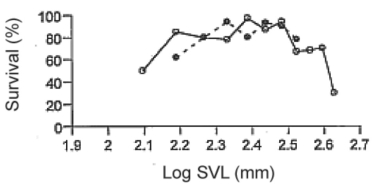 -Examine Figure 25.2.What type of selection for body size appears to be occurring in these marine iguanas?
 (Multiple Choice)
4.9/5 (81)
(81) Use the following information when answering the corresponding question(s).
In 1983 a population of dark-eyed junco birds became established on the campus of the University of California,San Diego (UCSD),which is located many miles from the junco's normal habitat in the mixed-coniferous temperate forests in the mountains.Juncos have white outer tail feathers that the males display during aggressive interactions and during courtship displays.Males with more white in their tail are more likely to win aggressive interactions,and females prefer to mate with males with more white in their tails.Females have less white in their tails than do males,and display it less often.(Pamela J.Yeh.2004.Rapid evolution of a sexually selected trait following population establishment in a novel habitat.Evolution 58[1]:166-74. )
-Refer to the paragraph on dark-eyed junco birds.Which of the following could explain why males display more often?
(Multiple Choice)
4.8/5 (86)
(86) Figure 25.4 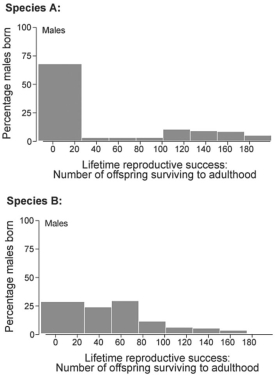 -Refer to Figure 25.4.Male reproductive success,measured as the number of offspring surviving to adulthood (pupating),is found for two closely related beetle species and graphed above.Which of these statements would you expect to be true of sexual dimorphism in the two species?
 (Multiple Choice)
4.9/5 (75)
(75) For a biologist studying a small fish population in the lab,which Hardy-Weinberg condition is easiest to meet?
(Multiple Choice)
4.9/5 (82)
(82) 
Filters
- Essay(0)
- Multiple Choice(0)
- Short Answer(0)
- True False(0)
- Matching(0)