Multiple Choice
Figure 25.2
Use the following information when answering the corresponding question(s)
Martin Wikelski and L.Michael Romero (Body size,performance and fitness in Galápagos marine iguanas,Integrative and Comparative Biology 43 [2003]:376-86) measured the snout-to-vent (anus) length of Galápagos marine iguanas and observed the percent survival of different-sized animals,all of the same age.Figure 25.2 shows the log snout-vent length (SVL,a measure of overall body size) plotted against the percent survival of these different size classes for males and females.
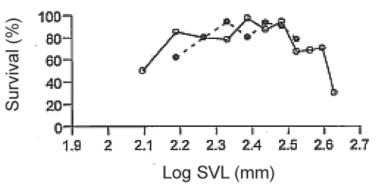
-Examine Figure 25.2.What type of selection for body size appears to be occurring in these marine iguanas?
A) directional selection
B) stabilizing selection
C) disruptive selection
D) You cannot determine the type of selection from the above information.
Correct Answer:

Verified
Correct Answer:
Verified
Q2: For a biologist studying a small fish
Q22: Cystic fibrosis is a genetic disorder in
Q23: Suppose 64% of a remote mountain village
Q25: Use the following information when answering the
Q27: Researchers (Helle et al. ,2004)analyzed rates of
Q28: Wikelski and Romero (2003)found that large marine
Q28: Which of the following is the most
Q30: Use the following information when answering the
Q31: Figure 25.4 <img src="https://d2lvgg3v3hfg70.cloudfront.net/TB3734/.jpg" alt="Figure 25.4
Q37: For biologists studying a large flatworm population