



 Chat with AI
Exam 53: Community Ecology

Exam 1: Biology and the Tree of Life40 Questions
Exam 2: Water and Carbon: the Chemical Basis of Life50 Questions
Exam 3: Protein Structure and Function47 Questions
Exam 4: Nucleic Acids and the Rna World33 Questions
Exam 5: An Introduction to Carbohydrates30 Questions
Exam 6: Lipids, membranes, and the First Cells47 Questions
Exam 7: Inside the Cell28 Questions
Exam 8: Cell-Cell Interactions27 Questions
Exam 9: Cellular Respiration and Fermentation27 Questions
Exam 10: Photosynthesis32 Questions
Exam 11: The Cell Cycle31 Questions
Exam 12: Meiosis34 Questions
Exam 13: Mendel and the Gene32 Questions
Exam 14: Dna and the Gene: Synthesis and Repair37 Questions
Exam 15: How Genes Work34 Questions
Exam 16: Transcription and Translation38 Questions
Exam 17: Control of Gene Expression in Bacteria31 Questions
Exam 18: Control of Gene Expression in Eukaryotes37 Questions
Exam 19: Analyzing and Engineering Genes40 Questions
Exam 20: Genomics38 Questions
Exam 21: Principles of Development25 Questions
Exam 22: An Introduction to Animal Development22 Questions
Exam 23: An Introduction to Plant Development21 Questions
Exam 24: Evolution by Natural Selection32 Questions
Exam 25: Evolutionary Processes32 Questions
Exam 26: Speciation33 Questions
Exam 27: Phylogenies and the History of Life38 Questions
Exam 28: Bacteria and Archaea38 Questions
Exam 29: Protists34 Questions
Exam 30: Green Plants49 Questions
Exam 31: Fungi37 Questions
Exam 32: An Introduction to Animals38 Questions
Exam 33: Protostome Animals38 Questions
Exam 34: Deuterostome Animals46 Questions
Exam 35: Viruses31 Questions
Exam 36: Plant Form and Function39 Questions
Exam 37: Water and Sugar Transport in Plants42 Questions
Exam 38: Plant Nutrition36 Questions
Exam 39: Plant Sensory Systems, signals, and Responses66 Questions
Exam 40: Plant Reproduction41 Questions
Exam 41: Animal Form and Function29 Questions
Exam 42: Water and Electrolyte Balance in Animals38 Questions
Exam 43: Animal Nutrition37 Questions
Exam 44: Gas Exchange and Circulation37 Questions
Exam 45: Electrical Signals in Animals33 Questions
Exam 46: Animal Sensory Systems and Movement36 Questions
Exam 47: Chemical Signals in Animals33 Questions
Exam 48: Animal Reproduction34 Questions
Exam 49: The Immune System in Animals32 Questions
Exam 50: An Introduction to Ecology38 Questions
Exam 51: Behavioral Ecology37 Questions
Exam 52: Population Ecology46 Questions
Exam 53: Community Ecology39 Questions
Exam 54: Ecosystems41 Questions
Exam 55: Biodiversity and Conservation Biology39 Questions
Select questions type


Figure 53.2 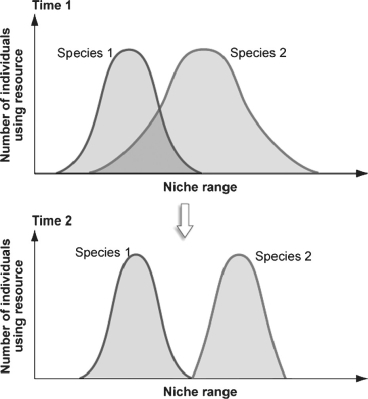 -What is the term used to describe the process shown in the panels in Figure 53.2,assuming Time 2 follows Time 1?
Free
(Multiple Choice)
4.8/5  (72)
(72) Correct Answer: Verified
C
What is the main advantage of controlled burnings of forested areas?
Free
(Multiple Choice)
4.8/5 (87)
(87) Correct Answer:Verified
VerifiedC
During succession,tall canopies of maple trees form allowing chipmunks to be better hidden against hawks.This is an example of _____.
Free
(Multiple Choice)
4.9/5 (71)
(71) Correct Answer:Verified
VerifiedD
A measure of how much a community is affected by a disturbance is termed _____.
(Multiple Choice)
4.7/5 (85)
(85) Which are the only two interaction types to depend on density and effective defense to determine the short-term impact?
(Multiple Choice)
5.0/5 (73)
(73) Figure 53.1 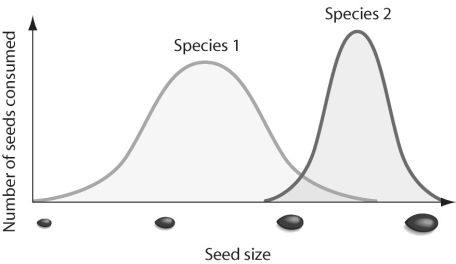 -According to Figure 53.1,which species is more successful in competing for seeds?
 (Multiple Choice)
4.9/5 (84)
(84) Some birds follow moving swarms of army ants in the tropics.As the ants march along the forest floor hunting insects and small vertebrates,birds follow and pick off any insects or small vertebrates that fly or jump out of the way of the ants.This is an example of what kind of species interaction?
(Multiple Choice)
4.8/5 (73)
(73) Which one of the following animals would most likely be defined as a keystone species?
(Multiple Choice)
4.8/5 (78)
(78) Figure 53.7 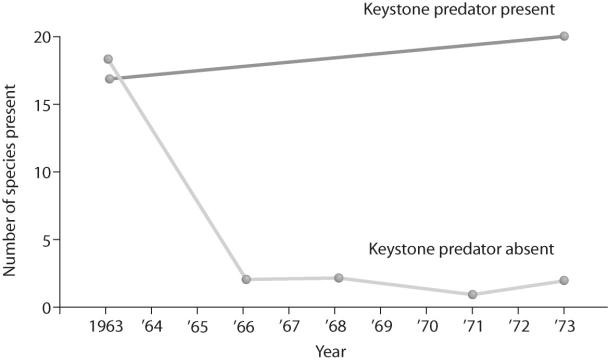 -What does the graph in Figure 53.7 tell you about the definition of a keystone species?
 (Multiple Choice)
4.9/5 (80)
(80) Figure 53.6 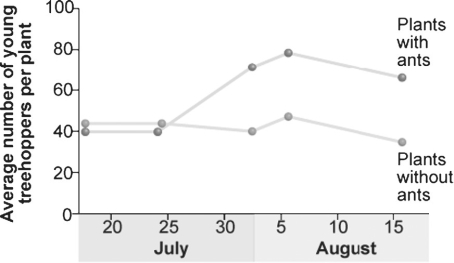 -Treehoppers (a type of insect)produce honeydew,which ants use for food.Treehoppers have a major predator,the jumping spider.Researchers hypothesized that the ants would protect the treehoppers from the spiders.In an experiment,researchers followed study plots with ants removed from the system and compared them to a control plot.In Figure 53.6,what can you conclude?
 (Multiple Choice)
4.8/5 (90)
(90) Bouchard and Brooks studied the effect of insect flight on dispersal and speciation in rain forest insects.They sampled all of the insects in the study area and found that 60 insect species are flightless and 19 are macropterous (able to fly).After analyzing the results of the Bouchard and Brooks (2004)study,you conclude that macropterous and flightless insects in the rain forests of northeastern Australia have dispersed and speciated in similar manners.What does this say about flight in these insects?
(Multiple Choice)
4.7/5 (83)
(83) Figure 53.9 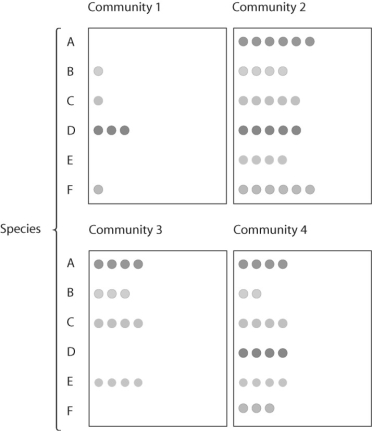 -In Figure 53.9,which community has the highest species diversity?
 (Multiple Choice)
4.9/5 (66)
(66) Figure 53.4 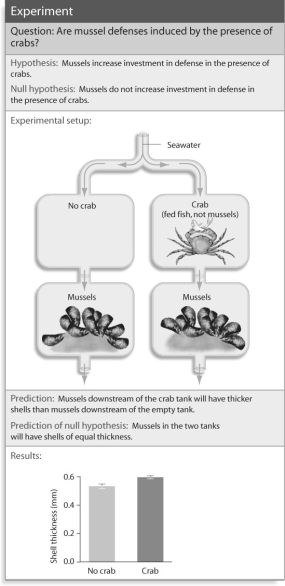 -What conclusion can you draw from Figure 53.4?
 (Multiple Choice)
5.0/5 (76)
(76) What is the main difference between asymmetric competition and symmetric competition?
(Multiple Choice)
4.9/5 (73)
(73) Figure 53.1
-In looking at Figure 53.1,what conclusions can be drawn?
-In looking at Figure 53.1,what conclusions can be drawn? (Multiple Choice)
4.9/5 (79)
(79) Figure 53.7
-Recall that Clements's view of biological communities is that of a highly predictable and interrelated structure,while Gleason's view of biological communities is that individual species operate independently.If we set up many identical sterilized ponds in the same area and allowed them to be colonized,what should we predict if Gleason's hypothesis is the one we believe is correct?
-Recall that Clements's view of biological communities is that of a highly predictable and interrelated structure,while Gleason's view of biological communities is that individual species operate independently.If we set up many identical sterilized ponds in the same area and allowed them to be colonized,what should we predict if Gleason's hypothesis is the one we believe is correct? (Multiple Choice)
4.7/5 (79)
(79) Figure 53.5  -In Figure 53.5,which individuals are displaying Batesian mimicry?
 (Multiple Choice)
4.8/5 (70)
(70) Snails typically avoid sunlit areas,but some snails infected with certain parasites become attracted to light and prefer sunlit areas.Which of the following is the most likely hypothesis given the life cycles of many parasites?
(Multiple Choice)
4.9/5 (85)
(85) 
Filters
- Essay(0)
- Multiple Choice(0)
- Short Answer(0)
- True False(0)
- Matching(0)