



 Chat with AI
Exam 53: Community Ecology

Exam 1: Biology and the Tree of Life40 Questions
Exam 2: Water and Carbon: the Chemical Basis of Life50 Questions
Exam 3: Protein Structure and Function47 Questions
Exam 4: Nucleic Acids and the Rna World33 Questions
Exam 5: An Introduction to Carbohydrates30 Questions
Exam 6: Lipids, membranes, and the First Cells47 Questions
Exam 7: Inside the Cell28 Questions
Exam 8: Cell-Cell Interactions27 Questions
Exam 9: Cellular Respiration and Fermentation27 Questions
Exam 10: Photosynthesis32 Questions
Exam 11: The Cell Cycle31 Questions
Exam 12: Meiosis34 Questions
Exam 13: Mendel and the Gene32 Questions
Exam 14: Dna and the Gene: Synthesis and Repair37 Questions
Exam 15: How Genes Work34 Questions
Exam 16: Transcription and Translation38 Questions
Exam 17: Control of Gene Expression in Bacteria31 Questions
Exam 18: Control of Gene Expression in Eukaryotes37 Questions
Exam 19: Analyzing and Engineering Genes40 Questions
Exam 20: Genomics38 Questions
Exam 21: Principles of Development25 Questions
Exam 22: An Introduction to Animal Development22 Questions
Exam 23: An Introduction to Plant Development21 Questions
Exam 24: Evolution by Natural Selection32 Questions
Exam 25: Evolutionary Processes32 Questions
Exam 26: Speciation33 Questions
Exam 27: Phylogenies and the History of Life38 Questions
Exam 28: Bacteria and Archaea38 Questions
Exam 29: Protists34 Questions
Exam 30: Green Plants49 Questions
Exam 31: Fungi37 Questions
Exam 32: An Introduction to Animals38 Questions
Exam 33: Protostome Animals38 Questions
Exam 34: Deuterostome Animals46 Questions
Exam 35: Viruses31 Questions
Exam 36: Plant Form and Function39 Questions
Exam 37: Water and Sugar Transport in Plants42 Questions
Exam 38: Plant Nutrition36 Questions
Exam 39: Plant Sensory Systems, signals, and Responses66 Questions
Exam 40: Plant Reproduction41 Questions
Exam 41: Animal Form and Function29 Questions
Exam 42: Water and Electrolyte Balance in Animals38 Questions
Exam 43: Animal Nutrition37 Questions
Exam 44: Gas Exchange and Circulation37 Questions
Exam 45: Electrical Signals in Animals33 Questions
Exam 46: Animal Sensory Systems and Movement36 Questions
Exam 47: Chemical Signals in Animals33 Questions
Exam 48: Animal Reproduction34 Questions
Exam 49: The Immune System in Animals32 Questions
Exam 50: An Introduction to Ecology38 Questions
Exam 51: Behavioral Ecology37 Questions
Exam 52: Population Ecology46 Questions
Exam 53: Community Ecology39 Questions
Exam 54: Ecosystems41 Questions
Exam 55: Biodiversity and Conservation Biology39 Questions
Select questions type


Figure 53.11 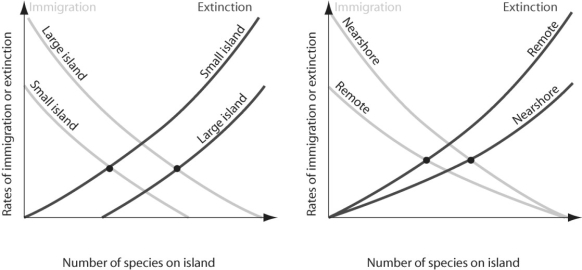 -According to Figure 53.11,a species has the highest chance of extinction when _____.
 (Multiple Choice)
4.8/5  (75)
(75) If two species are close competitors,and one species is experimentally removed from the community,the remaining species would be expected to _____.
(Multiple Choice)
4.9/5 (85)
(85) Figure 53.4 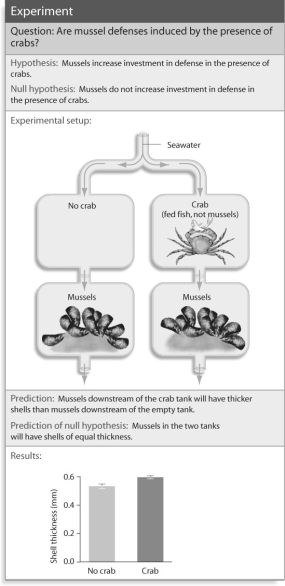 -Based on Figure 53.4,what result would you expect if you replaced the crabs with broken mussel shells?
 (Multiple Choice)
4.9/5 (61)
(61) Some birds follow moving swarms of army ants in the tropics.As the ants march along the forest floor hunting insects and small vertebrates,birds follow and pick off any insects or small vertebrates that fly or jump out of the way of the ants.What is the specific benefit relationship?
(Multiple Choice)
4.8/5 (82)
(82) Figure 53.8 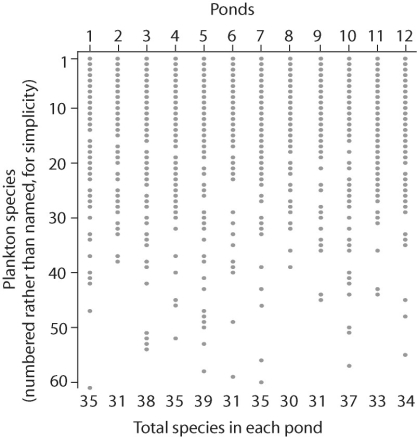 -Looking at the results in Figure 53.8,which hypothesis (by Clements or Gleason)is supported by the data?
 (Multiple Choice)
4.9/5 (85)
(85) Bouchard and Brooks studied the effect of insect flight on dispersal and speciation in rain forest insects.They sampled all of the insects in the study area and found that 60 insect species are flightless and 19 are macropterous (able to fly).What can you conclude so far about this study?
(P)Bouchard and D.R.Brooks.2004.Effect of vagility potential on dispersal and speciation in rainforest insects.Journal of Evolutionary Biology 17:
994-1006. )
(Multiple Choice)
4.8/5 (82)
(82) Figure 53.3 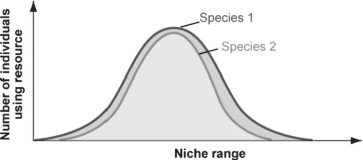 -In Figure 53.3,which species is the stronger competitor?
 (Multiple Choice)
4.7/5 (83)
(83) People with at least one copy of the HLA-B53 gene are better able to beat back malarial infections before the infection progresses.If this is a coevolutionary arms race between Plasmodium and humans,what would the next step in this race be?
(Multiple Choice)
4.7/5 (80)
(80) During a 1-year study,researchers found no difference in treehopper populations in any of their control and experimental groups.What could they measure during the second year to gain information about why this might have occurred?
(Multiple Choice)
4.8/5 (77)
(77) Which would be the best way to directly test the hypothesis that C.stellatus (a species of barnacle)is competitively excluded from the lower intertidal zone by B.balanoides (another species of barnacle)?
(Multiple Choice)
4.9/5 (87)
(87) Figure 53.5  -In Figure 53.5,which of the following statements is true?
 (Multiple Choice)
4.8/5 (77)
(77) In the hypothesis that C.stellatus (a species of barnacle)is competitively excluded from the lower intertidal zone by B.balanoides (another species of barnacle),what could be concluded about the two species?
(Multiple Choice)
4.9/5 (89)
(89) Which hypothesis supports the observation that herbivores do not generally eat all of the available plants?
(Multiple Choice)
4.7/5 (88)
(88) Figure 53.9 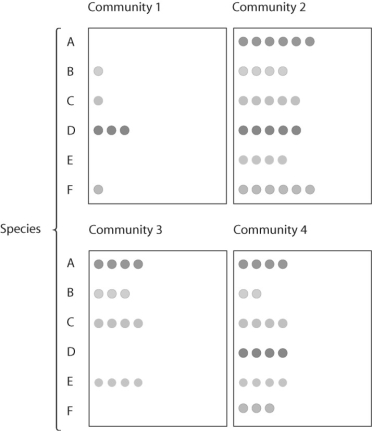 -In Figure 53.9,which community has the highest species richness?
 (Multiple Choice)
4.9/5 (76)
(76) What is the main difference between a disturbance and a disturbance regime?
(Multiple Choice)
4.8/5 (86)
(86) Figure 53.11
-Which of the following statements regarding Figure 53.11 is true?
-Which of the following statements regarding Figure 53.11 is true? (Multiple Choice)
4.8/5 (77)
(77) Figure 53.10 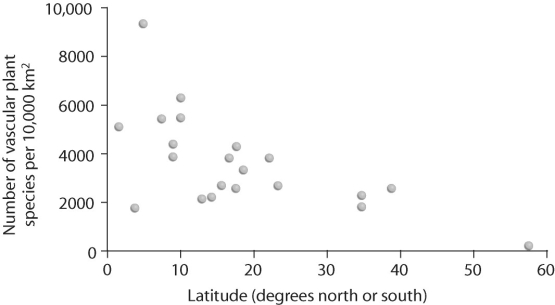 -In Figure 53.10,what can be stated about species diversity and latitude?
 (Multiple Choice)
4.8/5 (72)
(72) While traveling in Texas,you stumble across a snake with red,yellow,and black bands.You somehow remember that this could be a poisonous coral snake or a harmless milk snake,but you forget how to differentiate them because they both have similar colors and banding patterns.You wisely decide not to pick up the snake.What defense was successful in preventing you from grabbing the snake?
(Multiple Choice)
4.9/5 (81)
(81) 
Filters
- Essay(0)
- Multiple Choice(0)
- Short Answer(0)
- True False(0)
- Matching(0)