



 Chat with AI
Exam 51: Behavioral Ecology

Exam 1: Biology and the Tree of Life40 Questions
Exam 2: Water and Carbon: the Chemical Basis of Life50 Questions
Exam 3: Protein Structure and Function47 Questions
Exam 4: Nucleic Acids and the Rna World33 Questions
Exam 5: An Introduction to Carbohydrates30 Questions
Exam 6: Lipids, membranes, and the First Cells47 Questions
Exam 7: Inside the Cell28 Questions
Exam 8: Cell-Cell Interactions27 Questions
Exam 9: Cellular Respiration and Fermentation27 Questions
Exam 10: Photosynthesis32 Questions
Exam 11: The Cell Cycle31 Questions
Exam 12: Meiosis34 Questions
Exam 13: Mendel and the Gene32 Questions
Exam 14: Dna and the Gene: Synthesis and Repair37 Questions
Exam 15: How Genes Work34 Questions
Exam 16: Transcription and Translation38 Questions
Exam 17: Control of Gene Expression in Bacteria31 Questions
Exam 18: Control of Gene Expression in Eukaryotes37 Questions
Exam 19: Analyzing and Engineering Genes40 Questions
Exam 20: Genomics38 Questions
Exam 21: Principles of Development25 Questions
Exam 22: An Introduction to Animal Development22 Questions
Exam 23: An Introduction to Plant Development21 Questions
Exam 24: Evolution by Natural Selection32 Questions
Exam 25: Evolutionary Processes32 Questions
Exam 26: Speciation33 Questions
Exam 27: Phylogenies and the History of Life38 Questions
Exam 28: Bacteria and Archaea38 Questions
Exam 29: Protists34 Questions
Exam 30: Green Plants49 Questions
Exam 31: Fungi37 Questions
Exam 32: An Introduction to Animals38 Questions
Exam 33: Protostome Animals38 Questions
Exam 34: Deuterostome Animals46 Questions
Exam 35: Viruses31 Questions
Exam 36: Plant Form and Function39 Questions
Exam 37: Water and Sugar Transport in Plants42 Questions
Exam 38: Plant Nutrition36 Questions
Exam 39: Plant Sensory Systems, signals, and Responses66 Questions
Exam 40: Plant Reproduction41 Questions
Exam 41: Animal Form and Function29 Questions
Exam 42: Water and Electrolyte Balance in Animals38 Questions
Exam 43: Animal Nutrition37 Questions
Exam 44: Gas Exchange and Circulation37 Questions
Exam 45: Electrical Signals in Animals33 Questions
Exam 46: Animal Sensory Systems and Movement36 Questions
Exam 47: Chemical Signals in Animals33 Questions
Exam 48: Animal Reproduction34 Questions
Exam 49: The Immune System in Animals32 Questions
Exam 50: An Introduction to Ecology38 Questions
Exam 51: Behavioral Ecology37 Questions
Exam 52: Population Ecology46 Questions
Exam 53: Community Ecology39 Questions
Exam 54: Ecosystems41 Questions
Exam 55: Biodiversity and Conservation Biology39 Questions
Select questions type


A pied kingfisher in its first year of life helps in the feeding of three full siblings who would not have made it without the helper's efforts.What is its indirect fitness in its first year?

Free
(Multiple Choice)
4.8/5  (86)
(86) Correct Answer: Verified
E
How would you classify the genetic basis for most behavioral traits in the animal kingdom?
Free
(Multiple Choice)
4.8/5 (72)
(72) Correct Answer:Verified
VerifiedC
Figure 51.2 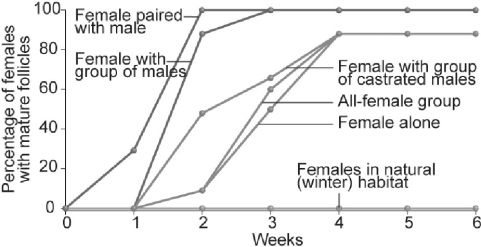 -In Figure 51.2,which of the following conclusions is most logical based on the data?
Free
(Multiple Choice)
4.8/5 (79)
(79) Correct Answer:Verified
VerifiedA
Figure 51.2
-In Figure 51.2,do the data support the hypothesis that females need spring-like light conditions to produce mature follicles?
-In Figure 51.2,do the data support the hypothesis that females need spring-like light conditions to produce mature follicles? (Multiple Choice)
4.8/5 (73)
(73) You observe scrub jays hiding food and notice that one particular individual only pretends to hide food.Your experiments associate the presence of other siblings with the frequency of pretending to cache food.A colleague shows you animals of the same species that do not perform this pretend caching.How does this information affect your conclusions about this behavior?
(Multiple Choice)
4.9/5 (76)
(76) The behavioral response associated with the escape behavior of kangaroo rats is an example of a _____.
(Multiple Choice)
5.0/5 (75)
(75) You have captured a number of rats from a wild population and quickly surmise with tests that they are very good at avoiding food with poisons.What would best explain this observation?
(Multiple Choice)
4.8/5 (82)
(82) The principal prediction that can be made from the expression Br > C is that _____.
(Multiple Choice)
4.9/5 (70)
(70) A pied kingfisher in its first year of life helps in the feeding of three full siblings who would not have made it without the helper's efforts.In this first year the bird does not raise any of its own offspring.In the second year of its life the pied kingfisher mates and raises two of its own offspring.After the first two years what is the inclusive fitness of the pied kingfisher?
(Multiple Choice)
4.8/5 (73)
(73) Based on your knowledge of cost-benefit analysis,why would you expect some white-fronted bee-eaters to fly very far away from the nests to forage when there are food sources nearby?
(Multiple Choice)
4.8/5 (82)
(82) Figure 51.6
Use the following information and Figure 51.6 when answering the corresponding question(s).
The following are an abstract and figure from a paper that explores the evolutionary relationship between a protein kinase and behavior (M.Fitzpatrick and M.Sokolowski.2004.In search of food: Exploring the evolutionary link between cGMP-dependent protein kinase (PKG)and behavior.Integrative and Comparative Biology 44:28-36).
Abstract:
Despite an immense amount of variation in organisms throughout the animal kingdom many of their genes show substantial conservation in DNA sequence and protein function.Here we explore the potential for a conserved evolutionary relationship between genes and their behavioral phenotypes.We investigate the evolutionary history of cGMP-dependent protein kinase (PKG)and its possible conserved function in food-related behaviors.First identified for its role in the foraging behavior of fruit flies,the PKG encoded by the foraging gene had since been associated with the maturation of behavior (from nurse to forager)in honey bees and the roaming and dwelling food-related locomotion in nematodes.These parallels encouraged us to construct protein phylogenies using 32 PKG sequences that include 19 species.Our analyses suggest five possible evolutionary histories that can explain the apparent conserved link between PKG and behavior in fruit flies,honey bees and nematodes.Three of these raise the hypothesis that PKG influences the food-related behaviors of a wide variety of animals including vertebrates.Moreover it appears that the PKG gene was duplicated some time between the evolution of nematodes and a common ancestor of vertebrates and insects whereby current evidence suggest only the for-like PKG might be associated with food-related behavior.
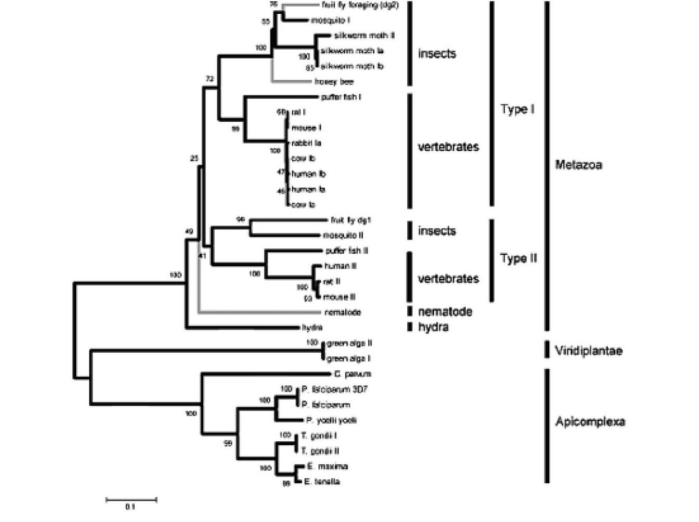 Neighbor joining trees depicting the evolutionary relationships of 32 PKG kinase domain and C-terminal amino acid sequences spanning 19 species of protozoans and metazoans.Values at the nodes represent the results of 5000 bootstrap replications.Lineages with known behavioral links with PKG are indicated by gray branches.
-Using Figure 51.6 and the accompanying paragraph,and knowing that the PKG encoded by the foraging gene has recently been associated with the maturation of out-of-nest behavior in honeybees,what would be a logical explanation for this relationship?
Neighbor joining trees depicting the evolutionary relationships of 32 PKG kinase domain and C-terminal amino acid sequences spanning 19 species of protozoans and metazoans.Values at the nodes represent the results of 5000 bootstrap replications.Lineages with known behavioral links with PKG are indicated by gray branches.
-Using Figure 51.6 and the accompanying paragraph,and knowing that the PKG encoded by the foraging gene has recently been associated with the maturation of out-of-nest behavior in honeybees,what would be a logical explanation for this relationship? (Multiple Choice)
4.9/5 (89)
(89) A lizard's bobbing dewlap (a colorful flap of skin hanging from an Anolis lizard's throat)is an example of a(n)_____.
(Multiple Choice)
4.8/5 (72)
(72) In the last phase of migration,birds seem to be using _____ to determine their final destination.
(Multiple Choice)
4.9/5 (76)
(76) Figure 51.4 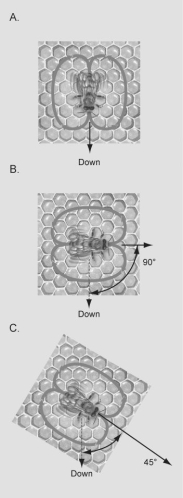 -If the diagram in Figure 51.4 shows the dances of bees in a hive at twelve noon on March 21 in the northern hemisphere,which dance is communicating that the food is to the south of the hive?
 (Multiple Choice)
4.7/5 (83)
(83) Which of the following experiments best addresses the hypothesis that moths stop flying in response to high-intensity bat sounds?
(Multiple Choice)
4.9/5 (82)
(82) Recent research has shown that von Frisch was not completely correct about the difference between the round dance and waggle dance.The new information suggests that _____.
(Multiple Choice)
4.8/5 (78)
(78) Scientists believe that the direction birds go when migrating is guided in part by _____.
(Multiple Choice)
4.9/5 (86)
(86) What was the main reason the honeybees switched from the "round dance" to the "waggle dance"?
(Multiple Choice)
4.8/5 (71)
(71) Figure 51.5 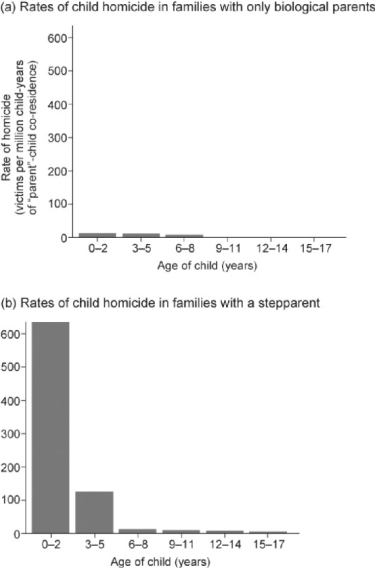 -In Figure 51.5,which is the most logical conclusion from the data?
 (Multiple Choice)
4.8/5 (68)
(68) In the second year of its life a pied kingfisher mates and raises two of its own offspring.What is its direct fitness in this second year of its life?
(Multiple Choice)
4.8/5 (89)
(89) 
Filters
- Essay(0)
- Multiple Choice(0)
- Short Answer(0)
- True False(0)
- Matching(0)