



 Chat with AI
Exam 51: Behavioral Ecology

Exam 1: Biology and the Tree of Life40 Questions
Exam 2: Water and Carbon: the Chemical Basis of Life50 Questions
Exam 3: Protein Structure and Function47 Questions
Exam 4: Nucleic Acids and the Rna World33 Questions
Exam 5: An Introduction to Carbohydrates30 Questions
Exam 6: Lipids, membranes, and the First Cells47 Questions
Exam 7: Inside the Cell28 Questions
Exam 8: Cell-Cell Interactions27 Questions
Exam 9: Cellular Respiration and Fermentation27 Questions
Exam 10: Photosynthesis32 Questions
Exam 11: The Cell Cycle31 Questions
Exam 12: Meiosis34 Questions
Exam 13: Mendel and the Gene32 Questions
Exam 14: Dna and the Gene: Synthesis and Repair37 Questions
Exam 15: How Genes Work34 Questions
Exam 16: Transcription and Translation38 Questions
Exam 17: Control of Gene Expression in Bacteria31 Questions
Exam 18: Control of Gene Expression in Eukaryotes37 Questions
Exam 19: Analyzing and Engineering Genes40 Questions
Exam 20: Genomics38 Questions
Exam 21: Principles of Development25 Questions
Exam 22: An Introduction to Animal Development22 Questions
Exam 23: An Introduction to Plant Development21 Questions
Exam 24: Evolution by Natural Selection32 Questions
Exam 25: Evolutionary Processes32 Questions
Exam 26: Speciation33 Questions
Exam 27: Phylogenies and the History of Life38 Questions
Exam 28: Bacteria and Archaea38 Questions
Exam 29: Protists34 Questions
Exam 30: Green Plants49 Questions
Exam 31: Fungi37 Questions
Exam 32: An Introduction to Animals38 Questions
Exam 33: Protostome Animals38 Questions
Exam 34: Deuterostome Animals46 Questions
Exam 35: Viruses31 Questions
Exam 36: Plant Form and Function39 Questions
Exam 37: Water and Sugar Transport in Plants42 Questions
Exam 38: Plant Nutrition36 Questions
Exam 39: Plant Sensory Systems, signals, and Responses66 Questions
Exam 40: Plant Reproduction41 Questions
Exam 41: Animal Form and Function29 Questions
Exam 42: Water and Electrolyte Balance in Animals38 Questions
Exam 43: Animal Nutrition37 Questions
Exam 44: Gas Exchange and Circulation37 Questions
Exam 45: Electrical Signals in Animals33 Questions
Exam 46: Animal Sensory Systems and Movement36 Questions
Exam 47: Chemical Signals in Animals33 Questions
Exam 48: Animal Reproduction34 Questions
Exam 49: The Immune System in Animals32 Questions
Exam 50: An Introduction to Ecology38 Questions
Exam 51: Behavioral Ecology37 Questions
Exam 52: Population Ecology46 Questions
Exam 53: Community Ecology39 Questions
Exam 54: Ecosystems41 Questions
Exam 55: Biodiversity and Conservation Biology39 Questions
Select questions type


Figure 51.3 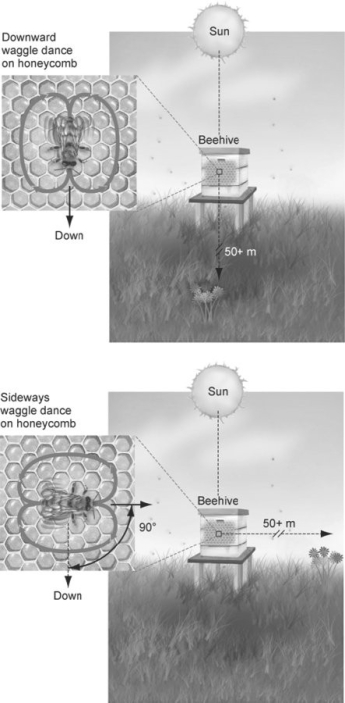 -From Figure 51.3 what can we determine about the location of the food source?
 (Multiple Choice)
4.8/5  (89)
(89) What is the primary mode of communication used by humpback whales?
(Multiple Choice)
4.8/5 (71)
(71) If you ask a question about behavior that concerns how it works,or what its mechanism is,you are asking a question that involves _____.
(Multiple Choice)
4.8/5 (88)
(88) You observe that by flashing a small light in a particular sequence,you can attract male fireflies of a certain species.You begin to think how this signal may be used against these males.Which of the hypotheses seems to be the most logical?
(Multiple Choice)
4.8/5 (81)
(81) If you ask a question about behavior that concerns how it works,or what its mechanism is,you are asking a question that involves _____.
(Multiple Choice)
4.9/5 (85)
(85) Looking at this evolutionary relationship of protein kinases (Figure 51.6)and knowing there is evidence that this particular protein kinase is linked to food-related behaviors in the animals studied,what conclusions can you draw?
(Multiple Choice)
4.9/5 (77)
(77) Homing pigeons' ability to always return to their home,no matter where they are released,is an excellent example of _____.
(Multiple Choice)
4.9/5 (93)
(93) Any process in which a signal from one individual modifies the behavior of a recipient individual is termed _____.
(Multiple Choice)
4.8/5 (66)
(66) In testing a hypothesis that "territorial defense in European robins is a fixed action pattern that is released by the sight of orange feathers," researchers found that robins defended their territory by attacking anything that was of similar size and had an orange patch.What experiment would you perform next to determine that the color initiated the defense response?
(Multiple Choice)
4.9/5 (83)
(83) In red-winged blackbirds,which of the following stimuli elicited the greatest territorial defense response?
(Multiple Choice)
4.8/5 (67)
(67) You observe scrub jays hiding food and notice that one particular individual only pretends to hide food.What kind of experiment could you perform to test whether this behavior was random or in response to another signal?
(Multiple Choice)
4.7/5 (86)
(86) You observe a species of bird that,upon hatching,has contact with its parents only while being fed.You also never hear the parents sing during the feeding process.What would you propose about song learning in this species of bird?
(Multiple Choice)
4.8/5 (78)
(78) If a prairie dog had the opportunity to perform an altruistic act (i.e. ,give an alarm call)to help its relatives,which combination of the following relatives would the prairie dog be most likely to help (base your answer solely on the genetic relationships)?
(Multiple Choice)
4.8/5 (77)
(77) How could you test whether male dewlaps (a colorful flap of skin hanging from an anole lizard's throat)were an important cue for female egg production?
(Multiple Choice)
4.8/5 (84)
(84) Why should a female barn swallow choose a male with long tail feathers?
(Multiple Choice)
4.9/5 (78)
(78) 
Filters
- Essay(0)
- Multiple Choice(0)
- Short Answer(0)
- True False(0)
- Matching(0)